




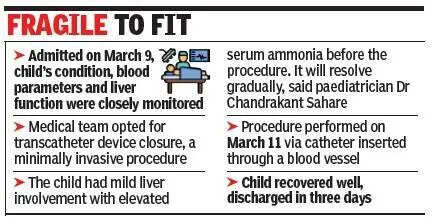
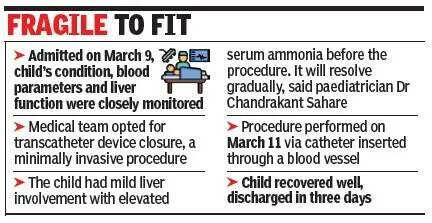
Pune: A one-and-half-year-old girl was successfully saved from a one in 50,000 rare congenital vascular condition called Abernethy Malformation wherein blood from the stomach and intestines directly flow into the heart, instead of being filtered and passing through the liver first.The antenataldiagnosis reflected the toddler’s condition and the surgery was challenging for the doctors.Dr Ashish Banpurkar, paediatric cardiologist, Vishwaraj Hospital, said, “In a normal child, blood from the stomach and intestines flows through portal veins to the liver where it gets filtered before entering the heart. However, in this case, the portal veins were bypassing the liver and were abnormally connected directly to the heart via Vena cava. Resultantly, the hepatic circulation was not well developed and there was a possibility of pulmonary hypertension and abnormal circulation (pulmonary AV malformation) developing. We planned an elective closure of the abnormal connection for the child.”He said that if left untreated, such an abnormal circulation could lead to complications affecting the liver, lungs and overall metabolism. “The child had been under observation and required admission due to mildly elevated blood ammonia levels, which were managed conservatively. During the evaluation, doctors diagnosed the child with the rare congenital condition known as Abernethy Malformation, also called a Congenital Portosystemic Shunt. Thechild was put through a minimally invasive cardiac procedure.”She was admitted on March 9 and the child’s clinical condition, blood parameters and liver function were carefully evaluated and monitored. The medical team decided to perform a transcatheter device closure, a minimally invasive procedure, saidDr Satyajit Funde, hospital radiologist.During the procedure on March 11, doctors inserted a catheter through a blood vessel and performed detailed angiography to measure portal venous pressure and blood flow dynamics.Cardiac anaesthesiologist Dr Vitthal Shendage said, “Once the team confirmed that the abnormal connection could be safely closed, a specially designed occlusion device was deployed to block the shunt. Post-procedure imaging and sonography confirmed that the device was correctly positioned and blood flow to the liver had been restored.”The child responded well to the procedure and was discharged within three days. “We expect normal circulation to continue, and the closure is considered a permanent solution with minimal chances of recurrence,” added Banpurkar.Consultant intensivist and paediatrician Dr Chandrakant Sahare said, “Prior to the procedure, the child had shown mild liver involvement with elevated serum ammonia levels and occasional increased nasal bleeding. With the abnormal connection closed now, the issues will resolve gradually.”Banpurkar emphasised the importance of early diagnosis and regular follow-ups in congenital conditions. “We were able to plan the treatment at the right time and perform the intervention safely because the child was monitored from the foetal stage.”