





Early in this maximalist’s dream of sensory overload, when the background voice of a girl menacingly provokes: ‘you are not ready for this’, one wants to tell her actually, one is over-prepared. As it turns out, the sequel attempts to outdo the original in volume and venom, perhaps at the expense of the original’s narrative weight. One went for a story, returned with a migraine and a beard. Dhar is the master of frame and fireworks, but he loses sight of the clock and control. Perhaps, deliberately. Channelling the mood of the moment, when the world is itching for war, he feeds the bloodlust of a section of the masses, ensuring a box-office bonanza but setting a dangerous precedent.

The exhausting revenge saga that mistakes length for depth picks up right after the first film’s climax, with undercover Indian agent Jaskirat Singh Rangi (Ranveer Singh), now deeply embedded as Hamza Ali Mazari, rising to dominate Karachi’s Lyari underworld following the death of gang leader Rehman Dakait (Akshaye Khanna).
Fuelled by personal tragedy and pumped up by Ajay Sanyal’s (R. Madhavan) radicalisation, Hamza consolidates power amid gang wars, shifting alliances, corrupt officials, and escalating threats from SP Chaudhary Aslam (Sanjay Dutt) and ISI operative Major Iqbal (Arjun Rampal), the mastermind behind terror networks targeting India.
As he infiltrates deeper into Pakistan’s criminal-terror-political nexus, the mission blurs into a brutal personal vendetta, forcing Hamza to dismantle funding routes, eliminate key enemies, and for a moment confront the psychological toll of living as a monster for his country.
Dhurandhar: The Revenge (Hindi, Urdu)
Director: Aditya Dhar
Cast: Ranveer Singh, Sara Arjun, Arjun Rampal, Sanjay Dutt, Rakesh Bedi
Runtime: 229 minutes
Storyline: Following the brutal fallout of the first mission, Jaskirat/ Hamza is thrust into a sprawling mission of retribution dotted with deep-state conspiracy
The film’s strongest hook is Ranveer’s performance. After being overshadowed by Akshaye in the first part and reduced to furniture by the demands of the character that expected him to be largely one note, here the actor flexes all his muscles, shifting seamlessly between vulnerability, cold calculation, and unhinged ferocity to carry the nearly 4-hour runtime almost single-handedly as a home-grown Rambo.
Drenched in odious emotion where savagery is the screenplay, for the most part, it works like an explainer of the first part, an answer to those who mocked Dhar’s peak detailing. Dhar’s style leans heavily on gratuitous violence, creating a world so relentlessly brutal that it seems the makers want the audience to become desensitised to the stakes and focus on the blood-curdling sequences. It feels more like an extended web series than a tight theatrical film, with indulgent sequences that impede mood and momentum.
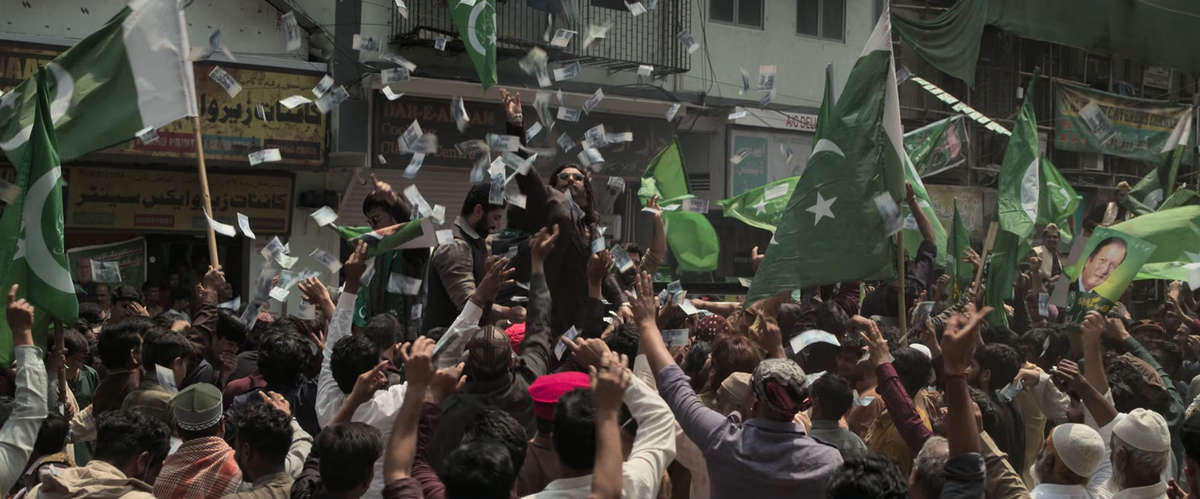
A still from ‘Dhurandhar: The Revenge’
| Photo Credit:
B62 Studios
In this game of cause and effect, the focus is on effect. If you take out the addictive background score, the mise-en-scene runs the risk of getting reduced to twenty ways to maim or decapitate the enemy. The language increasingly descends into the gutter, and the motive seems to justify the government’s controversial policy decisions, such as demonetisation.
An example of storytelling embedded in a political manifesto, the film’s heart beats for the right side of the political ecosystem. This time it serves like a mouthpiece of the ruling regime even more unabashedly by deliberately confusing Indians with Hindus, blurring the line between Pakistani and Indian Muslims, and painting the Opposition and non-governmental organisations as if they are in cahoots with the neighbour’s terror network. However, towards the end, when the makers tell us that we have our agents functioning in Pakistan’s political setup for more than 40 years, it goes against their own ’ chai-wallah’ narrative of mythical proportions.

Faithfully reproducing the ruling establishment’s playbook on security, nationalism, and enemies, the film lionises aggressive counter-terror operations, surgical strikes, and dismantling of terror networks — framing them as moral necessities. More importantly, it tends to commodify national grief from terror attacks into entertainment while reinforcing divisive binaries. The focus on Pakistan reminds one of those dramatic news stories on electronic media, mounted to divert attention from domestic politics to the goings-on in the neighbourhood.
While entertaining and rooted in documented events, it risks simplifying complex geopolitics into black-and-white jingoism. The sequence of events works like a documentation of the claims on ‘New India’ made in political speeches where Indian intelligence agencies conduct covert operations in foreign countries and law enforcement agencies indulge in extra-judicial killings. It gives the thrill of what-if to a mass that seeks validation for its voting choices in cinema halls and wants to see the dramatisation of the manufactured rage of social media as big-screen entertainment.
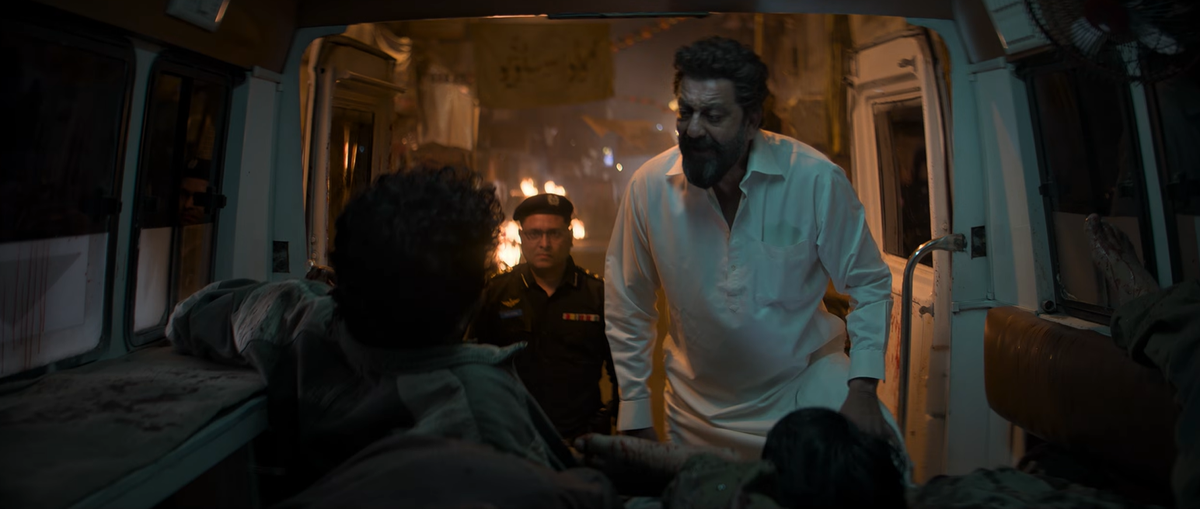
A still from ‘Dhurandhar: The Revenge’
| Photo Credit:
B62 Studios
The much hyped Bade Sahab bit turns out to be a much-flogged Dawood Ibrahim horse that has run its course. In fact, for a film that prides itself on walking the fine line between reel and real, some of the conjectures towards the end are laughable.
Rampal is solid but doesn’t carry the charisma and gravitas of Akshaye’s Rehman. Sanjay Dutt retains his swagger, and Rakesh Bedi generates rare moments of levity amidst the bloodbath. Honey trapped in the first part; Sara Arjun as Yalina has been given the task of upholding humanity in a testosterone-rich environment, and she gives a good account of a trope drenched in tears and sobs.

Sashwat Sachdev’s soundtrack doesn’t match the energy of the first part. Repurposed old songs such as Boney M’s Rasputin, Bappi Lahiri’s Tamma Tamma, and Kalyanji Anandji’s Tirchi Topiwala are fun in spots but feel more slapped than organic. They evoke more respect for the original creators rather than Sachdev’s creativity.
In the end, riding on Ranveer’s leonine performance, Dhurandhar 2 roars, but in its deafening cocktail of patriotism and propaganda, it forgets the quiet cost of humanity, leaving little space for reflection.
Dhurandhar: The Revenge is currently running in theatres
Published – March 19, 2026 04:11 pm IST