





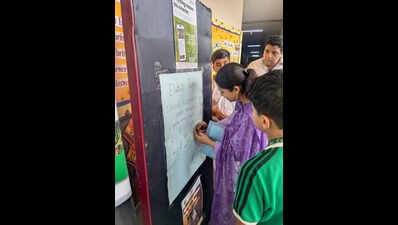
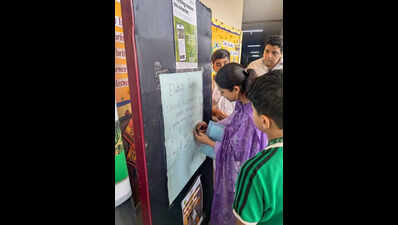
New Delhi: In the corridors of St Columba’s, nervous anticipation fills the air. To ease the tension of the parent-teacher meeting day, the school has turned the occasion into a small fair — transforming anxiety into activity. Children line up behind their stalls, eager to distract both parents and themselves. Some sell bhelpuri, others showcase flower vases made from repurposed plastic bottles while a few man book tables, calling out to hesitant passersby.Amid the bustle, a group of eighth and ninth graders stand apart — not selling, but collecting. “Any gadget or a part of it you don’t use any more, you can just donate it to us through your children, or call this number, and we’ll reach you for door-to-door collection,” explains Mohammad Kaif to curious parents. Nearby, his classmate Imanuel guards a large wooden bin they built themselves, already half-filled with discarded keyboards, wires and batteries. Many walk past, but some pause, intrigued by the cause.The students are part of Project YES, a year-long sustainability programme run by WellSpur Foundation in collaboration with NGO Chintan. The initiative aims to familiarise schoolchildren with the environmental hazards of e-waste, encouraging mindful disposal practices. The foundation has been reaching out to 15 schools across Delhi — Tagore International in Greater Kailash I in July, St Columba’s this month, DPS RK Puram in Nov.For Imanuel Simon, the experience has been an eye-opener. “Initially, I thought we wouldn’t gather much traction because we’re so used to seeing discarded gadgets at home that we hardly think of disposing them of properly.” But the project made him realise how fast-fashion consumer habits extend even to electronics, where upgrading to the next gadget often means unconsciously adding to the waste heap.Since early 2025, the foundation has been working with Delhi-NCR schools under the four-module project, which covers fast fashion and textile waste, e-waste recovery, air pollution and biodiversity conservation. It has conducted more than a dozen workshops, engaging over 1,500 students through awareness drives, collection activities and creative sessions designed to make environmental action participatory.Mehek Varma, representative of Chintan Foundation, explains the process. “First, students are sensitised about the issue — we conduct a baseline survey and ask them to create a collection point for e-waste. Later, we compare their responses to see how their understanding has evolved.” Once the collection drive concludes, the e-waste is handed over to Central Pollution Control Board for authorised recycling and disposal. “We know it takes time for people to adapt,” Varma adds. “But these children are helping us take baby steps towards change. A week ago, they were clueless about proper disposal — now they’re teaching others.”Parents, too, seem moved. Ritika and Pankaj Kumar, attending their son’s PTM, stop by the stall to praise the young volunteers. “We’ll send him tomorrow with the discarded computer keyboard nobody uses any more,” they say.For Sarabjit Singh, a ninth grader, the initiative became a moment of self-realisation. “For people like us, it’s common to throw old batteries away with regular garbage,” he says. “But they contain harmful materials like nickel, manganese and cobalt, which are toxic and can easily contaminate water. Over the past week, we’ve collected many such batteries that otherwise would have ended up with everyday waste.”The effort comes at a critical time. According to CPCB data, Delhi generates an estimated 2,00,000 tonnes of e-waste every year, much of it ending up in informal dumping grounds or dismantled under unsafe conditions.