




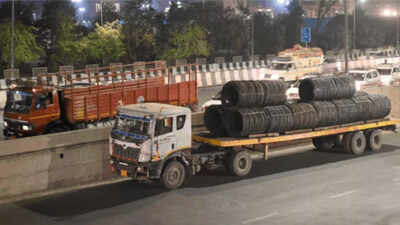
NEW DELHI: In a move aimed at curbing pollution caused by transit vehicles passing through the capital, the Supreme Court has approved a steep hike in the Environment Compensation Charge (ECC) for commercial vehicles entering Delhi. The decision, based on recommendations from the Commission on Air Quality Management (CAQM), raises the ECC for light motor vehicles (LMVs) from Rs 1,400 to Rs 2,000 and for trucks from Rs 2,600 to Rs 4,000 from April 1. The revised charges are intended to discourage non-destined vehicles from using Delhi as a shortcut and push them to take the eastern and western peripheral expressways instead.What Did The Supreme Court Decide?In an effort to deter heavy vehicles from using Delhi as a transit route and adding to pollution, the Supreme Court on Thursday accepted the recommendations of the Commission on Air Quality Management for a steep hike in the Environment Compensation Charge (ECC).The ECC for LMVs has been increased from Rs 1,400 to Rs 2,000, while trucks will now pay Rs 4,000 instead of Rs 2,600, with effect from April 1.The decision came during a hearing before a bench of Chief Justice Surya Kant, Justices Joymalya Bagchi and Vipul M Pancholi.Why Has The Charge Been Increased?Additional solicitor general Aishwarya Bhati told the court that the CAQM believes the revision will restore the deterrence value of ECC as originally fixed in 2015.According to Bhati, the charge had not been revised since 2015. She added that the revised structure would reinstate a significant cost differential between passing through Delhi and taking diversion routes such as peripheral expressways.Bhati also informed the bench that the ECC rates would be revised upwards by 5% from April 1 every year.However, the court clarified that the first annual revision will take effect from April 1, 2027.What Directions Did The Court Issue?While accepting the CAQM recommendations, the Supreme Court directed all stakeholders to ensure that commercial and heavy vehicles are not permitted to transit through Delhi.Instead, they should be diverted to the eastern and western peripheral expressways to reduce traffic congestion and pollution within the city.What Has CAQM Recommended To MCD?The Commission on Air Quality Management also recommended that the Municipal Corporation of Delhi undertake rationalisation of its toll structure.This includes revising existing toll rates, addressing disparities in vehicle classification compared with the framework adopted by the National Highways Authority of India (NHAI), and carrying out a comprehensive traffic and revenue study.The study would assess traffic potential and route diversion patterns, particularly in light of the proposed ECC revision.How Will Enforcement Work?The CAQM has suggested strengthening enforcement through technology-based systems.“The proposed revision, coupled with technology-enabled enforcement viz. time-bound installation and operationalisation of barrier-free Multi-Lane Free Flow (MLFF) system, integrated with RFID and Automatic Number Plate Recognition by MCD, and periodic escalation mechanism, is intended to discourage entry of diesel commercial goods vehicles into Delhi, divert such non-destined freight traffic away from Delhi and consequently, result in reducing the pollution load,” it said.