





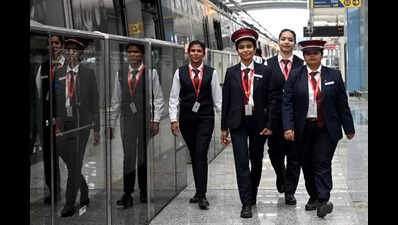
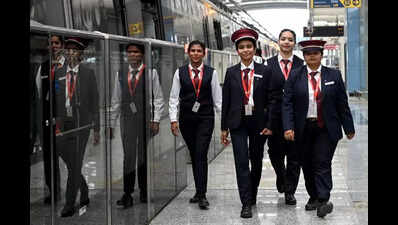
NEW DELHI: From the dusty lanes of rural Uttar Pradesh to the high-tech cockpit of one of India’s most advanced transit systems, 24-year-old Shivani’s journey has been anything but ordinary. The daughter of a Bareilly farmer, she once cycled to college every day. Today, she operates Namo Bharat trains on the Delhi–Ghaziabad–Meerut RRTS corridor, designed to run at 180 kmph with a maximum operational speed of 160 kmph.After completing a diploma in electrical engineering, Shivani — who uses only her first name — joined the Namo Bharat project without realising she would eventually be entrusted with driving the trains. “I didn’t know the job would involve operating trains. The responsibility came later, after medical and other tests,” she said. Despite having never driven even a scooter or a car, she now handles a sophisticated, semi high-speed system. “Initially, I was scared and nervous. During training, some people would wonder how a petite girl like me could drive such a train. Today, I feel proud to operate it and travel 400–500 km daily,” she told TOI. Women now make up nearly 30% of the operational staff on the Delhi–Ghaziabad–Meerut corridor. A full journey from Delhi’s Sarai Kale Khan to Meerut’s Modipuram takes just 58 minutes. ‘I’m the first woman from my village to work outside it’ Priyanka Awasthi, 25, has been steering Namo Bharat trains since the inaugural run on a limited stretch in Oct 2023. From a village in Unnao, her path to the operator’s cabin has been challenging. Her father, a private bus conductor, often stands all day collecting fares — not all of which passengers pay. “I used to think I’d do a job where payment is made first,” she said.Priyanka is also the first woman in Bhardar Naushara village to take up employment outside it. Her most cherished moment came when her family travelled on a train she was driving. “They couldn’t enter the operator’s cabin, but they kept asking each other whether I was at the controls. They were proud,” she said. Priyanka now supports four younger siblings who are still studying. Small gestures from commuters, she said, brighten her day. “Once, a passenger gave me a thumbs-up after getting off. It stayed with me.” ‘Each journey, a new learning curve for us’For 23-year-old Isha Dheerwan of Meerut, the RRTS corridor had long been just a construction stretch she saw around the city. She lost her father two years ago and became the family’s primary support after securing the operator’s job. “As the eldest child, I took responsibility for the family. Working here makes me feel proud that I’m breaking barriers,” she said. Kanchan, 24, from Modinagar, has been operating trains for nearly a year. The early months were tough, she said — dealing with technical snags, managing delays and ensuring punctual operations. “But I learned so much. The experience has made me stronger,” she said, adding that women can excel in any field with hard work and dedication. ‘Earning blessings on the way’ Poonam Verma, 24, from Azadpur in north Delhi, once dreamt of becoming an air hostess. But after her father met with an accident, she sought financial stability and joined the Namo Bharat project.“After two months of training, I became a train attendant. I feel I’m living my dream by ensuring passenger safety and comfort,” she said. She often guides children not to run inside the coach and assists elderly passengers. “Many senior citizens give blessings — that’s the best part of my day.” Aanchal Sharma, 26, used to travel by Namo Bharat during her commute from Duhai to Sahibabad as a Delhi University student, when only a 17-km section was operational. Today, she works on the same trains. “Sometimes I find neighbours and relatives onboard. They’re thrilled to see me,” she said.