





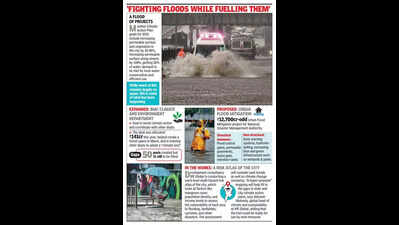
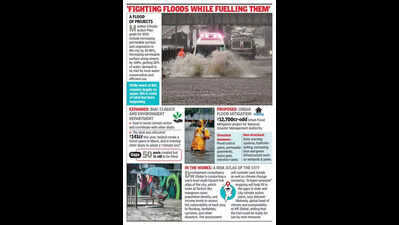
Mumbai: Two trends are unfolding in the city today, and the gap between them is as wide as the Mithi river in full spate.On the one hand, the BMC is spending a lot of money on reducing the impact of flooding, from river rejuvenation and floodwater pumps to hazard mapping and private weather services. The agency’s analysis found that 38% of this year’s budget goes to climate-related action, mostly on flood and water management. On the other hand, authorities continue to push infrastructure and real estate projects that expand concrete cover and thus stormwater runoff, without adequate precautions. Redevelopment alone is adding around 344 million square feet of built-up area, estimates show.It’s a contradiction officials privately acknowledge. “Development and construction is going faster than mitigation and environmental cleanup,” said a municipal officer. Adds Subhankar Karmarkar, professor of environmental science at IIT Bombay, “People talk about inadequate flood infrastructure, but it’s not that infrastructure is always inadequate, it’s that overall planning needs to be improved.”The irony was on display this past week when the spanking new Vikhroli bridge became water-logged due to littering and insufficient drainage.Shoddy work is not the only problem. While the BMC has proposed measures like permeable pavements and sponge parks to soak up more rainwater—the climate action plan suggests increasing permeable surface by 40% by 2030—large complexes are approved without such conditions. If developers raise plinths or expand concrete with parking and podiums, they should take responsibility for the run-off, says Lubaina Rangwala of World Resources Institute. “You can’t assume drains can handle all the extra run-off in a few hours,” she says, “Complexes should be asked to re-use or store water where it falls.”“Clearances for every project should look at whether it gets in the way of natural drainage,” adds Stalin Dayanand of Vanashakti. “Ideally, the urban development file should go to the environment department for clearance. But will an environment official have the courage to say no to a development proposal?”The BMC environment department has been recently expanded but it still lacks staff—with 35 posts remaining vacant—and authority to monitor whether conditions like rainwater harvesting are followed.Reducing storm run-off through permeable surface, greenery, and waste management is important because infrastructure alone cannot keep pace if extreme rainfall events continue to increase, experts say. A CEEW analysis shows Mumbai saw 10–12 more heavy rain days per year in 2012–22 than in 1982–2011.The Brimstowad project doubled storm-water drain capacity from 25mm of rainfall an hour to 50mm an hour. But “we are now witnessing 100 mm/hour of rainfall in many cities, not only in India, but even in New York,” says urban drainage expert Kapil Gupta, adding that Mumbai should plan for that level. Interestingly, he notes, “When Navi Mumbai was planned in the 1970s, the NATU committee had recommended that it be designed for 158 mm/hour.“Gupta suggests building underground tanks like Hindmata’s under existing parks and stadia. “This has now become a standard practice in major cities such as Hong Kong, Barcelona and Tokyo,” he says. Big new developments, he adds, should also be asked to build underground water storage tanks. Ideally, he says, “urban flood mitigation should be a combination of structural and non-structural measures with emphasis on nature-based solutions.“The BMC has proposed to expand green infrastructure such as retention basins, wetlands, and parks. Where these will come up is unclear. Ideally, say officials, new developments should be required to include a share of permeable surface or roof gardens. That requires changing the development rules and plan to integrate these concerns.In Europe and the US, insurance companies have begun to refuse coverage in high flood-risk areas, reshaping development patterns and policies. In India, such coverage is limited, and largely out of bounds for the lower-income communities who are hardest hit by flooding. Studies have shown that improving affordable housing and education also improves resilience to natural disasters, says Karmarkar. A study published last year by him and his colleagues found that areas in the city with higher female literacy rates and fewer part-time workers were likely to be less vulnerable to natural disaster risks. “The long-term solution,” says Karmarkar, “is a more equitable general development of the city.”