




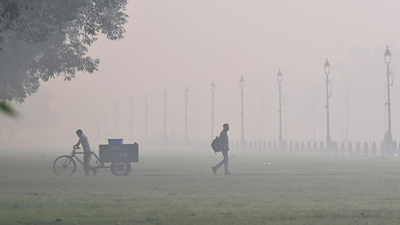
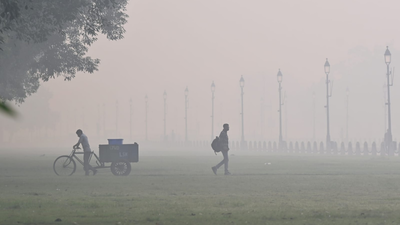
NEW DELHI: Every winter, a thick blanket of smog descends over Delhi, turning the capital’s skyline into a hazy silhouette. Schools shut, visibility dips, and the Air Quality Index rockets into the “severe” zone. Amid this grim routine, a new hope often rises — artificial rain.Officials and scientists talk about cloud seeding as a quick fix: a way to wash down the pollution by making it rain on command. But behind the promise lies a complex science and plenty of skepticism.
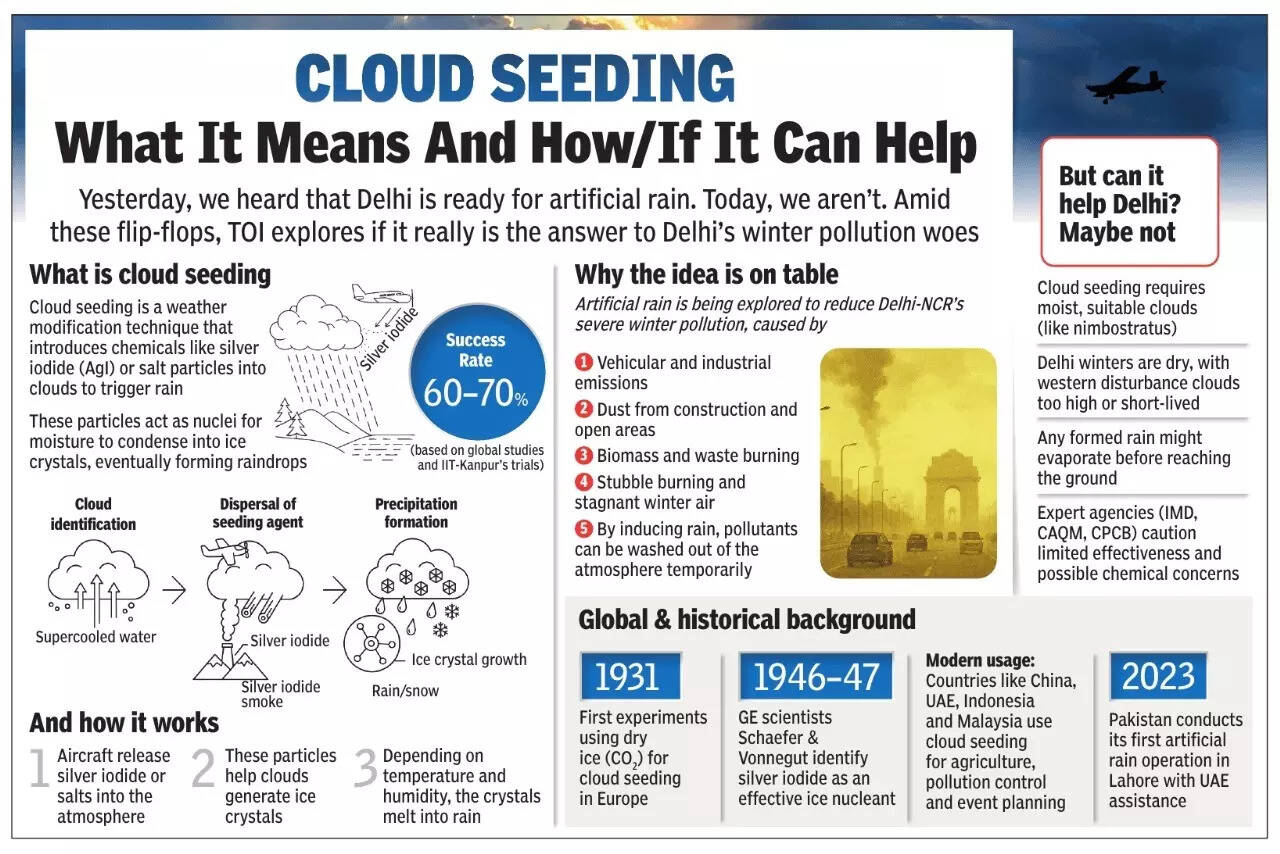
The promise of artificial rainCloud seeding isn’t new. It’s a weather modification technique that involves releasing silver iodide or salt particles into clouds. These particles act as tiny seeds, helping moisture condense into ice crystals, which can grow and eventually fall as rain.Under the right conditions, it can work. IIT-Kanpur trials and global studies suggest a 60–70% success rate, provided the clouds are moist and thick enough. The process typically involves aircraft flying through suitable clouds, dispersing the chemical, and waiting for nature to take over.Why Delhi is betting on itThe motivation is clear. Delhi’s pollution cocktail is brewed from vehicular and industrial emissions, construction dust, biomass and waste burning, and stubble smoke drifting from neighboring states. Add stagnant winter air that traps pollutants close to the ground, and you get the perfect storm, only without the rain.The logic behind artificial rain is simple: if the skies won’t clean the air naturally, perhaps we can help them along.The reality checkBut turning clouds into rain is easier said than done.Delhi’s winter skies are mostly dry, and when western disturbance clouds do appear, they are often too high or short-lived for effective seeding. Even if rain does form, it might evaporate before reaching the ground, limiting the benefit.Experts from the IMD, CAQM, and CPCB have also raised flags about limited effectiveness and potential chemical side effects. As one environmental scientist put it, “You can’t seed what isn’t there — and Delhi’s problem is often a lack of the right clouds.”A century-old experimentThe dream of making rain began nearly a century ago. In 1931, European scientists experimented with dry ice (CO₂) to trigger precipitation. By the 1940s, GE researchers Schaefer and Vonnegut discovered that silver iodide could effectively act as an ice nucleant, revolutionizing the field.Today, countries like China, UAE, Indonesia, and Malaysia have embraced cloud seeding — using it for agriculture, pollution control, and even to clear skies before major events. In 2023, Pakistan joined the list, carrying out its first artificial rain mission in Lahore with help from the UAE.Between hope and hazeSo, could cloud seeding be the answer for Delhi? Possibly — but only when the weather plays along. For now, it remains a temporary, conditional fix, not a long-term solution.While the idea of “rain on demand” captures the imagination, experts say that tackling Delhi’s smog requires more down-to-earth action — from curbing emissions to controlling stubble burning.