




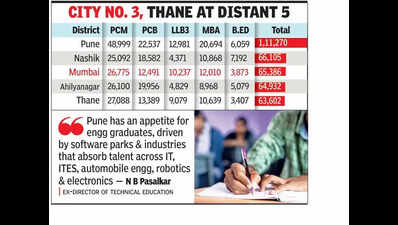
Mumbai: If professional education had a postcode this year, it would be Pune. Data from the state’s common entrance test (CET) cell shows that it has decisively pulled ahead as the preferred base from which students register for professional courses, leaving Nashik at a distant second and Mumbai in third place.Pune accounted for over 1.1 lakh registrations for programmes such as engineering, pharmacy, law, MBA and BEd. Mumbai city and suburbs logged 65,386 registrations—more than half of Pune’s tally—while Ahilyanagar was not far behind, with Thane close on its heels. Education experts said the divergence is rooted less in student ability and more in ecosystem design. Former director of technical education N B Pasalkar pointed out that Pune’s tilt towards engineering is no accident. “It has a massive appetite for engineering graduates, driven by software parks and industries that absorb talent across IT, ITES, automobile engineering, robotics and electronics.” Pune has positioned itself as a city where professional degrees translate smoothly into jobs, internships and industry exposure. That positioning has been reinforced by infrastructure. Pune’s campuses are largely designed around academic life, with easier access to labs, hostels and industrial clusters. “Strong linkages with manufacturing, IT, automotive and startup ecosystems give students live projects and practical exposure early on,” said a former Pune University vice-chancellor, adding the city’s identity as an education hub has only sharpened. Mumbai’s story is more complex. Students here continue to gravitate towards commerce and finance, reflecting the city’s economic character. “We see a strong preference for traditional commerce courses, often integrated with new-age ones like AI and blockchain,” said a former commerce dean of Mumbai University. Many Mumbai students also chart a different path: securing seats at IIMs or heading abroad for postgraduation. Another factor is capacity. Pune has far more professional colleges than Mumbai, which has struggled to expand academic infrastructure in step with demand and rising costs of living.At the margins are Sindhudurg, Gadchiroli, Ratnagiri, Hingoli and Gondia, from where only a few thousand registered. To address this imbalance, the CET cell has launched divisional-level interactive guidance programmes in Dhule, Akola, Wardha and Nanded. “We want students and parents to better understand the opportunities a professional degree can offer,” said CET commissioner Dileep Sardesai.