



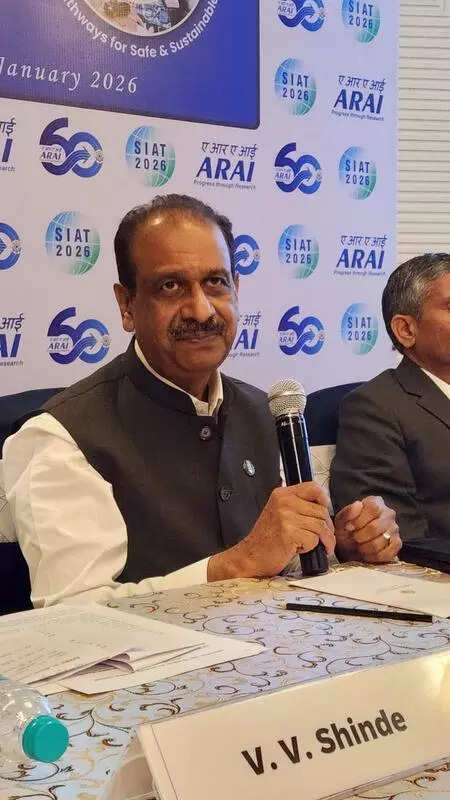
Pune: All electric four-wheelers in India would be mandated to produce an artificial sound at low speeds from Oct to improve pedestrian safety, Reji Mathai, director of the Automotive Research Association of India (ARAI), said on Wednesday.“The Acoustic Vehicle Alerting System (AVAS) will be mandatory for all electric four-wheelers travelling at 0-20km per hour to improve pedestrian safety. There are discussions on the need for such a system in two- and three-wheelers, focusing on its nature so that it differs from surrounding noise without causing disturbance,” Mathai said while speaking at a press conference to announce the 19th edition of the Symposium on International Automotive Technology (SIAT), scheduled from Jan 27 to 30, at the Pune International Exhibition and Convention Centre, Moshi. Mathai highlighted ARAI’s involvement in a consortium working on developing a pollution-emissions inventory for Delhi and other major cities. “It is contributing to the second phase of the Bharat New Car Assessment Programme, which is likely to come into force from 2027,” he said.Discussing the upcoming Bharat Stage VII (BS-VII) emission norms, Mathai said BS-VII was unlikely to bring significant changes to tailpipe emission limits, as existing regulations were already stringent. “Instead, the emphasis will shift towards controlling non-exhaust emissions, particularly particulate matter generated from tyres and brakes. The new norms are expected to place greater emphasis on real-driving emissions,” he said.Before BS-VII was formally implemented, India would transition from the existing vehicle test cycle to a newer, more representative one, Mathai said, adding that BS-VII would follow only after the new test cycle was stabilised.Mathai said ARAI was developing advanced testing facilities to simulate challenging driving conditions like fog and nighttime scenarios. “These facilities will be used to evaluate and fine-tune vehicle sensors, particularly those related to Advanced Driver Assistance Systems,” he said.On hydrogen mobility, ARAI has sought govt funding to establish a 700-bar high-pressure hydrogen cylinder testing facility, which requires an estimated investment of Rs 100 crore. Mathai said funding support of around Rs 65 crore had been requested under a Union ministry scheme. “Once approved, the facility is expected to take about 18 months to be commissioned,” he said.NH Walke, senior deputy director at ARAI, said this year’s SIAT would be the largest so far, featuring over 285 speakers, 387 booths and 275 exhibitors from across 10 countries.The four-day expo is expected to draw over 3,000 automotive experts and will feature 64 technical sessions and three plenary sessions.