





Ugo Bienvenu’s Arco is positioned in this year’s animation awards race with an odd, almost endearing self-awareness, fully conscious that it is competing against the pop-weapon momentum of Oscar-frontrunner KPop Demon Hunters while standing in the long shadow cast by last year’s winner, Flow, whose Cannes debut altered the ceiling for what animated cinema could achieve through atmosphere alone. Arco shares Flow’s belief in wonder as a primary language, though it features more prominent signposting and a desire to be more accessible to every viewer in the room.

The hook is fast and clean: a ten-year-old boy from the far future steals time-travel technology to see dinosaurs and crashes into the wrong century. Ten-year-old me would have detonated the space-time continuum without hesitation for a clear look at a velociraptor’s gait, and Bienvenu seems to understand that impulse pretty darn well.
The film opens in the year 2932, where humanity occupies cloud-level habitats shaped like suspended arboretums, a civilisation reorganised after ecological collapse forced the planet’s surface into recovery. Time travel exists as an educational rite governed by age, and the titular Arco experiences that rule as an unbearable delay. He steals his sister’s rainbow flight cape and gemstone while his family sleeps in anti-gravity pods and launches himself off the edge of his floating house with complete faith in momentum. But the attempt goes wrong, and he crashes into the year 2075, a near-suburban future that feels uncomfortably adjacent to the present, where the climate crisis has already been normalised.
A still from ‘Arco’
| Photo Credit:
NEON
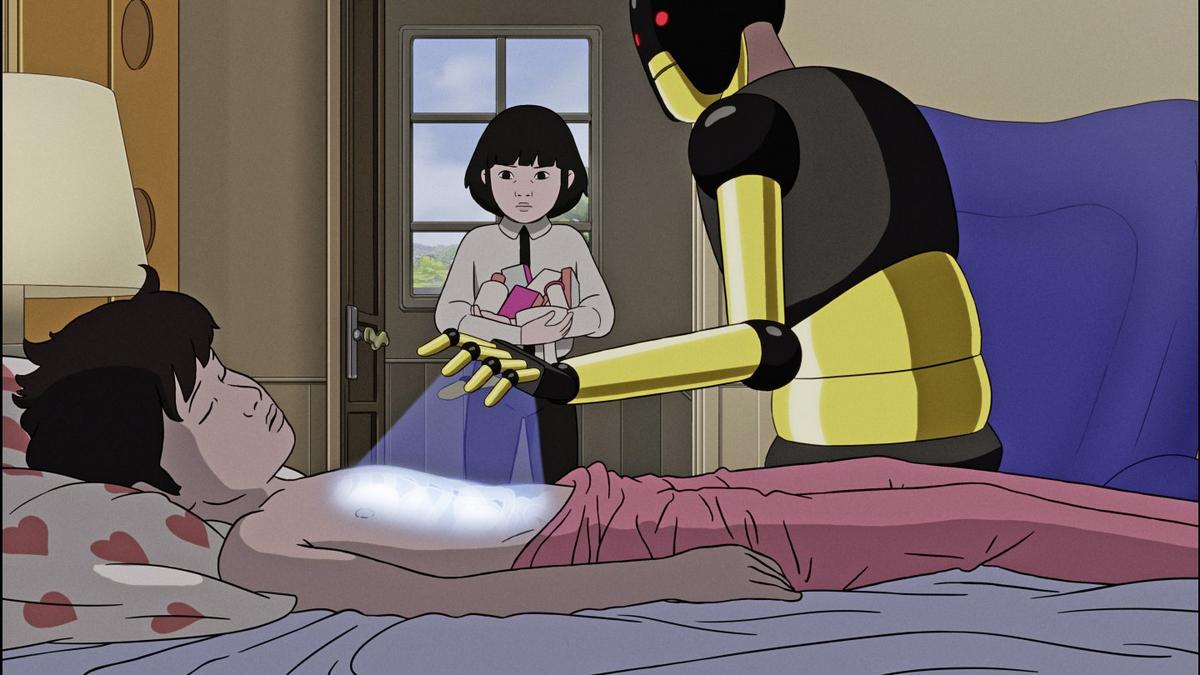
Ten-year-old Iris lives in this timeline along with her infant brother and the gender-fluid family caretaker robot, Mikki. Her parents appear as holographic projections during meals and bedtime, while work keeps them permanently elsewhere. Her town braces for wildfires and torrential storms with deployable domes and emergency protocols that feel commonplace. Iris finds Arco unconscious in the forest, shelters him from three bumbling conspiracy-obsessed brothers tracking rainbow anomalies, and helps him attempt repeated escape flights from her roof. Their bond grows through shared problem-solving and an optimistic solidarity.
The story advances through a chain of failures and recalibrations, each one tightening the attachment between the two, but the intimacy grows while the world actively destabilises, forcing Iris to decide who she protects and what she is willing to lose. This framing of closeness inside environmental collapse recalls the narrative pressures that prominently feature across Makoto Shinkai’s oeuvre. Meanwhile, Mikki’s presence stabilises these movements through its undying vigilance that fills the vacuum left by holographic parents, allowing affection to accumulate through habit and memory, and the robot’s earned humanity draws clear lineage from The Iron Giant through care performed consistently enough to become love.
Arco (French)
Director: Ugo Bienvenu
Cast: Swann Arlaud, Alma Jodorowsky, Margot Ringard Oldra, Oscar Tresanini, Vincent Macaigne, Louis Garrel, William Lebghil, and Oxmo Puccino
Runtime: 89 minutes
Storyline: A 10-year-old boy from the future who accidentally travels back in time where he bands together with a young girl and her robot caretaker as he sets out on a quest to return home
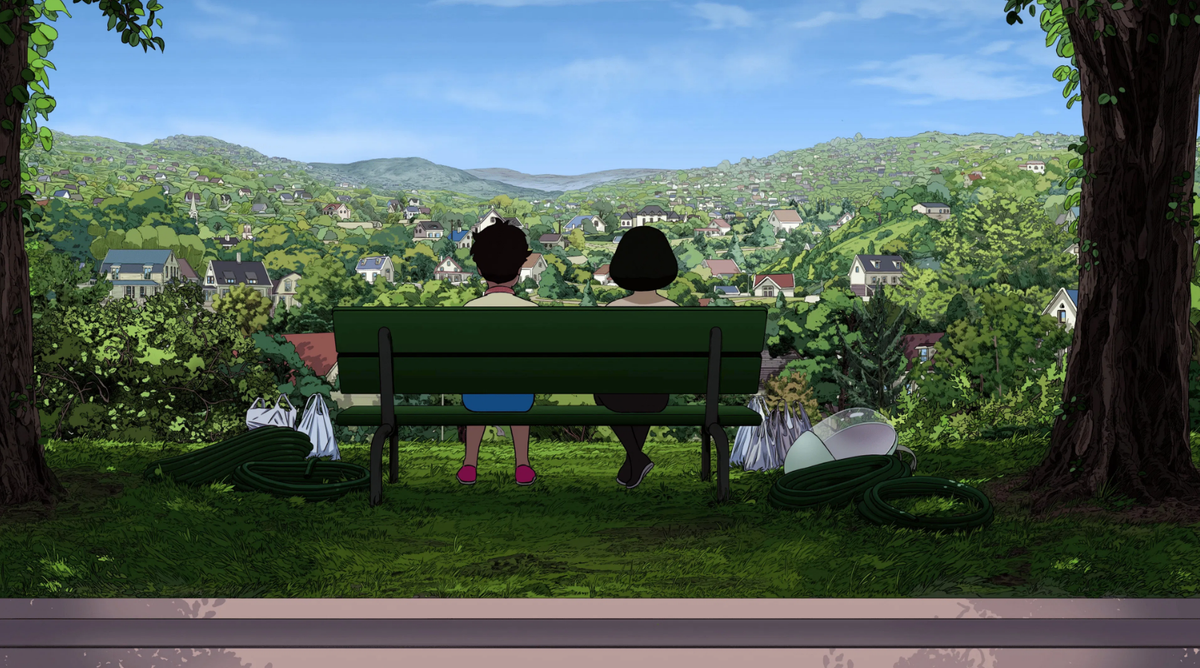
Visually, Bienvenu’s identity as an illustrator dominates every frame. Characters remain expressive but slightly rigid, while environments pulse with density and intention. Forests burn with textured urgency and cloud colonies hover with architectural clarity. Miyazaki’s influence registers through attention to weather, scale, and the dignity of landscape, yet the film’s real triumph lives in its meticulously detailed backdrop canvases of lush forest greens and sweeping suburbia.

The film’s most interesting ideas surface once it settles into the uncomfortable gap between its two futures, defined by altitude and access. In Arco’s era, humanity lives above the planet in cloud colonies that look pastoral and orderly, after collectively deciding the Earth’s surface needs to lie fallow for centuries. That decision feels calm and ethical when viewed from the sky, though its shadow stretches directly into Iris’s daily life in 2075, where climate collapse has already become a matter of scheduling. Her town survives by families siphoning themselves off from the outside entirely, and civic roles handed off to robots who patrol streets, teach classrooms, and troubleshoot kin with mechanical patience. Even history is mediated, taught through virtual portals and simulations, while the physical library sits abandoned as a room everyone agrees is barely visited.
When the wildfire forces Iris and Arco into the cave, Mikki’s climactic sacrifice turns this logic inside out, as the robot begins carving their images into stone, translating memory into a tactile product of labour because the systems designed to preserve meaning are clearly inadequate. The finale hardens into consequence once Arco learns that his parents have aged entire lifetimes searching for him. These mechanics carry the emotional logic associated with Interstellar in the way love persists across distorted time, with the epilogue also granting Iris a Murph-like future shaped by authorship and invention.
A still from ‘Arco’
| Photo Credit:
NEON
Bienvenu’s future is a slow reorganisation of responsibility, in which advanced societies lift themselves away from the damage and leave infrastructure to manage what remains. It feels unsettling precisely because it seems to offer a vision of tomorrow stabilised through distance, delegation, and an optimism that assumes someone else will finish the repair.
Still, Arco starts tripping over its own eagerness once the ideas pile up. The rules governing time travel never settle into something the film seems interested in enforcing, and more compelling concepts seem to be ushered offstage before they’ve had time to leave a mark. The pacing also keeps sustaining its velocity, which means chases, escapes, and revelations slide past without dragging their consequences along. And while the final reunion lands with real pathos when Arco’s family appears, the rush to wrap things up leaves the stitching exposed.

Even with those frustrations, Arco leaves a durable impression. The animation earns sustained respect through craft and control, and its world feels inhabited. Adults may find themselves scanning the horizon for the film it almost becomes, though children will likely absorb it whole, carrying its sense of curiosity forward, and that feels like an outcome worth defending.
Arco is currently running in theatres
Published – February 27, 2026 04:14 pm IST

