





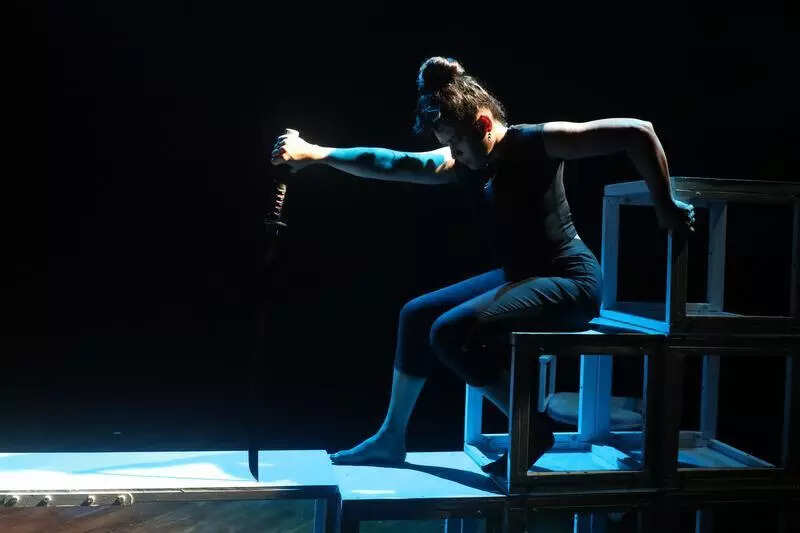
Pune: ‘A Woman Or Not To Be’ takes one of the most iconic figures in world theatre and quietly pulls the ground from beneath him. Shakespeare’s Hamlet, long celebrated as the ultimate portrait of tortured genius, is reimagined here as “Princess Hamlet” — a young woman whose grief is not indulged, whose rage is questioned, and whose choices are shaped by expectations vastly different from those imposed on men.To be staged in Pune on Jan 24 and 25 at The Box by Tamil Nadu-based Adishakti Theatre Company, the production approaches Hamlet not as a classic revival, but as a living argument about gender, power, and emotional freedom. Directed by Vinay Kumar, the play begins with a deceptively simple provocation: What if Hamlet were a woman? “Privileged angst has long been a favourite theme of storytellers,” says Kumar. “Beneath the grandeur of great literature often lie the questionable ethics of men whose flaws are celebrated as brilliance. For centuries, Hamlet has embodied this ideal — an icon of complexity and grief. Yet, through a contemporary lens of gender equality, he emerges as volatile, self-absorbed, and steeped in unchecked male privilege.” In this contemporary reimagining, Princess Hamlet is a 20-year-old college student who loves manga and anime and practices martial arts. Her world collapses when she returns home to find her mother murdered and her aunt married to her father. While the shock of the original plot remains, the emotional instructions have shifted. In this version, the mother’s ghost does not call for blood; instead, she urges caution, education, and self-preservation. This shift exposes the double standards inherent in how society treats mourning. The production moves away from Shakespeare’s original arc to question who is allowed to seek revenge and who is expected to endure quietly. “If revenge is a form of closure for trauma, is that closure available to every gender, or only to men?” asks Kumar. “Through Princess Hamlet’s journey, we confront the ethics of male privilege, the glorification of toxic masculinity, and the limits of emotional freedom afforded to women in their own existential struggles.” What emerges is not a rejection of the play, but a radical reframing of its moral centre. Kumar notes that despite countless reinterpretations — from the corporate corridors of Ethan Hawke’s Hamlet to the animal kingdom of The Lion King — the “gaze” remains overwhelmingly male, heroic, and self-destructive. “This enduring fascination with toxic masculinity continues to shape how we understand emotion and power,” he said. The play is grounded in long-term research into the psychology of grief, examining how loss settles into the body as much as the mind. Drawing from the theories of Freud, Jung, Melanie Klein, and Hanna Segal, A Woman Or Not To Be explores the self-destructive impulses and defence mechanisms that define the human experience of mourning.