





A ‘summit of 10 nations’ was held, not across the high tables of diplomacy, but on the lawns of a heritage club. Nine musical ensembles, from across the world, congregated last weekend to hold a live conversation among people. No flags were exchanged, yet, they found a common cause and agreed to explore, share and celebrate. While the Konakkol intricacies seamlessly played out on the drums, hip-hop collided with Indian classical traditions, a Bengali from New York explored Tagore on his saxophone and a pianist with Cuban-roots added the embellishments.
The action unfolded at the Dalhousie Institute ( traditional hosts of JazzFest Kolkata), which is an annual three-day event (December 5-7) of cross-border sonic exchanges. A Munich-based collective united Germany, Morocco, Hungary and India. There were musicians from France, Switzerland, Denmark and the U.S.. They presented a kaleidoscope of stories and portraits, finding expression in innovation and improvisation. Khalil Gibran came gift-wrapped in Schubert’s Lieder, a train ride resonating in the ghatam.
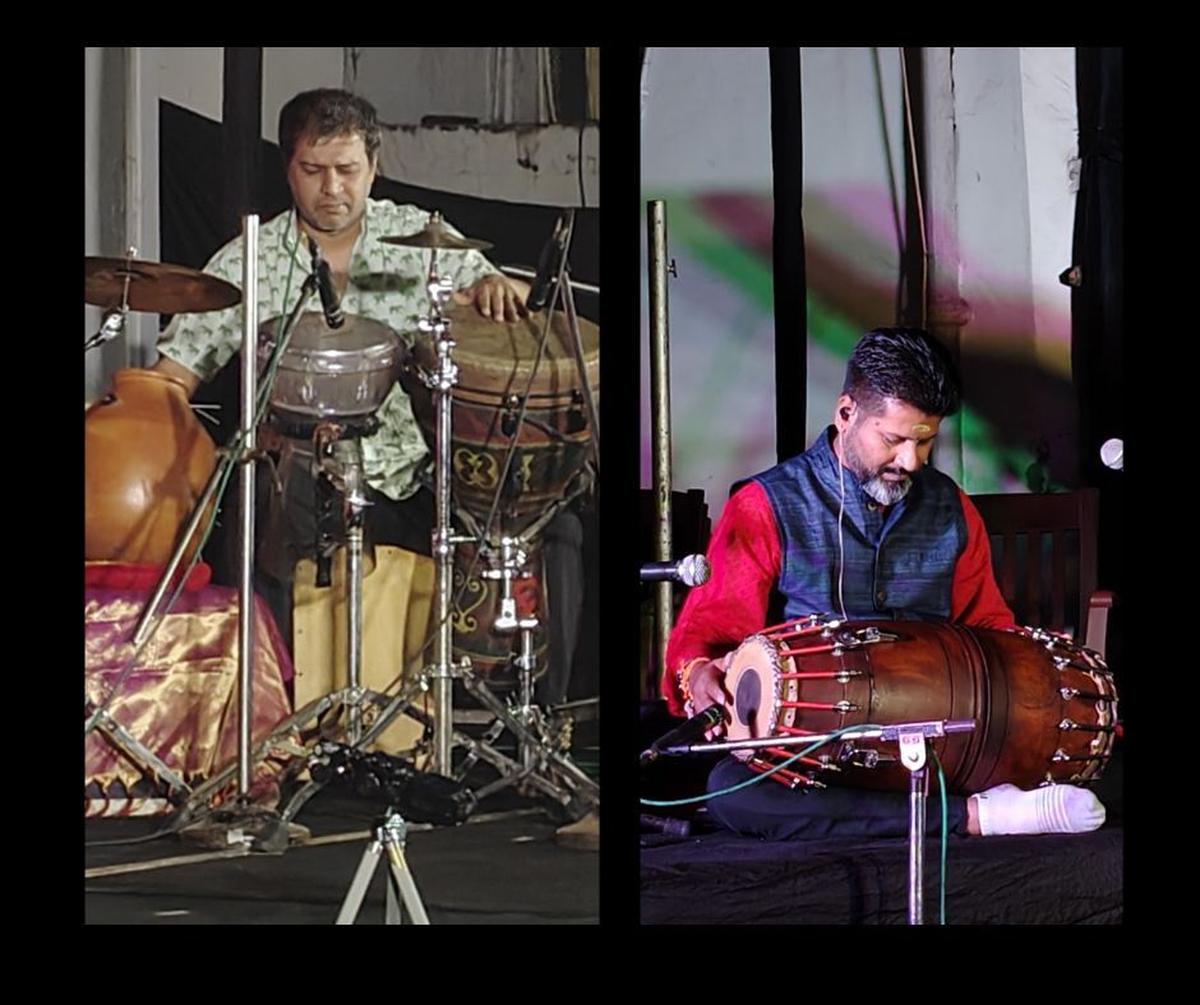
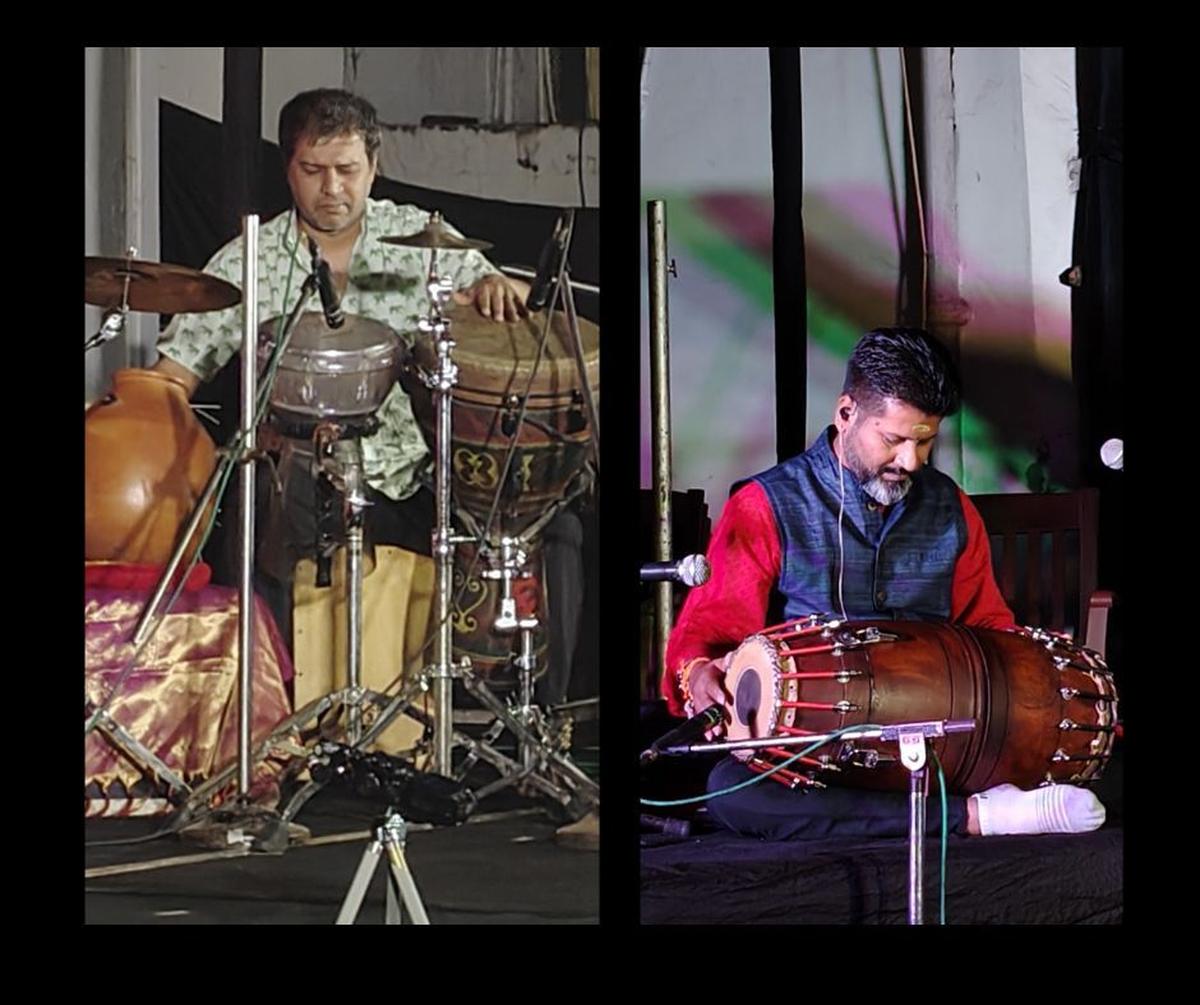
Manjunath and Kathik Mani at the event.
| Photo Credit:
Shantanu Datta
Music was the centrepiece of this summit, but a question lingered: how much of this was jazz as we know it? Curiously though, the answer presented itself with the eclectic mix of experiences that curator Varun Desai put together for what has always been a receptive audience of changing tastes.
While Alexandre Herer’s ‘Bombay Experience’ (France/India) showcased Manmeet Kaur’s polite poetry about societal concerns (stray dogs, healthcare — for instance), Manjunath’s mridangam helped in the narration just as Alexandre’s improvised passages on the keys accentuated the emotions. Immigrant musings of love and loss were at the core of Devi Laskar’s poetry, spoken in English and Bengali. Her earnestness, framed with empathy by the accompanying quartet — Caravanserai (USA/India/Cuba), the band put together specially for the festival. Birsa Chatterjee, from NYC and his friend Esteban Castro, a duo within the curated quartet, justifiably earned some lone time with the audience to offer luminous renditions of ‘Favourite Things’ and ‘Tomai Gaan Shonabo’, connecting emotionally with John Coltrane and Rabindranath Tagore.

Manuel Gutierrez (piano), Xacobe Xurxo Martinez Antelo (double bass), Lar Legido (drums, pots & pans) of Sumrra (Spain) during their magical performance at JazzFest Kolkata.
| Photo Credit:
Special Arrangement
More exciting possibilities of musical cross-pollination were hinted at by Tout Blue, a Geneva-based quartet, wherein the Annie Lennox-ish vocal incantations of Simone Aubert bonds with cello (Beatriz Raimundo) and viola (Luciano Turella). ‘Walls have ears, doors have eyes and trees have voices’: sang Simone as she played the electric guitar strings on the fretboard, generating a distinct tone to play the central melody. The additional cushioning of electronic sound pieces (Pol) created a hypnotic spell.
A Danish-Indian jazz odyssey was set in motion when Kolkata’s guitar titan Amyt Datta, prodigal drummer Jivraj Singh (one-half of pop duo Parekh and Singh) and bassist Mainak Nagchowdhury teamed up with Copenhagen trumpeter Ida Brinch and alto saxophonist Maria Dybbroe to revisit their compositions. For Amyt Datta’s ‘Neelima’ and ‘Ironic Byronic’, Jivraj’s percussion left spaces to allow the tunes to flower, courtesy the combined heft of the sax-trumpet combination. Ida and Maria’s tunes were homages to the past, invoking visions of snow-capped mountains as distinct from the Mediterranean feel of Amyt’s originals. We speak the same language, Ida had commented after their first rehearsal, reconfirming once again the border-less possibilities of jazz.
Zoom (Germany) was the closest to jazz as we know it. With laid-back bass grooves and syncopated guitar fill-ins, the band stayed focussed on nuance as did Soumojit Sarkar Trio (India) that came on board at short notice after Poland’s Light Star Guiding fell victim to flight disruptions. Soumojit, an excellent pianist, stayed the course of standards, his interpretations of Miles and Coltrane revealing a commendable understanding of the genre.
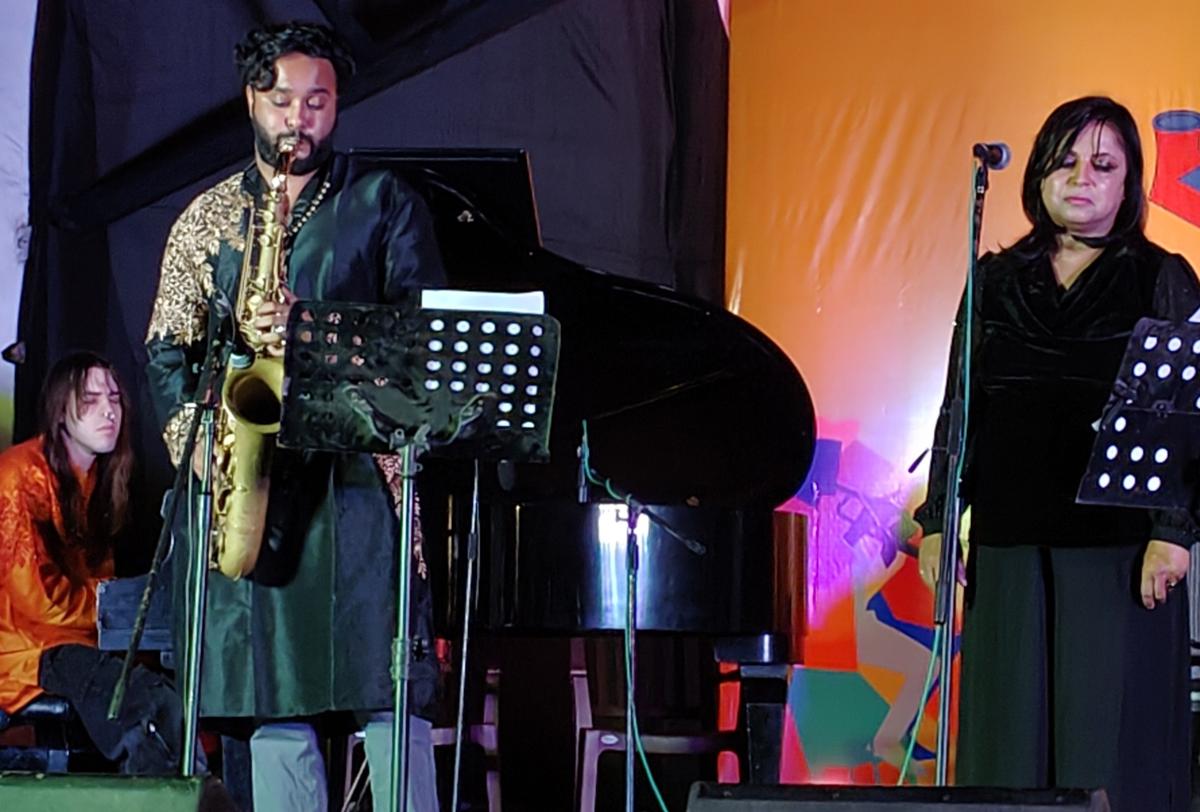
Birsa Chatterjee (saxophone), Esteban Castro (piano), Devi Laskar (poetry) of Caravanserai (USA/India/Cuba).
It was, however, left to the magic of Sumrra (Spain) and the brilliance of Cabaret Rocher Trio (France) to demonstrate how, amid the gate-crashing of genres, it is still possible to create a hybrid soundscape, one that is wildly free yet deeply-rooted in the core aesthetics of jazz. Sumrra has been audacious, redefining jazz’s global frontiers by ‘dancing’ between structured elegance and improvisational abandon for 25 years. Etienne Cabaret, Christophe Rocher and Nicolas Pointard, who make up the trio from Brittany were no less evolutionary. They foreground Celtic vibes with bass clarionets, switching roles instinctively as they navigate complex melodic landscapes anchored by the drummer, who kept it soft but brisk, and airy but tight.
So, where was jazz in all this? Maybe it was omnipresent in the redefining of its storied traditions. Ask the youngsters who danced wildly to the music of Jisr, Mohcine Ramdan’s Moroccan bass and Karthik Mani’s cajon spreading good cheer. They’ll tell us they loved it. Maybe that’s all that matters.
Published – December 12, 2025 03:35 pm IST