






The gayest anime ever made has saddled up again, back with such swaggering authority — on horseback, draped in couture, grinning through gold teeth, and spinning the most beautiful balls put to screen — that even the idea of a “return to form” feels astonishingly insufficient. Four years after its predecessor Stone Ocean closed the long, looping book on the original Joestar bloodline on Netflix, Part 7 of the beloved Jojo’s Bizarre Adventure titled Steel Ball Run rides in like new gospel for its legions of zealous emissaries, as a soft franchise-reboot that carries the DNA of its storied legacy in its bones and the confidence of spending nearly twenty years being hailed as one the greatest manga ever written.

The early hysteria around its premiere — including the internet’s immediate convulsions as it knocked Frieren off its comfortably cushioned throne on MyAnimeList within hours of release — comes with a strange sense of inevitability once you actually watch it. Because this is what Araki has always been building toward — a version of JJBA that feels complete in its craft and yet completely unbound in its imagination. There is still nobody working in anime or manga who thinks like Hirohiko Araki, and there is still nothing that looks, moves, feels or metabolises absurdity into form the way JJBA does. Steel Ball Run is the culmination of those accumulated joys fans have spent years cultivating through Araki’s sacred texts.
Steel Ball Run: Jojo’s Bizarre Adventure (Japanese)
Director: Toshiyuki Kato
Cast: Shogo Sakata, Yōhei Azakami, Kenta Miyake, Kaito Ishikawa, Masaaki Mizunaka, Kenichirou Matsuda
Episodes: 1 of TBD
Runtime: 47 minutes
Storyline: Set in the United States in 1890, a paraplegic ex-jockey, and a master in a mystic art compete with a vast number of others in the Steel Ball Run: a mad-dash across America for a grand prize of 50 million dollars
For anyone stepping into this world for the first time, JoJo’s Bizarre Adventure is best understood as a multi-generational saga centred around the Joestar family, shifting protagonists and settings while maintaining a throughline anchored in the family’s persistent entanglement with supernatural forces. It begins in 19th-century England, and expands into globe-spanning adventures that mutate into something far stranger with the introduction of Stands — psychic manifestations of one’s spirit that transform combat into a series of increasingly elaborate and absurd puzzles. Through all of this, Araki’s art evolves in tandem, moving from heavily muscled figures inspired by ‘80s body culture to elongated, androgynous forms that draw directly from fashion illustration, classical sculpture, and editorial photography; a sensibility that has led to his work even being exhibited at the Louvre. Steel Ball Run resets the board entirely, relocating the story to an alternate 1890s America around a massive cross-country horse race from San Diego to New York, where competitors battle across the country for a grand prize of $50 million.
A still from ‘Steel Ball Run: Jojo’s Bizarre Adventure’
| Photo Credit:
Netflix
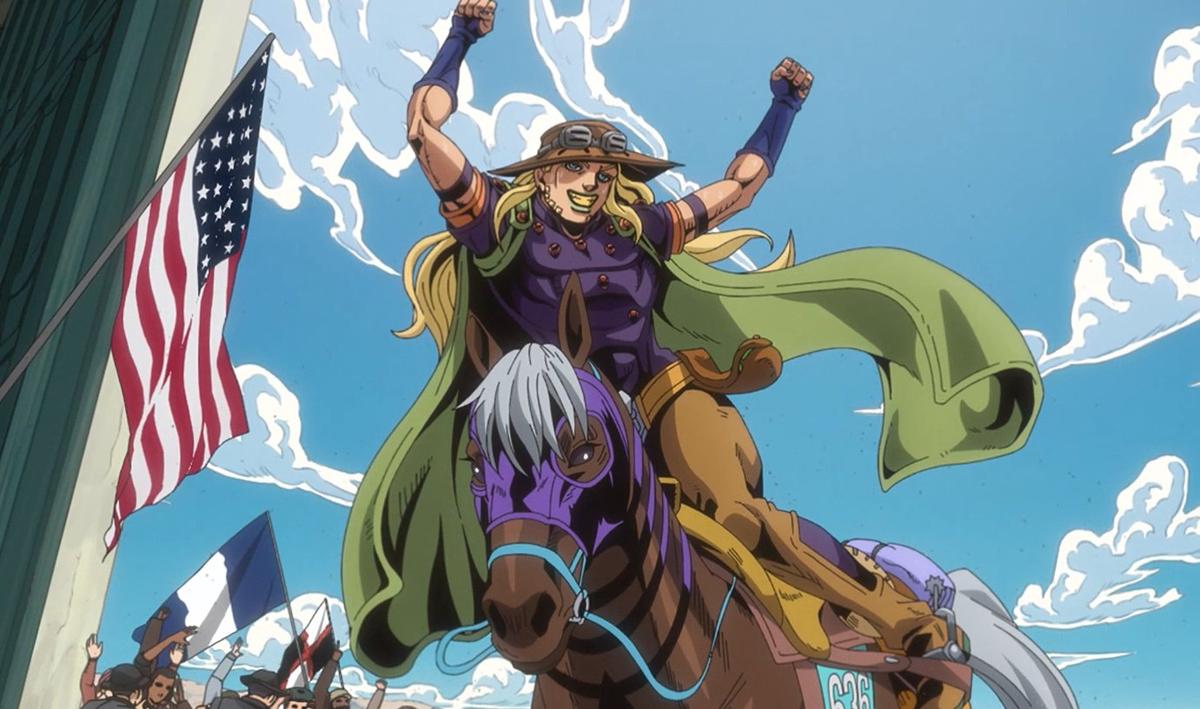
The heart of that journey is our protagonists, Johnny Joestar and Gyro Zeppeli. Johnny is a former racing prodigy now crippled and confined to a wheelchair. His pale features and cropped blond hair are set against a star-spangled outfit that feels unabashedly Americana, yet faintly ironic. Meanwhile, Gyro is a sight to behold — a spectacle of deliberate excess, draped in striped leathers, metallic accents, a wide-brimmed hat, two holstered green steel balls, and teeth adorned with gold-embossed grills that glint with every teasing “Nyo-ho-ho”. Araki’s long flirtations with haute couture, including collaborations with brands like Gucci and consistent references to runway aesthetics, inform every aspect of their presentation, and the anime preserves this with an attention to texture and silhouette that has always treated clothing as an extension of these exaggerated characters. What we learn of them in the premiere is carefully rationed, with Johnny defined by loss, a fallen jockey searching for a way to reclaim agency, and Gyro positioned as a mysterious catalyst, his mastery of those mysterious spinning balls capturing Johnny’s motivations to enter the race. Johnny’s closing voiceover reframes their chance encounter as the beginning of something beautiful.
That relationship exists within JJBA’s long-standing reputation as one of the most decidedly queer-affirming texts in mainstream anime, which has spent decades dismantling rigid masculinity through sheer expression. Araki’s approach to queerness resists the need for explicit posturing, allowing its characters to exist in a space where vulnerability, flamboyance, and desire move freely without needing justification. Steel Ball Run continues this tradition, positioning Johnny and Gyro within a dynamic that already hums with a special something. The anime seems fully aware that it is inheriting the expectations of committing to their blossoming relationship with nuance. Curiously enough, Steel Ball Run began serialisation in 2004, a year before Brokeback Mountain arrived to codify a certain kind of cowboy longing in Western cinema (take from that what you must, nyo-ho-ho).

The supporting cast are bursts of varying personalities, and their designs do most of the heavy-lifting before their motivations are even articulated. Fan-favourite (and long plague for the Joestar-kind) Diego “Dio” Brando is introduced as an English racing-wunderkind with a predatory elegance, his conniving intent echoing all-too-familiar archetypes. The race promoter Steven Steel embodies the theatrical ambition of the American Dream, and his booming speeches about the race’s significance are layered over moments of visible strain, particularly in his eyebrow-raising relationship with Lucy Steel. We also have a Black racer named Pocoloco who drifts through the chaos with an almost irritating faith in luck, and a Native American darkhorse contender named Sandman who decides to leg the entire race simply because he’s built differently.
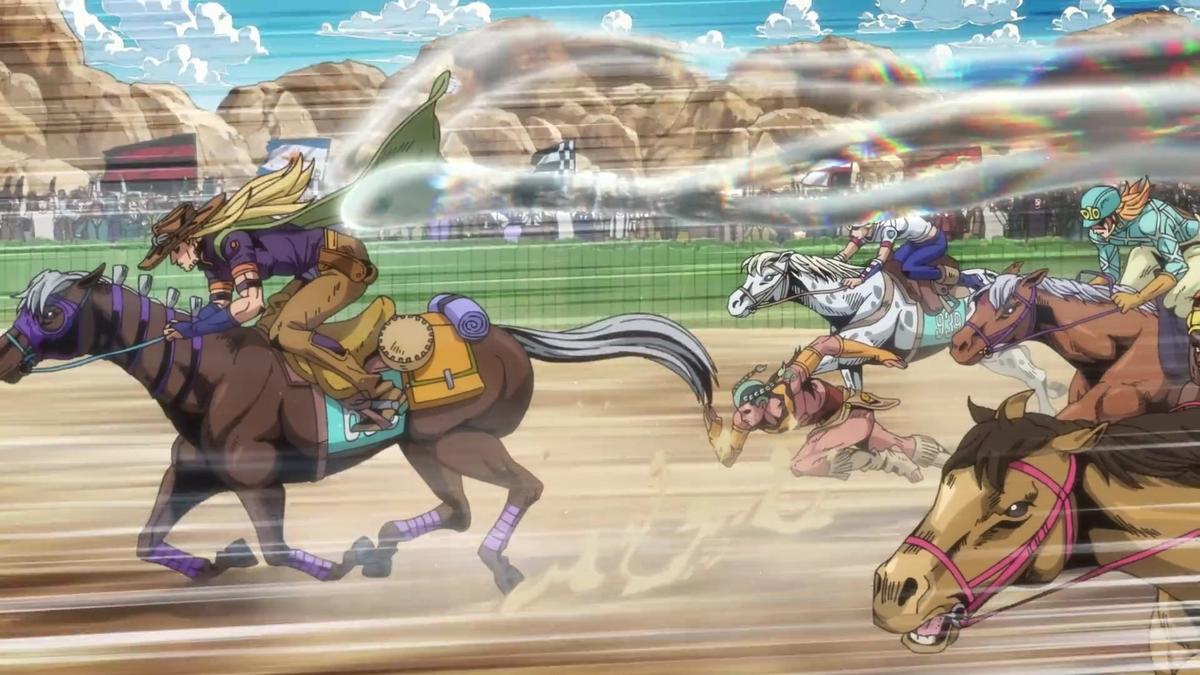
The premiere wastes very little time before snapping into the first leg of the 6,000-kilometre endurance race, which unfolds as a series of escalating set-pieces, with riders colliding, veering, scheming, and improvising across terrain that shifts from open desert to crowded choke points. The closing stretch sharpens into a genuine five-way scramble, with Gyro, Johnny, Dio, Pocoloco, and Sandman all converging at the front in a sequence that finally gives the race its full sense of scale, as five completely different approaches to movement, strategy, and survival collide in the same narrow band of space. The final seconds compress into a near photo finish, with Gyro edging ahead at the last possible moment to steal the win in style, while Johnny watches that outcome with a clarity that locks his trajectory in place, because the race has just shown him exactly who he needs to follow and why.
A still from ‘Steel Ball Run: Jojo’s Bizarre Adventure’
| Photo Credit:
Netflix
David Production approaches the adaptation with a level of technical assurance that comes from long familiarity with Araki’s demands, translating his compositions into motion without sanding down their eccentricity. The race sequences lean on a blend of 2D and CG that occasionally reveals its scaffolding. Yet the overall effect maintains clarity and propulsion, ensuring that the density of the visuals does not overwhelm us. What truly elevates the episode is its sound design, which has always been a defining element of the JJBA experience. The sharp, resonant impact of Gyro’s steel balls is rendered in a way that makes their impact feel tactile, while Diego’s aggressive riding style is punctuated by subtle audio cues that nod toward the franchise’s most iconic time-stopping menace. And the masterful Yugo Kanno also returns as the series’ composer, his glorious new motifs the invisible force binding all things epic together.
Looking ahead, Steel Ball Run carries both immense promise and a degree of productive anxiety, because the material it adapts expands into territory that pushes even JoJo’s elastic boundaries, which will challenge the limits of adaptation in ways that earlier Parts did not. There is also the lingering question of release strategy, with Stone Ocean’s staggered rollout still fresh in memory, and a story built on momentum benefits from consistency.

But what remains undeniable, even at this early stage, is that JoJo’s Bizarre Adventure remains committed to its own strangeness, gathering every eccentric assumption people attach to anime and refining it into something deliberate and unexpectedly precise. Steel Ball Run kicks off as a reminder of why these adventures have always been particularly bizarre, and it is that commitment carried out with unabashed gusto that allows it to stand apart as one of the medium’s most enduring achievements.
Steel Ball Run: Jojo’s Bizarre Adventure is currently streaming on Netflix. The fate of its release schedule remains,
To be continued…
Published – March 20, 2026 06:08 pm IST