




There is something so satisfying in saying the names of great rock bands out loud, because the best ones feel built to last. Legendary monikers like Led Zeppelin or Iron Maiden or Judas Priest certainly make a run for the money, but nothing quite rolls off the tongue as sleek and feral as Def Leppard. Nearly five decades after forming in Sheffield, the glam-rock veterans will finally play in India next week, closing a loop that remained open since a cancelled run in 2008, with dates now part of a broader touring wave that has seen legacy rock acts return to the country as its live circuit expands rapidly. Ahead of their three-city run across Shillong, Mumbai and Bengaluru, lead singer Joe Elliott talks through the band’s history, success and the long road to India.

“I was working in a factory in Sheffield. I missed my bus home and bumped into a kid… that was Pete Willis,” Joe says, situating their conception in a fairly frank exchange. “He said, we’re looking for a singer, and I said, I’ll do it… and that was it,” he adds, describing how the band effectively formed the next night in his parents’ house, where they sat in his bedroom going through records before playing together for the first time.
The group that assembled in Sheffield in 1977, would stabilise into a lineup of Joe, guitarist Steve Clark, bassist Rick Savage, and drummer Rick Allen, with Phil Collen joining later in 1982 after Pete Willis left during the recording of Pyromania. The timing was crucial because their debut album On Through the Night (1980) had already entered the UK Top 20, while their sophomore High ‘n’ Dry (1981), produced by Robert John “Mutt” Lange, introduced the style that would become their signature, even if its commercial reach remained limited at the time.
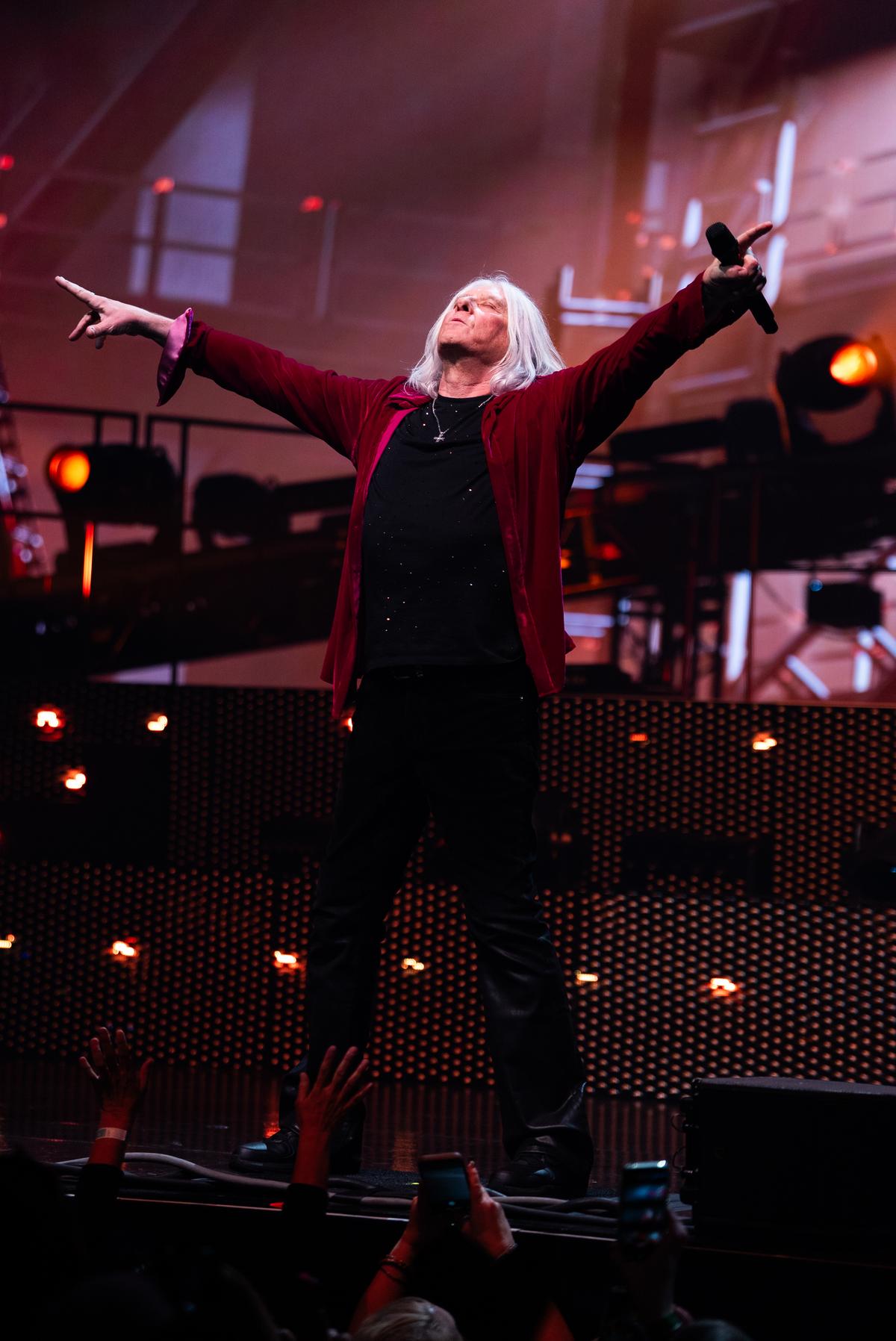
Def Leppard frontman Joe Elliot performs live in concert
| Photo Credit:
Special Arrangement
“When you’re 16 or 17, the world is your oyster. You’ve got absolutely no limitations. Your imagination is the only thing that will limit you,” Joe describes the mindset that carried the band through those early years. He points to David Bowie’s ’Suffragette City’ as the first song they managed to play all the way through and the pivotal moment where their rehearsals were finally imbued with a sense of purpose. “Within a month we were writing our own material. ‘Ride Into the Sun’ was the first or second song we ever wrote,” he says, noting how quickly they moved from imitation to authorship, with those early tracks later appearing on their 1979 EP, which began circulating in the UK rock press and helped position them within the New Wave of British Heavy Metal alongside bands like Iron Maiden and Saxon, even as their melodic instincts set them apart.

Joe frames the scale of what followed. “Did we ever genuinely think we could be the biggest band in the world? I think that answer probably comes 10 years later,” he says, pointing to their seminal album Hysteria in 1987, which took over three years to complete and went on to sell more than 25 million copies worldwide, producing seven hit singles and remaining on the US charts for over two years. “By the summer of ’88 into the summer of ’89, it’s arguable who was bigger between us and U2,” he says.
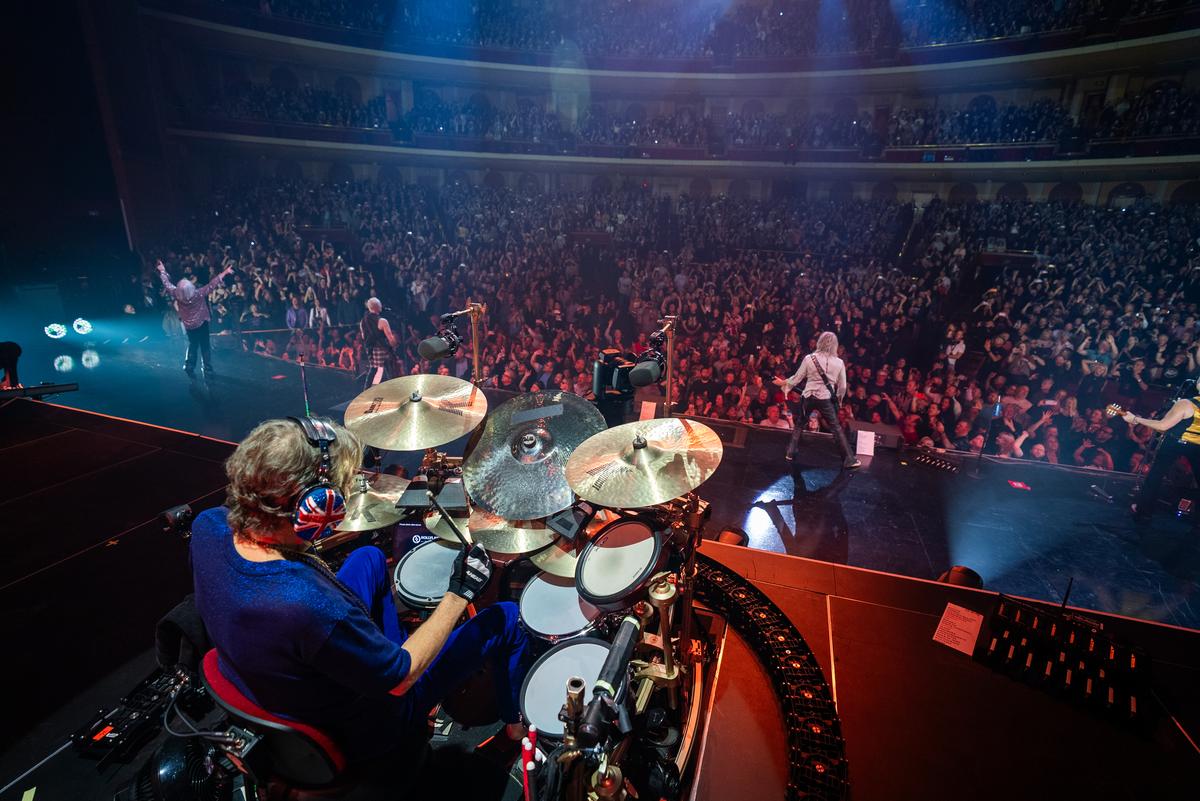
Def Leppard performs live in concert
| Photo Credit:
Special Arrangement
The making of Hysteria remains central to how the band understood itself, largely because of how many times it nearly came apart. “We weren’t prepared to release Pyromania 2; we wanted it to be different, equally as good, if not better,” Joe says, describing a process that involved abandoning early sessions with Jim Steinman and then restarting momentum when Mutt Lange returned after taking a break from production. The delays were compounded in 1984 when drummer Rick Allen lost his left arm in a car accident, forcing the band to pause recording and later rebuild their approach using electronic drum kits that Allen learned to play with a combination of pedals and acoustic triggers that directly shaped the album’s rhythmic precision. “The reason it took so long is because we wanted it to be right,” Joe says, reducing the multi-year process and one of the most expensive recording budgets in rock history into a single decision that the band refused to compromise on.
Within that extended timeline, the band’s most iconic track ‘Pour Some Sugar On Me’ occupies a distinct position, since its almost accidental emergence disrupted the album’s carefully managed progression. “I just started playing the chorus, when Mutt walked back in from a coffee break and said, ‘what’s that?’. I sang it, and he went, ‘hang on a minute’,” he says, describing how Robert shifted the session toward capturing the idea, building a rough version with programmed drums and layered guitars before presenting it to the rest of the band. “He said, ‘this is the best hook I’ve heard for years, trust me’,” Joe adds. “We said, we’ve got some good news and some bad news”, remembering the band’s initial resistance to adding another song after years of recording fatigue, which shifted immediately once they heard the demo. The track was completed in roughly 10 days, a fraction of the time spent on the rest of the album, and went on to become one of their biggest hits, pushing Hysteria back up the charts nearly a year after its release.
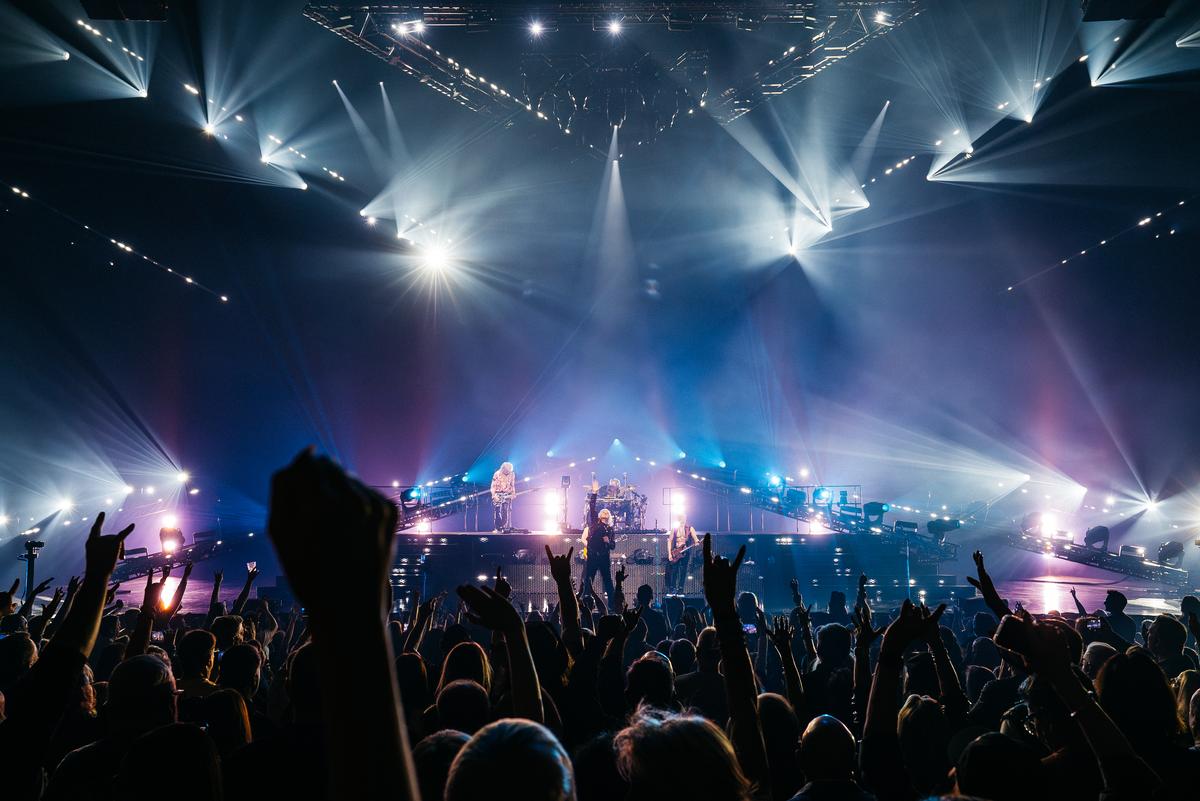
Def Leppard performs live in concert
| Photo Credit:
Special Arrangement
Def Leppard’s relationship with India exists in fragments that are only now being connected through a full tour. “We came over in 1998 when we did the Indian MTV Awards where we spoke to Sting side-stage before doing a couple of songs, but that’s literally our only experience,” Joe says. The cancelled 2008 shows remain unexplained from his perspective. “I don’t remember why they were cancelled, it’s so long ago now. But it’s nice finally to be able to come down there and do some actual gigs; we did get a flavour that there are fans here and it’s never too late”.
His explanation for the recent surge of legacy rock bands in India — Guns N’ Roses, Linkin Park, Green Day and the upcoming Scorpions tour among them — is practical. “Bands only go where they’re invited,” he says, reducing the country’s scale into something workable. “You only need 1% of the population, and you’re talking about millions of people. If there are Def Leppard fans in India that have been dying to see us for 30-40 years, then we owe it to ourselves and to our audience to actually be there,” he adds.

India also seems to exist beyond the stage in a smaller ritual the band has carried with them for years. “It’s the one meal at the end of a tour, it will always be Indian, 100%,” he says about their post-gig supper of choice, placing it as a constant across decades of touring regardless of location. His own preference, however, stays measured. “Sav and Phil will ask for a dish that’s as hot as the face of the sun. I’m a huge fan of chicken korma, but I don’t like it too hot,” he chuckles.
Def Leppard is touring India for a three-city headline tour, featuring concerts in Shillong (March 25), Mumbai (March 27), and Bengaluru (March 29). Produced and promoted by BookMyShow Live, this first full-scale Indian tour features opening acts like Indus Creed and Thermal And A Quarter. Tickets are available on BookMyShow.
Published – March 19, 2026 04:29 pm IST

