




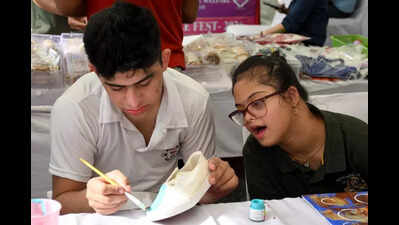
New Delhi: Beena slows and taps Shivraj’s arm, pointing to a small stall. In their 70s, they blend into the evening crowd at India Gate, but up close, their silence speaks. He smiles and pulls out a creased photograph. This is where they first met, at an NGO stall, both unable to hear, brought together through a matrimonial service. They pause, their eyes meet. Her hand slips into his, as his fingers close around hers. Nothing is said.The couple has raised three children. One of them, a CODA (child of deaf adults), reflects on those early years. “I still don’t know how they managed everything when we were young,” Shubham, 33, says. “But they did. And they did it well. I’m proud to be their child. They are true fighters.”A few steps away, on the lawns, children from Asha Kiran spin in loose circles. Some miss a step, some clap out of rhythm, but none of them stops. One child pulls another into the circle, and the group breaks into laughter that carries across the grass.Across India Gate, purple banners sway lightly. From a distance, it looks like any other festival. Up close, it feels different. People linger longer at each stall. Conversations stretch. Small moments hold attention.At the first ‘Purple Fest’ hosted by Delhi govt’s social welfare department on Tuesday, the lawns are lined with 40 to 50 stalls. Some display assistive devices while others showcase artwork, crafts and small businesses run by persons with disabilities.At one stall, 15-year-old Aishwarya, a resident of Noida who hails from Odisha, stands beside rows of bright paintings. Visitors stop, look closely, and pick their favourites. By evening, more than 500 of her paintings have been sold.Her mother, Sunanda, watches from the side, her eyes following every interaction. She recalls how doctors once said Aishwarya might struggle to walk. “By one and a half years, she was taking her first steps. Schools turned her away, so I began teaching her at home. Each rejection turned into practice, each practice into progress.”Today, Aishwarya paints confidently and is preparing for a role in a Bollywood project. When asked about it, she smiles shyly. “I love colours,” she says.Next to her, 17-year-old Arav Mahajan from Paschim Vihar arranges a row of hand-painted shoes. One pair stands out in pink and lavender, dotted with small stars. He picks it up and shows it to a visitor, explaining how it became his best-selling design. A national-level ice skating champion, he is known for his performances on ice. Here, he stands behind a table, speaking about brushes, colours and patterns.In another corner, a small crowd gathers around a game stall. A ball strikes a stack of glasses, and they fall with a sharp clatter. Thirteen-year-old Aarav, seated in a wheelchair, laughs as he prepares for another turn. His parents stand close.His father Rakesh keeps an eye on the game while his mother Babli adjusts his position slightly. They have come from Hauz Khas. Money is limited, she says, and they depend on support from family. But they move through the festival with quiet focus, stopping at stalls, asking about schools, therapies and scholarships. Every few minutes, they turn back to Aarav and ask what he wants to try next.Apart from performances, the festival offers an opportunity to showcase innovation too. A small crowd gathers around a demonstration of PathPal, an assistive device designed to help visually impaired users move independently.At another end, the Purple Café stays busy. Orders are called out, trays move quickly, and chefs with disabilities handle the rush with ease. Behind the counter, Pushpa sets down a tray of muffins. She laughs often, but if someone speaks too softly, she cuts in with a smile. “I can’t hear you.”Her certificate lists her as 67% disabled. In school, she struggled to hear the teacher and see the board. “I was always guessing,” she says. She still completed Class XII and made it to Delhi University. Then came online classes. Without someone beside her to repeat lessons, she fell behind. Job rejections followed.But baking gave her a way forward. Now, at the National Association for the Blind café, she spends her days making muffins and cookies. “Whatever vision and hearing I have, I use all of it,” she says.As evening sets in, lights brighten across the lawns. Performances continue, while smaller groups gather around games, workshops and art displays. From Purple Fun Zones hosting interactive games to the Purple Kaleidoscope art gallery featuring accessible artwork, every corner echoes one truth — abilities outshine disabilities.