





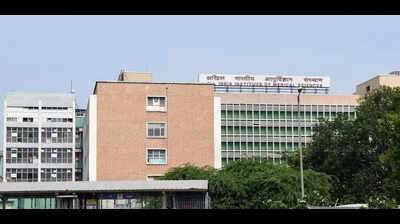
New Delhi: Nearly 60 lakh people in the city are living with uncorrected vision problems, either for distance vision or near vision, many without access to simple spectacles that could restore their sight, according to an analysis by doctors at AIIMS that flags major gaps in eye care services in Delhi.The report, prepared by Dr Rajendra Prasad Centre for Ophthalmic Sciences at AIIMS and submitted to World Health Organization using the refractive error situation analysis tool (RESAT), estimates that 29.5% of Delhi’s population suffers from refractive errors or presbyopia — conditions that can usually be corrected with a pair of glasses.Dr Praveen Vashist, professor and head of community ophthalmology at AIIMS, said the burden was particularly high among older adults. Nearly 70% of the people aged above 50 years need vision correction, while among schoolchildren, refractive error is the leading cause of defective vision, affecting about 13.1%.Despite the scale of the problem, the access to correction remains incomplete. The study found that only about 59.8% of people needing distance vision correction and 47.1% needing near vision correction are covered. Women, the report notes, have lower access to spectacles than men.The situation analysis also highlights gaps in Delhi’s eye care infrastructure. The city has 249 eye care institutions, but more than three-quarters are privately run, leaving public health facilities with limited capacity to deliver services.While 1,085 ophthalmologists and 489 optometrists or ophthalmic technicians are serving the population, experts say there is still a shortage of trained mid-level eye care personnel needed to expand services.The gap is most visible at the primary care level. Only 50 vision centres are functioning across the city, though services are required in 269 primary health centres and Ayushman Arogya Mandirs, indicating a major shortfall in community-level eye care.School screening programmes also remain limited, with only about 25% of children receiving free spectacles through public health initiatives.The report identifies several barriers to care, including uneven service coverage, a shortage of trained eye care workers, the affordability of spectacles, and limited outreach to vulnerable groups such as elderly patients, rural women and economically weaker populations.However, a pilot project in east Delhi’s Trilokpuri shows how the gap can be bridged. Under a mass presbyopia programme, trained ASHA workers conducted door-to-door screening and distributed ready-made reading glasses in the community.The initiative covered 2,085 households and screened 7,001 residents, achieving over 81% coverage. Among adults aged above 40 years, 25.8% were found to have presbyopia, while 4.6% had distance vision problems requiring referral for treatment.AIIMS doctors say the results demonstrate that community health workers can help detect vision problems early and deliver basic eye care at the doorstep, reducing avoidable vision impairment.Doctors involved in the study say expanding vision centres in primary health facilities, strengthening workforce training and increasing school screening programmes will be key to ensuring that millions who need spectacles receive them in time.