




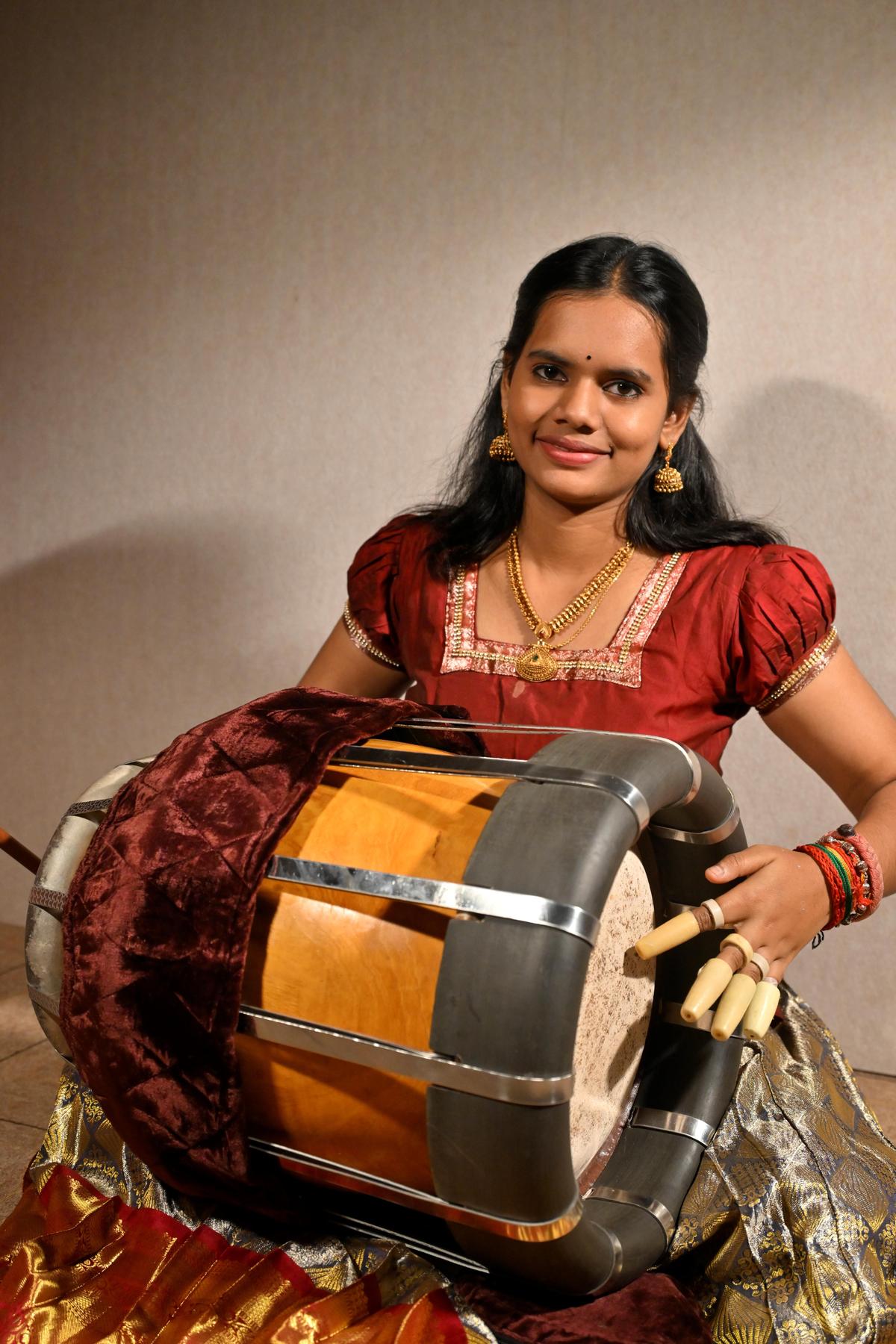
From playing the thavil in the temples of Mannargudi near Thanjavur as a schoolgirl to joining A.R. Rahman’s ‘Wonderment Tour’ concert in Chennai recently, Amirthavarshini Manishankar’s musical journey seems like a fairy tale. But in reality, it is also a story of conviction and perseverance — of a young girl carving a space for herself as a thavil artiste in the male‑dominated world of Carnatic percussion.
“I was both excited and emotional when Rahman sir asked me to play a tani avarthanam at the ‘Wonderment Tour’ concert. Performing solo in front of a huge audience was a dream come true,” says Amrithavarshini. The 18‑year‑old recalls how she got the opportunity, “It felt surreal when Rahman sir began following me on Instagram last October. A little later, his manager called to say that I needed to be in Chennai for two days in February to be part of the concert.”
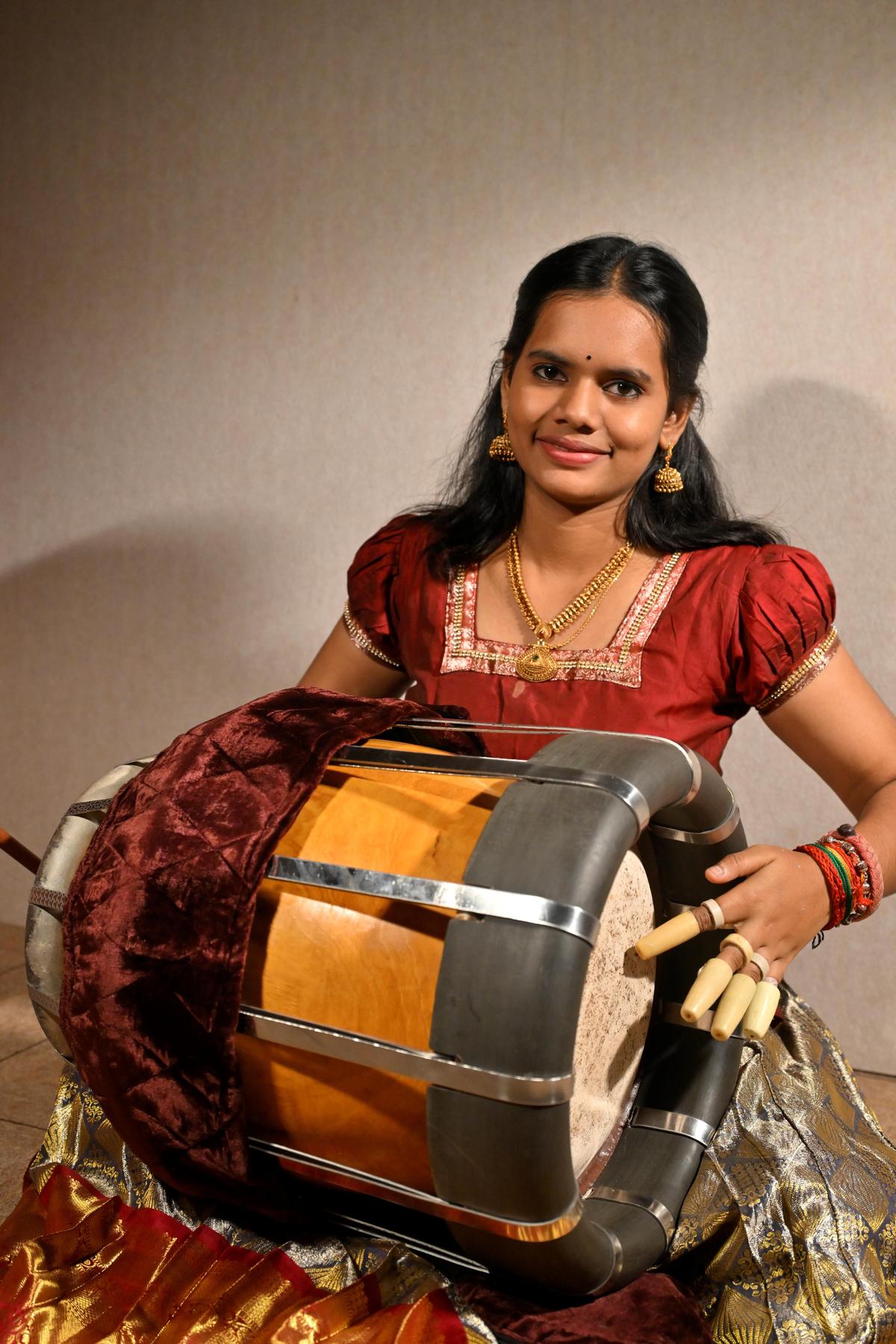
Amrithavarshini Manishankar.
| Photo Credit:
J. Johan Sathyadas
Hailing from a family of six generations of musicians, Amirthavarshini grew up listening to her father, a nagaswaram artiste, A.P. Manishankar, and violinist-mother G. Jayanthi Shankar, who often performed during rituals and festivals in temples. A decade ago, when she was just eight, Amrithavarshini defied convention by choosing to learn the thavil — an instrument rarely pursued by women. “I once asked my parents why there were no women thavil artistes. They said the instrument is heavy and the posture required to play it is difficult. After hearing that, I became even more determined to take it up,” she says.
Though many were sceptical about her decision, her elder brother, Manoj Kumar — who passed away a few years ago — stood firmly by her side. “I always pray to him before every concert,” she says.
Amirthavarshini was the first female student of Adhichaburam A.B. Ramadhass. She later came under the tutelage of Kovilur K.G. Kalyana Sundharam. She now continues her advanced training, particularly to hone her manodharma skills, under veteran thavil artiste Thanjavur T.R. Govindharajan.
On her guru’s advice, Amrithavarshini began playing the thavil by resting the Instrument on her lap instead of placing it on the floor. “This is not easy given its weight of nearly 60 kg. Playing it for long hours requires immense stamina and often results in pain in the shoulder and legs. At times, my fingers have bled, taking up to 10 days to heal. Before a concert, I wrap a tape around my fingers and apply glue to secure the cap that produces the sound. Thankfully, modern audio systems have made performing a little easier now, as the amplified sound output has reduced physical strain,” she explains.
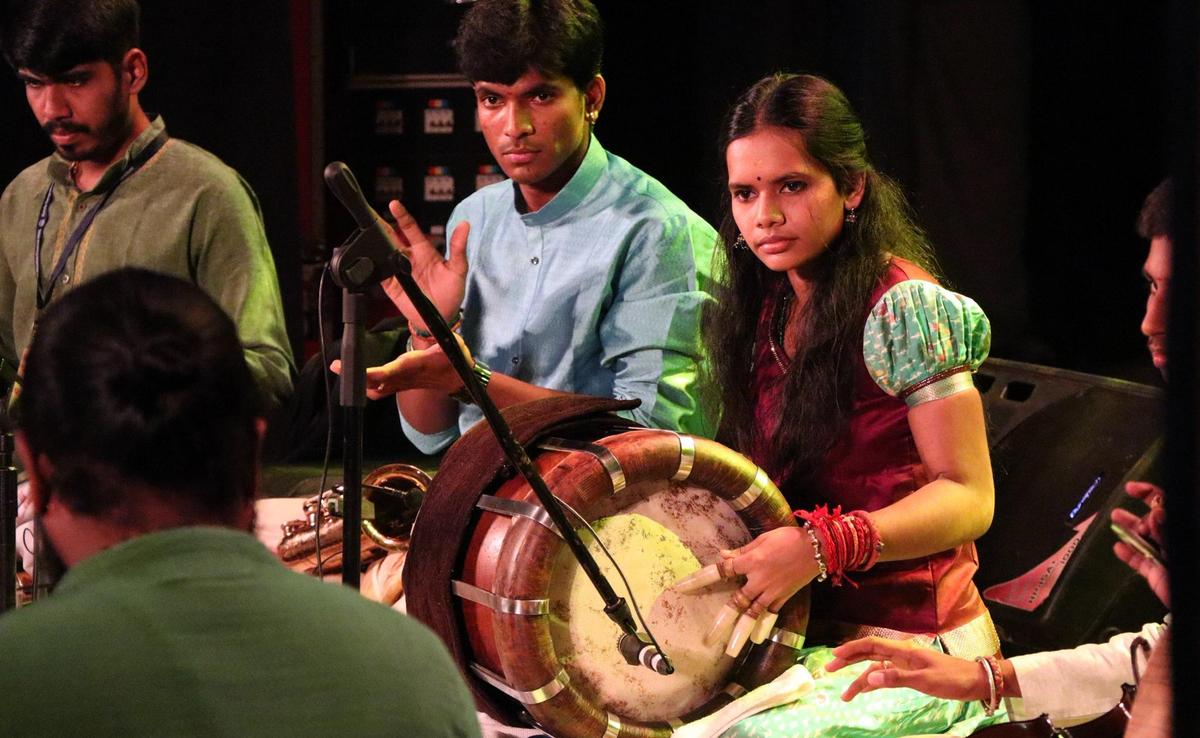
Amrithavarshini performing at National Percussion Festival in Kerala in 2025.
| Photo Credit:
K.K. Najeeb
Amrithavarshini’s maiden public performance at the age of 11 was at the Arulmigu Muthumairamman Temple in Haridhwarmangalam. “The temple trustee S.N.S. Narayanaswamy, had come home to invite my parents to the annual panguni festival. Watching me practice, he asked if I would perform with them. I agreed and played a simple avartanam.”
Amirthavarshini has accompanied leading artistes across genres, including violinist A. Kanyakumari, flautist Sikkil Mala Chandrasekar, drums Sivamani and singer Daler Mehndi.
“I secured the third position in the Kala Utsav competition (instrumental category), conducted by Ministry of Education in 2020. It felt wonderful to see my image on their banner when I participated again in 2022.”
Amirthavarshini is gearing up for her next musical outing — this time, as part of an all-women percussion ensemble called ‘Women Who Drum’, which will perform at The Mahindra Percussion Festival this weekend in Bengaluru. “I am excited to share the stage with established artistes at the festival,” she says.
In her effort to get more women to play the thavil, Amrithavarshini has begun guiding young girls interested in playing the instrument. “Currently, I am focusing on workshops rather than conducting regular classes, as I am pursuing degrees in law and music. I am also compiling a reference book on korvais exclusively for thavil learners,” says Amrithavarshini.
In July 2025, she launched Yuva Thaal Tharang (YTT), an ensemble that features thavil, violin, mridangam, kanjira, ghatam and saxophone. Featuring both all-women and mixed groups, YTT has presented more than 50 concerts across India, making its debut at the Kerala Sangeetha Nataka Akademi. “The aim was to make thavil as a lead rhythm instrument. The response has been quite encouraging,” she says.
Her message to aspiring women percussionists is clear and heartfelt: “Discipline, dedication, consistency and passion are essential. But above all, you must be strong‑willed. The thavil should not be viewed merely as an instrument — it is a sacred responsibility, a commitment to carrying forward our tradition.”
Published – March 04, 2026 05:12 pm IST