




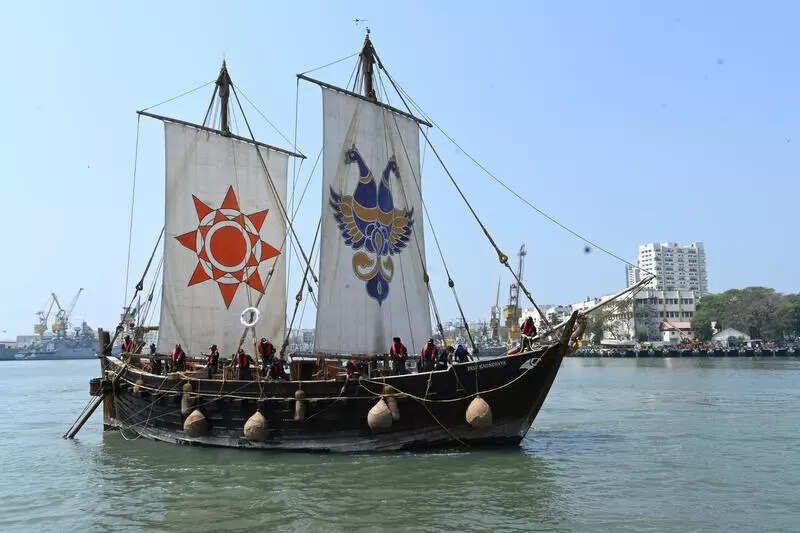
Mumbai: The 39-day voyage of the Indian Navy’s reconstructed sailing vessel INSV Kaundinya, which was flagged into Mumbai Harbour on Monday, proved to be as much a battle against nature as a test of human endurance.Sailing out of Porbandar in Gujarat on Dec 29, 2025, the wooden, square-rigged vessel, inspired by a 5th-century ship depiction in the Ajanta Caves, faced immediate resistance from the Arabian Sea. What followed over the next 39 days — 17 days to Muscat and 22 days back to Mumbai after a halt in Oman — was not a symbolic voyage but a demanding test of endurance, seamanship and mental strength.Commander Hemant Kumar, naval architect and expedition leader, and Commander Vikas Sheron, who oversaw operational training, described it as a journey that constantly pushed both men and material to their limits. The Porbandar-to-Muscat leg was expected to take around 15 to 18 days. Within hours, the sea disrupted those expectations. “On the very first day, the wind started pushing us back, testing our determination and training on the very first day,” Commander Kumar said.With square sails that can be angled only up to about 50 degrees, the vessel’s ability to sail into headwinds is limited. Instead of heading westward, the ship drifted north for three to four days, nearing Sir Creek along the India-Pakistan maritime boundary. “Another day and we might have been into the boundary. But fortunately, by New Year’s Eve, we got the desired wind and we came back to the point from where we had started,” said Kumar. “Imagine the mental state. After days at sea, you are almost at zero point. But that is where training helps. You have to anticipate setbacks.”Commander Sheron said morale held steady. “It was the maiden voyage. The josh was high,” he said. Once favourable northeasterly winds arrived, Kaundinya began making steady progress. But stronger winds brought heavy rolling. “It would roll up to 50 degrees at times. Sometimes it was 24 to 48 hours of continuous rolling, like we see in the movies. The sea was testing our naval skills and endurance, showing its mighty avatar,” he said. Without the deep stabilising keel seen in modern yachts, the vessel swayed dramatically from side to side. Cooking became nearly impossible and fresh supplies started spoiling. “You can’t even stand properly, forget cooking. We survived on ready-to-eat meals, dal, rice and protein supplements. Preventing dehydration was critical.”Some crew members experienced seasickness, but watch duties continued uninterrupted. “Work does not stop. Each member had a role to play,” Commander Kumar said. Commander Sheron highlighted the physical vigilance required. “At least five to six people were always on deck maintaining lookout. There is no engine sound, only wind and waves. You have to stay alert.”Heavy rain around the tenth day added to the discomfort. There was limited covered space and only raincoats were primary defence. If strong winds tested stamina, the absence of wind tested patience. “There were two to three days of complete zero wind. When there is no wind, you don’t sail. You just stall.”Commander Kumar described the experience as navigating through “glassy seas”. “The water is like a mirror. For nearly 72 hours, it feels like you are not moving at all,” he said. With no engine to fall back on, waiting was the only option. The crew carried out maintenance tasks and stayed mentally engaged. “You have to keep engaging yourself. If you are calm, the sea is calm. But you cannot afford complacency,” said Kumar. After 17 demanding days, Kaundinya reached Muscat within the projected timeframe despite early setbacks. The crew remained in Oman for 26 days for maintenance before beginning the return journey on Feb 8. “We received good southwest winds on the way back,” Commander Sheron said. “The return took about 22 days because the distance towards Mumbai was longer.”Even with favourable winds, square-rig sailing required constant coordination and teamwork. “Everything depends on teamwork. Sails have to be trimmed manually for efficiency,” he said.Commander Sheron said the vessel was inducted into the Navy on May 14 last year at Karwar naval base. The southwest monsoon, however, restricted sailing activity for nearly three months. “We had to preserve and protect the boat during heavy rains. From Sept onwards, we began systematic training,” he said. The crew’s preparation unfolded in stages — harbour familiarisation, day sails, night sails and then multi-day voyages. “You cannot attempt a 10-day sail on day one. Confidence builds step by step,” Commander Sheron said.Unlike modern naval ships equipped with propulsion systems and automated controls, Kaundinya demands physical effort at every stage. “There are no modern systems. Everything is manual — sails up, sails down. There is no air-conditioning, no fan. You are exposed to the environment,” he said. “Square-rig sailing is very different from what most sailors are accustomed to today.”Commander Kumar added that standard operating procedures had to be developed from scratch. “How do you formulate training for a ship you have never sailed before?” he said. “Every day was a learning day.” For the crew, the 39-day passage was more than a maritime crossing. It was a living test of endurance, preparation and faith in a historic mission. “First, you need to believe in the project,” Commander Kumar said. “It starts from there.“