



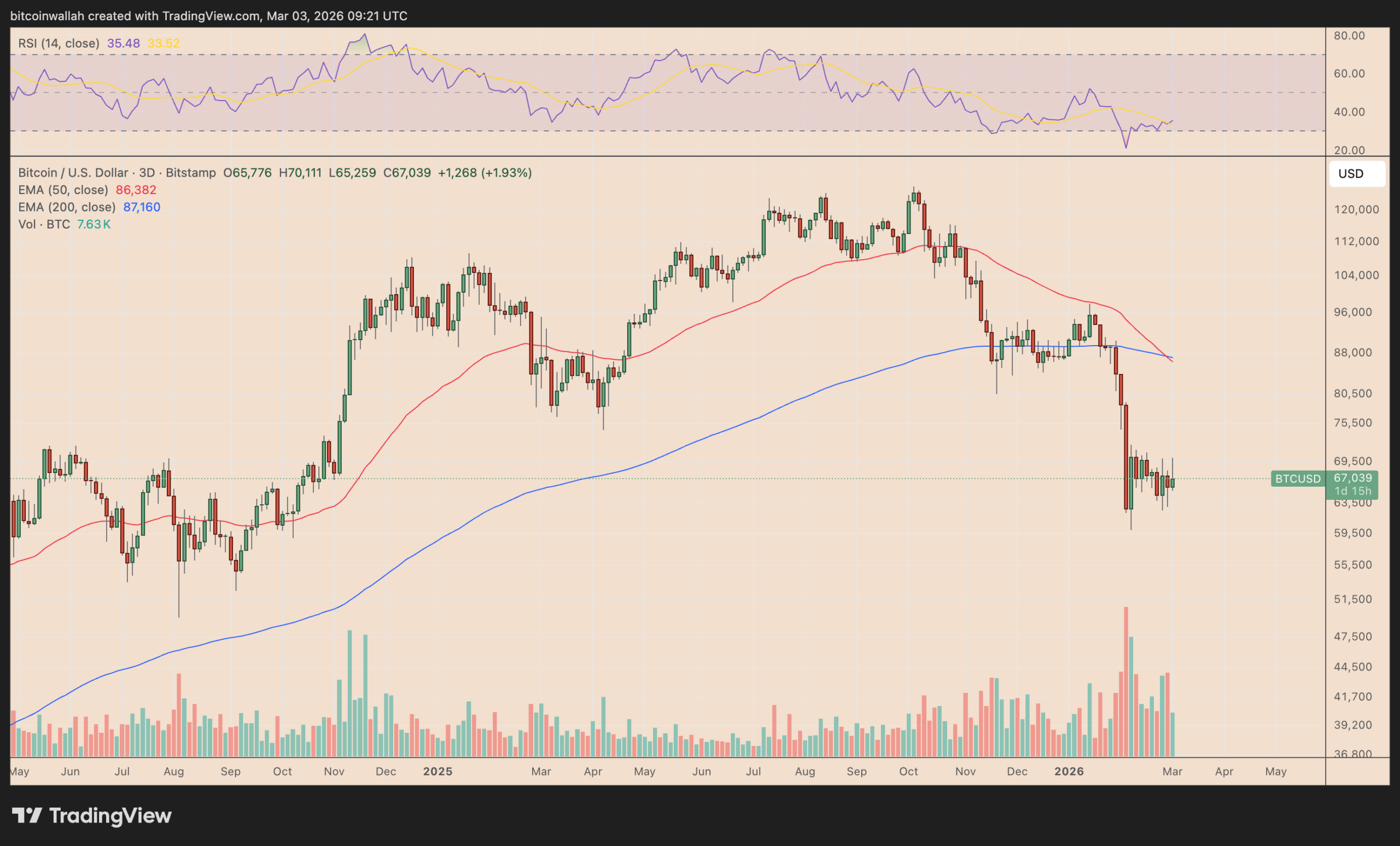
Bitcoin (BTC) is flashing a fresh “death cross” on its three-day chart, marking the bearish signal’s first appearance since June 2022.
Key takeaways:

Past BTC death crosses preceded 35% drops
A death cross pattern appears when the short-term 50-period moving average crosses below the longer-term 200-period moving average, and it has at times presaged further near-term weakness.
In 2022, for example, Bitcoin’s 50–200 MA crossover on the three-day chart came before a steep slide of about 50%, with BTC eventually bottoming near $15,480.

In total, BTC has formed a death cross three times before 2026. The average returns over the following one, three, and 12 months were around –35%, –20%, +30%, respectively.
Bitcoin averaged a drawdown of roughly 80% from its peak in those three cycles. As of March 2026, BTC had already dropped by about 50% since its record high of around $126,270 five months ago.
Related: Bitcoin slide slowing, but bear market still in play: Analysts
It suggests BTC is now entering “the most brutal part of the bear market,” per analyst Mister Crypto.
That view echoes market commentators who see Bitcoin eventually carving a bottom in the $30,000–$45,000 range.
Bitcoin ETFs attract $458.20 million despite Middle East turmoil
US spot Bitcoin ETFs attracted $458.20 million in net inflows on Monday, signaling that dip-buying has returned after weeks of outflows.

The inflows came as Bitcoin volatility spiked following a sharp escalation in the Middle East.
After US and Israeli strikes on Feb. 28, Iran said it was closing the Strait of Hormuz and warned it would attack ships attempting to pass, raising fresh concerns about energy prices, supply chain stability, and shipping routes.
However, Arthur Hayes, the former BitMEX CEO, argued that this may eventually boost Bitcoin prices.
In a recent essay, Hayes said that prolonged US involvement could eventually push policymakers toward easier money.
He wrote that the longer US President Donald Trump engages in costly “Iranian nation-building,” the higher the chance the Fed “lowers the price and increases the quantity of money.”
This article does not contain investment advice or recommendations. Every investment and trading move involves risk, and readers should conduct their own research when making a decision. While we strive to provide accurate and timely information, Cointelegraph does not guarantee the accuracy, completeness, or reliability of any information in this article. This article may contain forward-looking statements that are subject to risks and uncertainties. Cointelegraph will not be liable for any loss or damage arising from your reliance on this information.