







“Meet me in Montauk” was a necessary lighthouse phrase we once shared. It meant that in a world so urgently self-destructive, there needed to be a ‘Montauk’ in Chennai, a safehouse destination where we could find each other or ourselves, at a specific time on a certain day of the week, should we get separated by whatever forces intervened. My safehouse still exists in Chennai. I simply no longer go there in search of her.
“Meet me in Montauk.” That was what the version of Clementine Kruczynski in Joel Barish’s memories said moments before she dissolved into oblivion. He would wake up with no memory of hers, only to ditch work and run amok to catch a train that goes to Montauk, the same train where a blue-haired stranger called Clementine Kruczynski meets him.
This Saturday, with the world outside disintegrating amid talks of an imminent World War, it seemed possible to take a trip to Montauk once again, to immerse myself in screenwriter Charlie Kaufman’s maelstrom of heartbreak and desire, Eternal Sunshine of the Spotless Mind. The 2004 Michel Gondry directorial saw a crowd of dreamers abandon their realities this weekend at the PVR screens, where it was re-released.
Imagine going to a place you seldom think about. You wish you could meet someone new, and you do. You cannot speak to women eye-to-eye, and yet you stare at the colour of her eyes. You wonder why you fall in love with every woman who shows you the least bit of attention — and you realise you did fall in love with her before. She’s no stranger. She was the one who lit up your life with every shade of the rainbow, and you erased her from your brain. Starring Jim Carrey and Kate Winslet, Eternal Sunshine of the Spotless Mind follows a dysfunctional couple who undergo memory-erasure procedures to erase memories of each other, only to keep finding the other in the cold Montauk, drawn by remnants of the warmth their physiological bodies carry from icy nights spent on a frozen Charles River. The film is set in a time when advancements in interpersonal technology hadn’t taken over relationships, and yet, the film feels timeless on account of how surreal yet accurate the idea of memory feels. Memories become both the portal through which Joel and Clem find each other and the fabric of everything that makes them them.


Kate Winslet (left) and Jim Carrey (right) in Michel Gondry’s “Eternal Sunshine of the Spotless Mind”
| Photo Credit:
Focus Features
The inevitable decay of ‘nice’
All love begins to feel like a bed of roses before thorns start to grow, and Charlie Kaufman paints an aching portrait of how true love is the one that learns to live with both the roses and their thorns. When they meet again on the train, Clem yells at Joel for being hung up on the word ‘nice’: “I don’t need nice. I don’t need myself to be it, and I don’t need anybody else to be it at me,” she says, which we retrospectively understand is psychological inertia from the night she had when Joel was under the knife (Joel goes through the erasure procedure days after he learnt that she erased him). And yet, everything about this stranger she met on the train seems… nice. “God! I have to stop saying that,” she would say later that evening, because meeting your perfect stranger, the person with whom you seem to be able to utterly, fiercely be yourself, seems nice. ‘Tere Sang Pyar Main Nahin Todna’ by Lata Mangeshkar plays in the background, because you never wish to break this love. Nice is easy. Nice doesn’t need work. But nice fades, inevitably, and you find yourself bickering with each other at a flea market about having children.
Also read: You must remember this
Where Kaufman’s magic truly takes shape is in how he chooses not to present this progression linearly. He captures in fascinating detail a bewitching quality of memory, of how it feels as if it exists in a vacuum as a tactile element that accrues meaning only in relation. So Joel’s erasure happens backwards. We see the disintegration from moments of friction — the fallout over a late night out, incongruence over child-rearing, silent dinner dates, loss of magic — to all that were once everything they could ask for, all the ‘niceness’ — warm evenings under a blanket when they could bare their souls and bodies naked, coffee time when their quirks never clashed as discordant, and a thrill-seeking exploration of a stranger’s residence.

Kate Winslet (left) and Jim Carrey (right) star in Michel Gondry’s “Eternal Sunshine of the Spotless Mind,” a Focus Features release.
What one could only articulate over repeated viewing is how, with the withering of the connection, memories also seem to lose texture. Set pieces become more intimate. With the help of cinematographer Ellen Kuras, who documents the film with an affecting hand-held intimacy, Gondry softens and dims the light in the grainy frames as memories are erased.
But in Eternal Sunshine, memories are also buoys in an endless ocean; in the sci-fi angle explored in the film, memories get a latitude and longitude as Dr Howard Mierzwiak, who runs Lacuna Inc, performs the procedure to eliminate memories on ‘a memory map’ that he forms in the brain of the patient. In many ways, this is Kaufman embracing a soothing idea, that maybe memories aren’t mere vapours after all, and that perhaps Joel could have, instead of opting for the procedure, journeyed back to the Montauk that exists in his head to realise that Clementine — with all her flaws — is still who he wishes to be with.
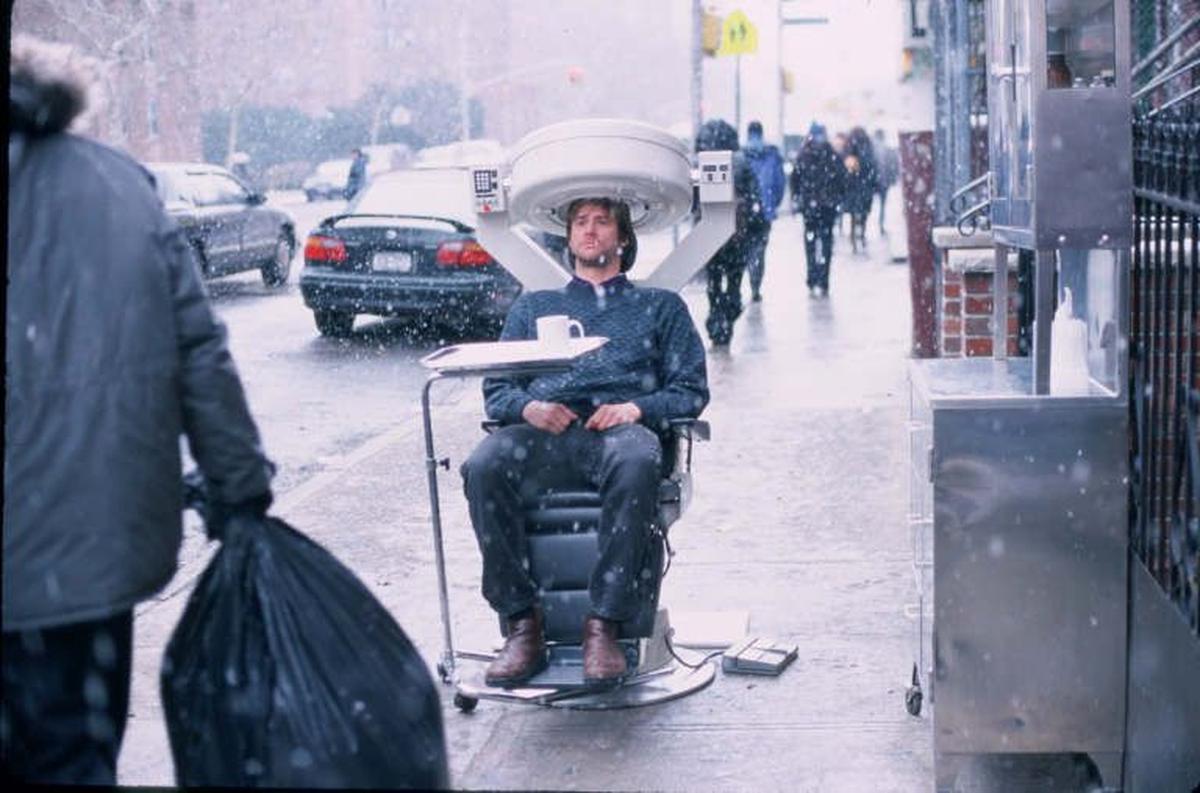
Jim Carrey in Michel Gondry’s “Eternal Sunshine of the Spotless Mind”
| Photo Credit:
Focus Features
The fracturing physical world in the memories
If the non-linearity is one thing, there’s also the astonishing way the writer and the director tie physicality to these memories. They use permeable surfaces to transition from one memory to another, and largely, by setting these memories in solid yet cracked three-dimensional shapes that truly stand out — for everything seems all the more vivid when we revisit them in our memories. The transitions all happen through tangible substances — pages of a journal, a dented car, the colour of Clementine’s hair, or even intimacy. When the Clementine in Joel’s head gives him ideas on how they can escape the erasure, Joel thinks of a rainy day when he was a child, and rain begins to pour inside his house. The memory of playing with a pillow as a child melts into that of playing a similar pillow-suffocation game with Clementine.
The erasure of the said memories then becomes a violence that Joel had inadvertently invited. Cars drop from the sky, houses crumble, and Clementine gets sucked into darkness. And so he fights to keep some version of Clementine — the one in real life, the one in his memories, or the one in his mind who is conscious of the erasure and wishes to stay — as the world around disintegrates.

Kate Winslet in Michel Gondry’s “Eternal Sunshine of the Spotless Mind”
| Photo Credit:
Focus Features
And yet, through it all, when Clementine, with her Green Revolution hair, says, “Meet me in Montauk,” Joel holds onto that fallback destiny with every fibre of his existence, as he finds Clementine all over again in Montauk the following day. “I don’t see anything I don’t like about you,” says Joel once they realise what they had done to each other. “But you will! But you will, and I’ll get bored with you and feel trapped, because that’s what happens with me,” she responds. But that is okay. If love lies in the youthful excitement of the early days, it also exists in the boring, silent dinner dates. If you could have a choice between never falling in love or falling in love knowing it would end in heartbreak, what would you do? Kaufman simply nudges you towards what your heart already screams after.
And if there is strength in love, it is in enduring through all its shapes and forms, and in learning to love again. Which is why, even though I may not find anyone in my Montauk in Chennai, I will learn to build other Montauks. We will always remember to meet in Montauk.
Published – March 02, 2026 04:19 pm IST