






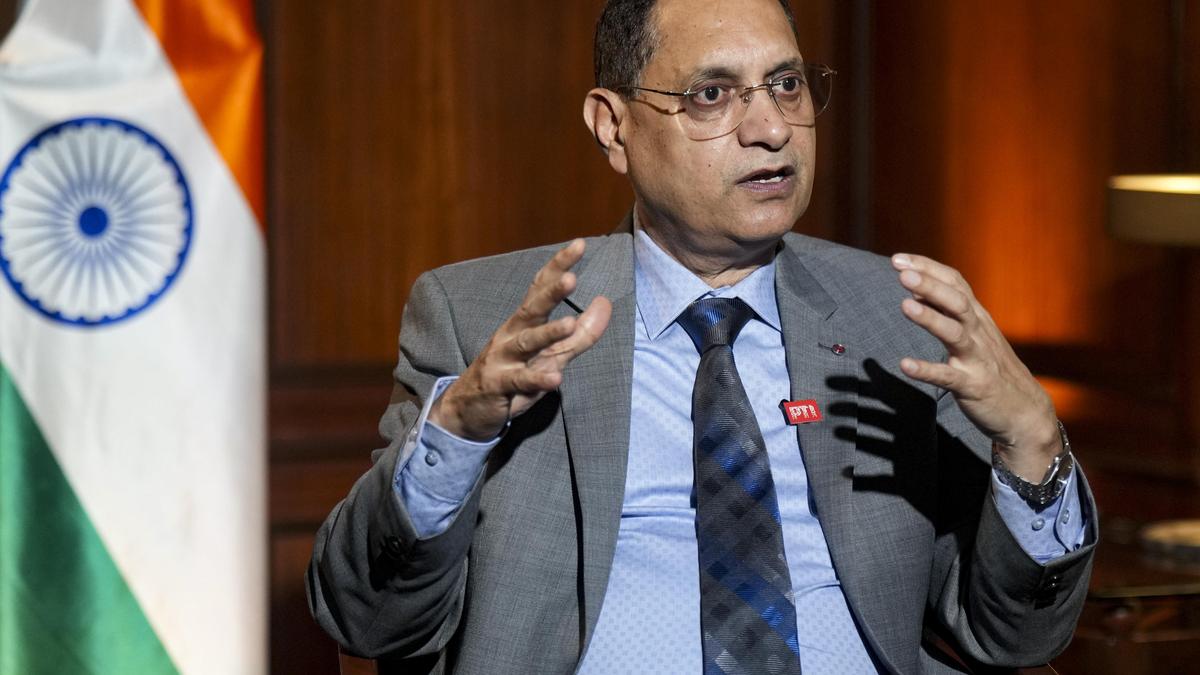
Chairman of the Securities and Exchange Board of India (SEBI) Tuhin Kanta Pandey. File
| Photo Credit: PTI
The Securities and Exchange Board of India (SEBI) is pushing banks and other regulators to tighten enforcement of insider-trading rules, in particular safeguarding unpublished price sensitive information, the regulator’s chief said.
SEBI has taken action in the past year against officials of India’s electricity regulator and executives at Indian lender IndusInd Bank, and sent notices over alleged violations to Bank of America and executives at consulting firms PwC and EY under its insider trading rules.

“The insiders may lie not only in companies, they may also lie in the people who have gotten information in a fiduciary capacity,” SEBI Chair Tuhin Kanta Pandey told Reuters in an interview on Thursday (February 26, 2026). The interview was placed under embargo by the regulator till Monday (March 2, 2026).
“It may also lie with regulators because they are also doing regulation. So we really have to see that everyone is adequately sensitized to this issue,” he said.
Regulatory data shows that SEBI investigated 287 cases of alleged insider trading in the financial year 2024-25, compared to 175 cases in the prior year. Data for the current financial year ending March 31 is not yet available.
Simplifyinf foreign investment rules
Mr. Pandey, who took over as chair of the market regulator a year ago, has focused on easing entry processes for foreign investors. Feedback has been gathered across 77 meetings with foreign portfolio investors over the year, Mr. Pandey said, adding that rules are being changed where needed.

SEBI has reduced the documentation needed for entry of foreign investors and hopes to bring down the time taken to five days eventually, Mr. Pandey said.
The regulator is working with the federal government and the central bank to simplify the differing rules that apply to foreign portolfio investors and longer-term strategic investors.
“The different ways in which foreign money can come in needs to be re-looked at,” Mr. Pandey said, declining to provide further details.

India classifies overseas investment of up to 10% as foreign portfolio investment, while larger holdings fall under foreign direct investment and are subject to sectoral caps and in some cases security checks.
Easing regulations for foreign investors has been seen as important at a time when portfolio and longer-term strategic investments have been weak.
Overseas portfolio investors sold $18 billion in Indian equities in 2025. Longer term foreign direct investment remained low at $4 billion in the April-December 2025 period, although it has risen from $0.6 billion during the same period the previous year, according to central bank data.
Status quo on derivative rules
Mr. Pandey, a former top bureaucrat, has tightened rules across the country’s booming derivative market, where most retail investors are making losses, according to SEBI studies.
On Thursday (February 26, 2026), the chief of India’s largest exchange National Stock Exchange Ashish Kumar Chauhan said that a minimum qualifying criteria for participating in derivatives should be imposed.
Asked about the possibility of such measures, Mr. Pandey said SEBI may not take further steps immediately.
“We want to give a certain space to those policy measures that were taken, because we also cannot have a state of flux. The policy can’t just be evolving by the day,” Mr. Pandey said.
“We will be more data-driven, thoughtful, and consultative before we take further measures on this,” he said.
SEBI has reduced the number of derivative contracts available for trade, raised the minimum trading amount but stayed away from any rules that bar small retail investors from that segment.
Published – March 02, 2026 08:50 am IST