





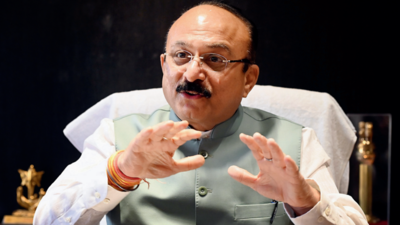
Wide-ranging structural changes in education — from reforms in school regulation to addressing gaps in institutional funding — can be expected in Delhi in the coming months and years, education minister Ashish Sood told TOI in an interview as Delhi govt completes one year in office. Excerpts:Q: There has been criticism that while several announcements have been made, timelines are not being met. CM Shri schools took a long time to start. Is govt announcing projects in haste?
We took office on Feb 20 last year; things cannot change overnight. The intent has always been clear. Admissions for CM Shri schools were done and students have been selected according to the planned process. The objective is to provide technology-enabled and AI-supported education, multilingual learning interventions and building long-term academic capacity.The technology-enabled component took time because Delhi has never undertaken procurement at this scale before. Nearly 7,000 smart classrooms are being prepared. Large-scale purchases of smart boards and computers require formal tendering processes, vendor selection and adherence to procedural timelines. Most classrooms are expected to be ready before the next budget cycle. Q: The school fee regulation law has been under scrutiny. Many argue that the proposed legislation lacks transparency and is anti-parent… A lot of misinformation is being spread. If the law were truly non-transparent or anti-people, why would private schools be opposing it so strongly? The people of Delhi are not approaching courts, it is private school organisations and associations that are challenging it. That indicates that the bill is in the public interest.The situation has arisen largely because earlier govts failed to act despite being in office for 11 years. They could not bring a new fee regulation law. Attempts were made, cabinet proposals were drafted and discussions took place, but nothing was finalised. We completed the process within four to five months. This reflects our intent.Earlier, there were claims of an education revolution, but on the ground there was no legal framework protecting parents on the issue of fees. In many instances, school account audit reports were unavailable for years. Q: Soon after BJP govt took office, a grant of Rs 417 crore was sanctioned for 12 Delhi govt-funded colleges. What is the status?The allocation for these 12 colleges was around Rs 387 crore earlier, which rose to about Rs 405 crore in 2024-25 and further increased to nearly Rs 700 crore in 2025-26. This enhanced funding is aimed at clearing financial backlogs, repairing infrastructure and ensuring timely payment of salaries so that colleges could function in a stable academic environment. There were periods when staff faced serious hardships, and salaries were delayed even during festivals. We want academic communities to focus on teaching and learning rather than administrative or financial crises. Systems have now been streamlined, and colleges have received funds both for repairs and for clearing dues. The idea is simple: when institutions function in a stable environment, students benefit.Q: You recently said that several infrastructure lapses have come to light in govt schools and an audit was initiated. What action are you taking to fix them?Infrastructure conditions in many schools are extremely poor. Some buildings had been declared unsafe years ago, yet students continued studying at alternative locations without any long-term solution. In one case, students had to travel several kilometres because their school building had been declared dangerous in 2022, but no serious corrective action was taken.We have initiated detailed audits, including 3D assessments, covering every classroom, toilet and facility. The reports will capture even minor details such as broken switches, structural damage and safety risks. There are hundreds of schools where construction remains incomplete or where spending patterns appear irregular, with funds released but projects left unfinished. Now additional funds are being sought to complete those works, and it is necessary for us to first examine how earlier allocations were utilised. Accountability cannot be overlooked. There was a school building that had already used Rs 1 crore of sanctioned funds, but officials later claimed that an additional Rs 4 crore was required to complete the project. Q: One promise made at the start of your tenure was that all schools would become certified under the National Initiative for Proficiency in Reading with Understanding and Numeracy (NIPUN) framework. Where does that plan stand?The first step was to understand learning outcomes. A baseline survey was conducted at the beginning of the academic year, and we are now preparing a technology-enabled assessment to identify gaps and challenges more accurately.Our commitment is that by the end of govt’s tenure, all schools in Delhi will become NIPUN-certified institutions where foundational learning outcomes are fully achieved. We should not reach a stage where a Class VII student is unable to read a Class V English text. That is unacceptable. Q: What is your broader vision for education?Technology-enabled education is central to our vision. We plan to introduce AI chatbots to support students through personalised learning processes. Currently, around 2,200 students are selected for specialised preparation support programmes run by govt. We aim to widen this support and use technology-driven interventions so that more students benefit from targeted academic assistance and improve their performance.We are also developing portals for holistic report cards in line with National Education Policy. Alongside academic reforms, work is underway on startup and incubation policies to foster entrepreneurial skills among students, with the objective of enabling Delhi’s youth to become job creators. By 2035, we aim to help nurture around 5,000 startups through education-linked initiatives.