




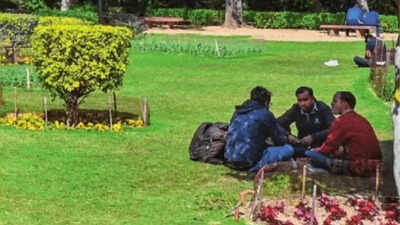
In the mid-1950s, as independent India’s bureaucracy expanded, central govt employees began forming cooperative housing societies in Delhi, planning communities for post-retirement years. Vasant Vihar was one of them.Located near Chanakyapuri, the colony took shape in the 1970s. Suresh moved in as a 20-year-old young man with his father, who was then working in the defence ministry. “There were only singlestorey houses then — some 250 gaj, some 2,000 gaj. Beautiful parks. It was a completely different world,” he recalls. “Even now, when I say I live in Vasant Vihar, people instantly light up.”The colony’s character had been shaped by its residents — many retired or nearing retirement. They forged a slow lifestyle and strong social bond. The neighbourhood functioned like an extended family — festivals were celebrated together, community functions were common and gardening competitions were big events.Over time, this social cohesion changed. As younger generations entered demanding careers, community participation reduced. “We got tied up with work, so we weren’t as socially involved,” says a second-generation resident. For the elderly, the core spirit hasn’t disappeared. “For me, it’s still the same. There’s no place in Delhi like this,” says another local.Because of the colony’s proximity to the diplomatic enclave, many houses belonging to officers posted outside Delhi were rented out — often to embassies and foreign mission staff — giving the area an early cosmopolitan character. The planning was ahead of its time. Plot sizes varied widely, blocks were designed with nearby schools, and water distribution was planned at a city level. Originally, construction rules required roughly 50% open space and 50% built-up area. Over time, the latter expanded significantly, changing the colony’s character.The green cover, one of the colony’s biggest strengths, bloomed through planting drives led by locals, notes Vivek Tandon, whose father was an original allottee. A census counted nearly 15,000 trees, while large parks acted as shared breathing spaces.Vasant Vihar’s civic infrastructure, however, is under growing pressure. Built near the Ridge, the area has limited room for expansion. Rising population density has strained roads and sewage systems have aged. Markets designed for smaller populations now handle far higher footfall. Encroachment and parking pressure have added to the civic strain.Safety remains a relative strength. While residents acknowledge no area can claim to be crime-free, most say the colony remains safer than most other areas. Accessibility is another plus point. Educational institutions draw younger families, helping maintain generational continuity, while institutions like Vasant Vihar Club continue to act as social bridges.