



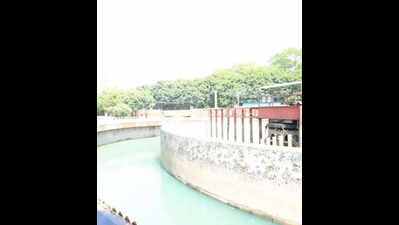
New Delhi: One of Delhi’s most critical water infrastructure projects, Chandrawal water treatment plant under Delhi Water Supply Improvement Project (DWSIP), is finally moving ahead after remaining stalled for over a decade because of policy indecision, tender cancellations and procedural lapses.The renewed momentum is being seen as crucial for addressing the capital’s growing water crisis, reducing transmission losses and ensuring reliable 24×7 supply to some of its most densely populated areas.
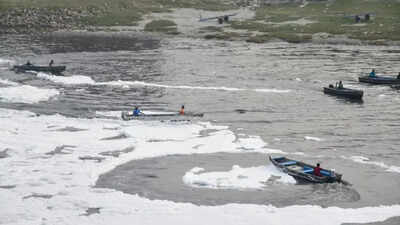
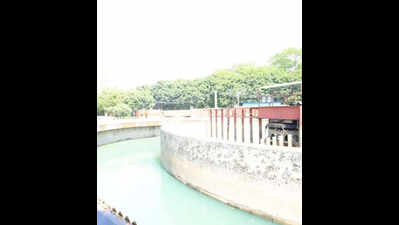
Senior govt officials said the project hit a bump soon after it had been approved. In Sept 2011, Japan International Cooperation Agency conducted a detailed study to improve Delhi’s water supply system and submitted Water Supply Master Plan-2021. Based on this, the Chandrawal command area covering Old Delhi, New Delhi Municipal Council areas, Civil Lines, Karol Bagh, Patel Nagar, Rajinder Nagar, Kamla Nagar, Malkaganj, Naraina and adjoining areas were identified for a comprehensive upgrade under DWSIP. The project was designed to benefit around 22 lakh people, or nearly 11% of Delhi’s population, living across 96 square kilometres.Recognising the urgency of the project, the Centre, in the Union Budget, 2026-27, has provided additional assistance of Rs 380 crore for the plant as an externally aided project.“The project was expeditiously reviewed by govt, and there was a proposal to increase the share of Delhi govt from Rs 313.8 crore to Rs 713.3 crore; Rs 399 crore was accordingly approved by the state council of ministers in Nov 2025. Thereafter, Delhi Jal Board awarded the work of package 3 and 4, related to improvement of the water supply network, in Dec,” one of the officials said.Chief minister Rekha Gupta said that a new state-of-the-art 105 MGD (million gallons per day) water treatment plant is being constructed at Chandrawal at a cost of Rs 599 crore and is scheduled to be commissioned this year. Water minister Parvesh Verma said the new plant will significantly enhance Delhi’s ability to treat raw water with higher ammonia levels, a key challenge that has disrupted supply in recent years. Currently, two plants at Chandrawal supply about 90 MGD of water. With the commissioning of the new plant and redevelopment of existing facilities, the total output from Chandrawal is expected to reach nearly 160 MGD.DWSIP also focuses on fixing the “last-mile” problem. Under the project, water distribution pipelines are being replaced at a cost of Rs 1,331 crore across west, east and central Chandrawal zones. The work covers nine assembly constituencies and aims at reducing leakages, preventing contamination and ensuring uniform pressure. Underground reservoirs will be strengthened, water meters installed and grievance redressal centres set up, with the objective of bringing non-revenue water down from 30-45% to below 15%.Chandrawal’s revival is part of a broader strategy to bridge Delhi’s widening water deficit. With a population exceeding 2.5 crore, the capital requires around 1,250 MGD water, but the current supply from nine treatment plants is limited to 990 to 1,000 MGD. Capacity additions over the past few years have been marginal, even as demand continues to rise. To address this gap, Jal Board planned three new water treatment plants at Iradat Nagar near Narela, Chhatarpur and Najafgarh, which will collectively add 235 MGD. Simultanously, long-term raw water security is being pursued through proposed dams in Himachal and Uttarakhand, including the Giri, Kishau and Lakhwar Vyasi projects. The need for robust treatment and distribution systems was underscored by recent ammonia spikes in the Yamuna, which forced plants like Wazirabad and Chandrawal to operate below capacity, leading to slashing supply to several parts of the city.