




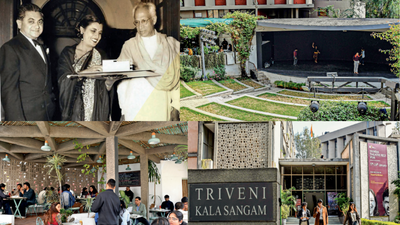
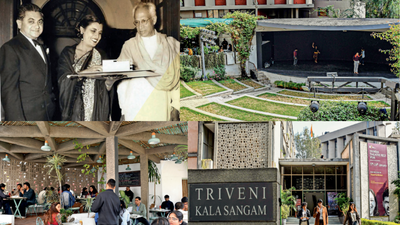
NEW DELHI: On any given afternoon at Triveni Kala Sangam, the air carries more than the smell of coffee. It holds echoes of dance rehearsals, strains of music and artists arguing passionately over form and freedom.Established in 1950 by the late Sundari K Shridharani and later shaped by American architect Joseph Allen Stein, Triveni has been a cultural melting point of the capital for over seven decades. The institution has consistently offered artists a place to learn, perform, exhibit and belong. Shaped by Shridharani’s struggles as a dancer and cultural practitioner, it was envisioned as a home for the arts, one that wears its history lightly yet lives it every day.
Triveni’s story begins far from Delhi, with a young girl growing up in Karachi. Dance came to Shridharani early, encouraged rather than curtailed. When her inclination became clear, her family sent her to Santiniketan, then alive with Rabindranath Tagore’s ideas of art as a way of living. Though she stayed only six months, the seed was sown.Shridharani then moved to Almora to the Uday Shankar India Cultural Centre, whose halls were frequented by figures like Ravi Shankar and Zohra Sehgal. For her, Almora proved transformative. Years later, she remarked, “Had I not gone, Triveni would never have happened.”
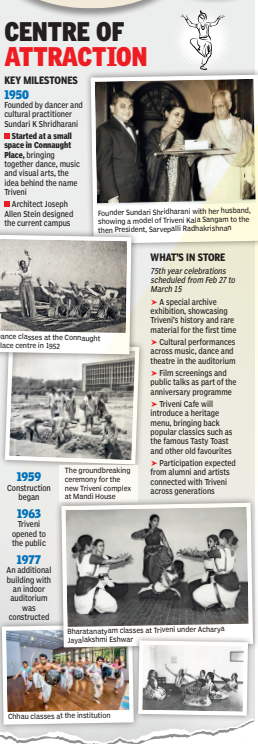
Life, however, brought upheavals. While she was in Europe studying dance, Partition turned her into a refugee overnight. Advised not to return to Pakistan, she landed in Bombay and began earning her living as a dancer. It was a precarious period, but one that sharpened her resolve. In 1950, she married play wright journalist Krishnalal Shridharani and moved to Delhi. That year, she founded Triveni Kala Sangam. The couple lived at Imperial Hotel, where dance classes began in borrowed spaces, driven more by vision than infrastructure.Soon, Triveni found a modest address in Connaught Place, two rooms above a coffee shop. Cramped, chaotic and electric, the space drew teachers of the highest calibre. Dance, music and visual art flowed together, and the name ‘Triveni’, inspired by the sacred confluence of rivers, came naturally. Space remained a constraint as the institution grew. Shridharani wrote several letters to govt, and the then PM Jawaharlal Nehru listened.
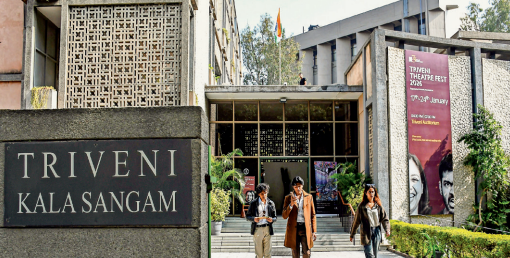
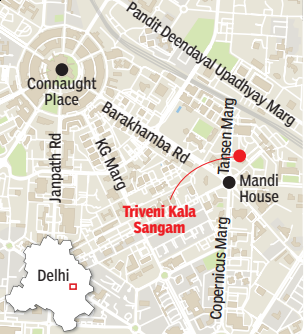
Her son, Amar K Shridharani, now Triveni’s general secretary, recalled the early days: “I used to go to Triveni when it was at CP. I was five then, and my mother would wait at the stairs for me. By the time she started looking for land to expand, I was nine, so the memory is vivid.” Around the same time, Stein arrived in India. When he met Shridharani, he was struck by her clarity and optimism. She wanted dance studios, galleries and an amphitheatre, even though the land promised was barely half an acre and funds were scarce. Stein took on the challenge. Construction began in 1959 on Tansen Marg, built on collective faith as much as brick and mortar.In 1963, Triveni finally opened its doors. The then President Dr S Radhakrishnan inaugurated the campus. Ravi Shankar performed. A young Hema Malini danced, months before she entered cinema. The institution that lived in borrowed rooms now had a home.
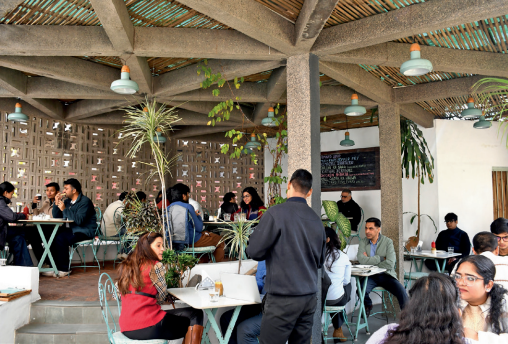
The architecture mirrored its philosophy: open, unintimidating and humane. Evolution, however, was constant. The open-air amphitheatre struggled during monsoons and peak summers, and by 1977, a second building housing an indoor auditorium came up. “I came to Triveni in the late 90s and have been pursuing art for over two decades. There is no hand-holding; you are mentored to develop your own way of expression. Whoever asks me for an institution for guidance in art, I bring them to Triveni. Those who are serious never leave it. It’s unique,” said Nivedita Pande, a practising architect planner.Through the decades, the institution witnessed defining moments in Indian art. In 1968, M F Husain painted live in one of its galleries, spreading massive canvases across the floor as visitors watched. Artist Seema Kohli, who studied here in the 1990s, chose Sridharani Gallery for her first major solo decades later, returning to where it all began.Amar recalls Husain visiting almost daily. “He was a close friend of my mother’s. Once she told him, ‘You paint for everyone except me’. That’s when he painted one for her with three horses: one dancing, one painting and one playing the sitar, representing what Triveni means.” A replica of the painting hangs in one of the corridors. On the original, Husain wrote, ‘To Sundari, from Husain.’ Over the years, Triveni became both a stage and a school for some of India’s most influential artists. Its galleries exhibited modern masters like Husain, Rameshwar Broota, Tyeb Mehta, Vivan Sundaram and Mrinalini Mukherjee. Its classrooms shaped artists like Mona Rai, Seema Kohli, Vasundhara Tewari Broota and Hemi Bawa. Its performance spaces hosted dancers like Yamini Krishnamurthy, Indrani Rahman and Singhajit Singh while students such as Hema Malini and Sharon Lowen trained within its walls. In music, it featured legends like Pandit Ravi Shankar and Pandit Hariprasad Chaurasia, even as newer generations, including photographer Gauri Gill, found formative grounding here.Regina and Arun involved their daughters with Triveni from an early age. “They were fortunate to attend dance, theatre and sculpture classes here for several years. It offered them an ideal space for creative self-expression. Being part of its environment allowed them to absorb the nuances of Indian and global art, culture and music during their formative years. We hope they carry these learnings into adulthood and develop their own interpretations,” Regina said.Then there is the canteen, an institution in itself. Long before cafés became cultural hangouts, Triveni’s canteen fed artists generously. Shammi kebabs, aloo parathas, cutlets, endless cups of chai and coffee, and a sandwich known as the ‘tasty toast’ sustained people and their ideas. Today, it has evolved into a café that draws crowds well beyond the art world.At 75, Triveni remains rare in its openness. Seven galleries function simultaneously, some commercial, some not. Anyone can rent a space, stage a solo show, or perform. Few institutions have protected artistic freedom so quietly, for so long.“The institution will host a celebration from Feb 27 to March 15 that reflects its legacy as a cultural crucible of Delhi,” said Rachit Jain, project director, Triveni@75. “There will be a curated exhibition drawn from Triveni’s archives, showcasing rare photographs, documents and memorabilia tracing its journey. Music, dance and theatre performances will be staged in the auditorium, alongside film screenings and public talks. The canteen will introduce a special heritage menu, reviving much-loved dishes from earlier decades,” he added.