


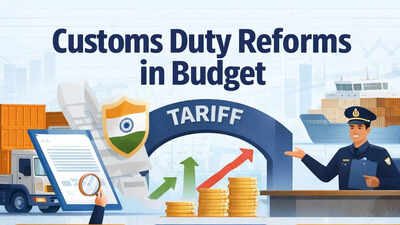
What can be done for customs reforms. (AI generated image)
By Krishan AroraIndia customs has seen several reforms over the years – from tariff rationalization to digitization to simplified procedures & schemes to support domestic Industry. While high tariff rates and duty rate rationalization remains a key industry demand, there is a need for a structured next phase focusing towards simplifying regulatory provisions, procedural laws, and leveraging technology for ease of doing business. In this context, the upcoming budget is expected to place significant emphasis on reforms aimed at ease of compliance, accelerating system modernization and procedural simplification.The next phase of customs reform is likely to be driven by faster processes and time-bound resolutions, as delays, uncertainties and administrative cost often outweigh duty impact. SVB investigations and provisional assessments have been a persistent issue which results in prolonged uncertainty for businesses. Despite introducing time bound resolutions, a structured framework is required to make this effective. This is discussed below.SVB investigations – Need for time bound closuresSpecial Valuation Branch (SVB) investigations mechanism currently does not have a prescribed time limit for completion, resulting in prolonged uncertainty for businesses. In numerous cases, investigation has been pending for several years, going beyond a decade in some cases. This adds to compliance burden and hardship for businesses – in terms of continued monitoring of process, submission of data time & again and uncertainty of potential incremental duty burden which can no longer be passed on to customers. Additionally, it also adds to the cost of compliance.It is expected that the government will introduce appropriate provisions in the budget for time bound closure for SVB investigations. The expected move will provide certainty and reduce risk of custom duty becoming a non-transferable cost to businesses.Recently there have also been discussions around revamping the SVB process and introducing a post clearance audit to validate related party customs valuations. It is expected that issues with the current system do not linger on in the new set of procedures, as and when introduced. Provisional assessments – Need for structural changesBudget 2025 took a positive step to introduce a two-year period for finalization of provisional assessments. While this provision is in the right spirit, a framework for tangible action points on behalf of both importers as well as customs officers may be brought in to make this two-year period work in practice. The statute should also provide for a time bound agreement in form of a provisional assessment order culling out responsibilities of importer and customs officer to facilitate finalization of provisional assessment. For instance, in case of classification disputes leading to provisional assessment, importers may be directed to obtain an advance ruling within a specific period for assessment closure. Similarly, in case of valuation issues, customs officers should be entrusted with time bound closures. The period of limitation for issuing notices for assessments is counted from the date of finalized assessment instead of date of filing of bill of entry. As provisional assessments are often pending for years, the actual period covered in potential litigation goes well beyond the statutory limitation of five years. This causes multifold issues for industry including risk of several years going into litigation, requirement of maintenance of records for such number of years as covered in provisional assessments and recurring provision in books of accounts for potential duty liability. To ensure certainty and ease of doing business, the period of limitation should be counted from the date of filing of the bill of entry. This will provide confidence to industry, reduce retrospective duty & interest demands and free up administrative time locked in dispute resolution.Digitalization as the Cornerstone of Compliance ReformWhile digital systems are used there is still a need to deeply integrate the systems and eliminate manual intervention to reduce operational delays which affect efficiency of businesses.Digital transformation remains central to the customs reform agenda. While the Government has been successful in digitalizing the systems, different platforms with limited interaction have caused significant procedural issues and duplication of efforts for businesses. The Budget is expected to reinforce one unified customs system to further smoothen the process of paperless data submission, further easing clearance process and reduced dwell time. Conclusion – Shifting the Narrative from Rates to ReliabilityIndia’s customs reform journey is entering a phase where regulatory stability, procedural simplicity, digital reliability, will be more important than marginal tariff adjustments. A customs framework that is more predictable, transparent, and technology‑enabled will support in improving India’s trade facilitation standards and in supporting the broader objectives of economic growth and global integration.(Krishan Arora is Partner & Leader, Indirect Tax, India Investment Advisory – Grant Thornton Bharat. With inputs from Ravi Jain, Director, India Investment Advisory – Grant Thornton Bharat)