





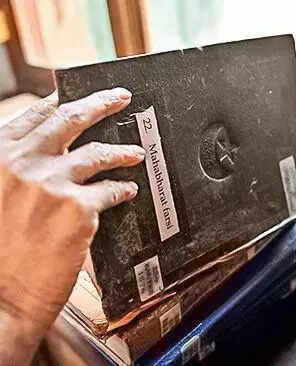
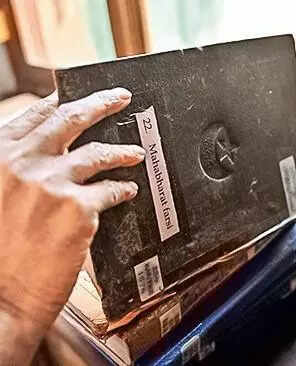
The group of workers who smudged the glass cases of the almirahs clean or hanged the massive chandeliers from the high ceiling, may not be aware of it. But they have just helped restore a piece of history. The refurbished iconic Karimi Library at the first-floor heritage building of Anjuman-i-Islam near CST is awaiting inauguration on the Republic Day (January 26). Unknown to most of Mumbaikars, Karimi Library, a treasure trove of knowledge and wisdom, houses some of the rare manuscripts and tomes.The pages of the Persian translation of the Mahabharata, commissioned by Mughal emperor Akbar and prepared under the supervision of Abul Fazl in the late 16th century, are intact. There are many copies of the Ramayana in Urdu, An 1896 edition of Hanuman Chalisa jostles for space with the 1892 edition of Shrimad Bhagwat Geeta, both in Urdu. The pages are yellowing and brittle, but happily these timeless tomes have been digitalized. The printed books may not last till eternity, but the digitalized versions are immortal.“These are our prized possessions. This is a timeless treasure of epics and literary gems and a repository of Urdu’s cultural heritage. The renovated heritage building and the Karimi Library may not need restoration for at least next 100 years. Those who come after us to manage the institution will feel proud of our efforts,” says Padmashree Dr Zahir Kazi, Anjuman president and a practising senior radiologist. Seated at his ground floor, spacious office with awards, shields and framed photographs of some of Mumbai’s heritage buildings decorating the walls, Dr Kazi fishes out an old booklet on Anjuman’s history. It informs that, in 1898, a famous philanthropist Qazi Abdul Karim Porebanderi donated 4418 books, mainly in Arabic, Persian and Urdu. The library was founded with his generous donation and, in 1946, it expanded its purpose as an Urdu Research Institute was opened here. There are today over 30,000 books in this library which in 2010 underwent a complete refurbishment, retaining its priceless collection and improving its accessibility. A lift has been installed beside the wooden stairway. “Before we installed the lift, we had to take NOC from the Mumbai Heritage Conservation Committee (MHCC) of the BMC,” says conservation architect Kirtida Unwalla who has restored several other iconic buildings in the city, including Juma Masjid, Afghan Church and Eros Cinema.“The good thing about Anjuman building is that it has always been an educational institution,” says Unwalla. “The building is in Indo-Sarcenic architectural style.”Unwalla hands us a photo copy of the plaque at the heritage building. It informs that the foundation stone of the Anjuman was laid by Lord Reay, governor of Bombay, on March 31, 1890 and it was formally opened on February 27, 1893 by another governor George Robert Harris.Much before this building came up, Anjuman-i-Islam was founded in 1874 by a group of devout but progressive Muslims, led by Badruddin Tyabji, third president of Indian National Congress and first Indian Chief Justice of Bombay High Court. Founding fathers comprised Badruddin Tyabji, his brother Cumurruddin Tayabji, Mohammad Ali Nakhuda Roghe, Qazi Shahabuddin, Rahmatullah Mohammed Sayani, Haji Munshi Ghulam Mohammed and Jairajbhoy Pirbhoy. The school was started with three teachers and 130 pupils.A meeting in the Town Hall for this drew Khojas, Memons, Arabs. Today it has over one lakh students, 97 institutions and 3000 staff.It is here that many freedom fighters, including Moinuddin Harris and Mustafa Fakih, met, at times discreetly, and discussed plans to banish the British.