






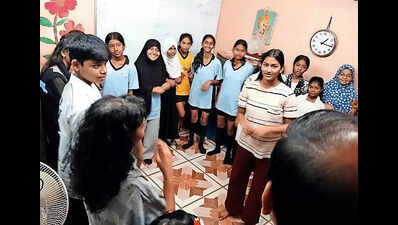
When the sun sets over the narrow lanes of Cheetah Camp and Sathe Nagar, a quiet vigil begins in the slums. Eyes stay alert, footsteps steady, and courage walks hand in hand with determination. These are not cops on night patrol. They are girls—young, fearless, and affectionately called the “Girl Singhams of Mumbai.”For the past four years, 12 adolescent girl groups—comprising more than 1,200 between the age of 11 and 18—have been transforming their own neighbourhoods from within. Supported by child rights organisation Child Rights and You (CRY), they have emerged as unlikely protectors and change agents within their communities, questioning customs that once felt immutable and confronting social problems most adults had reconciled to.CRY backs the initiatives as means to bring lasting change in the areas of education, health and nutrition, safety and protection and tackling of child labour and child marriage. The Govandi project, for one, helps create safe spaces where children’s voices are heard in decisions affecting their lives.“We started by educating the community about the ill-effects of early marriage,” says Simran Shaikh, 16, leader of one Smart Adolescent Girls Group. Almost every evening, Simran and her group walk through the locality, talking to families, listening carefully, and quietly watching for signs that a young girl might be pushed into marriage.“Our group has earned the trust of many families,” says Simran. “Parents are beginning to understand education and empowerment can change a girl’s life.” In the last few months, six child marriages have been averted in the vicinity. The girls who were about to be married off are back in classrooms.Salma (name changed), a member of the group for the past two years, is a typical example of how the project has empowered the children. A Class 8 student, she was initially hesitant to join but began attending at the insistence of her friend Rukshana, who was already a member. Salma’s father is an auto driver, while her mother works as a domestic help. “I had almost dropped out of school to support my mother, but Rukshana encouraged me to complete my education,” she says. Salma’s family was even planning to marry her off as soon as she turned 16. However, due to the group’s meetings to persuade her parents, Salma was allowed to continue her schooling. “They have identified cases early and acted in time,” says Kumar Nilendu, who works for CRY in the western region. “With support from facilitators and local authorities, the girls were able to convince families to stop the marriages. Alongside, CRY ensured structured life-skills programmes to strengthen their confidence and leadership,” he added.One afternoon, during a routine group meeting, the conversation shifted to Karbala Maidan—the only open space available to the kids here. It was dark, neglected, and unsafe, with no lights, no CCTV cameras, and the uneven ground making it difficult to play cricket or football. Soon afterwards, red soil was laid on to even it, streetlights were refurbished, and CCTV cameras set up. What was once a place to avoid turned gradually into a space for laughter, evening games and freedom. The maidan was reclaimed.A similar approach was taken against a spot where an illegal liquor vending shop operated. “We felt unsafe even walking in the lane,” recalls Asmita Sharma, one of the group leaders. “Drunk men would sit near the entrance. There was harassment.”Fifty of the girls gathered to discuss the issue. Letters were drafted and they marched to the police station to file a formal complaint against the liquor shop. Soon the shop was shut down.Alka, 15, who was among the girls who marched to the police station to demand the closure of the liquor shop, is one of five children in a financially weak family. She says participating in this activity gave her immense confidence. “Even my parents congratulated me for my efforts,” she says, adding that the experience inspired her to dream of becoming a police officer.Collective action has clearly transformed these girls. They speak without fear; and walk into police stations, municipal offices, and elected representatives’ chambers with confidence. They also listen patiently to younger children, encourage them to speak up, and stand firm when rights are threatened—respectfully, but without hesitation. On the eve of National Girl Child Day, the Girl Singhams continue their quiet vigil.