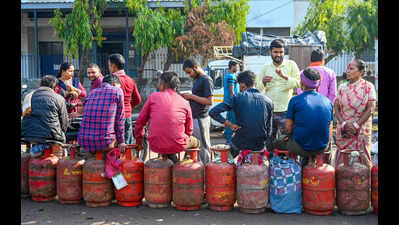







NEW DELHI: Giving an expansive interpretation of a terrorist act as defined by UAPA, Supreme Court on Monday said it is not restricted to only use of conventional weapons, such as guns, bombs and explosives, but also extends to all acts threatening national integrity and sovereignty, including disrupting supply of essential commodites by agitation or protest.The top court rejected student activists Umar Khalid and Sharjeel Imam’s bail pleas that their act of making alleged inflammatory speeches and holding protest and appeal for a ‘Chakka Jam’ can at the best be termed as public order problem and not terror act as they were not part of any overt act and did not use any firearms or explosives.
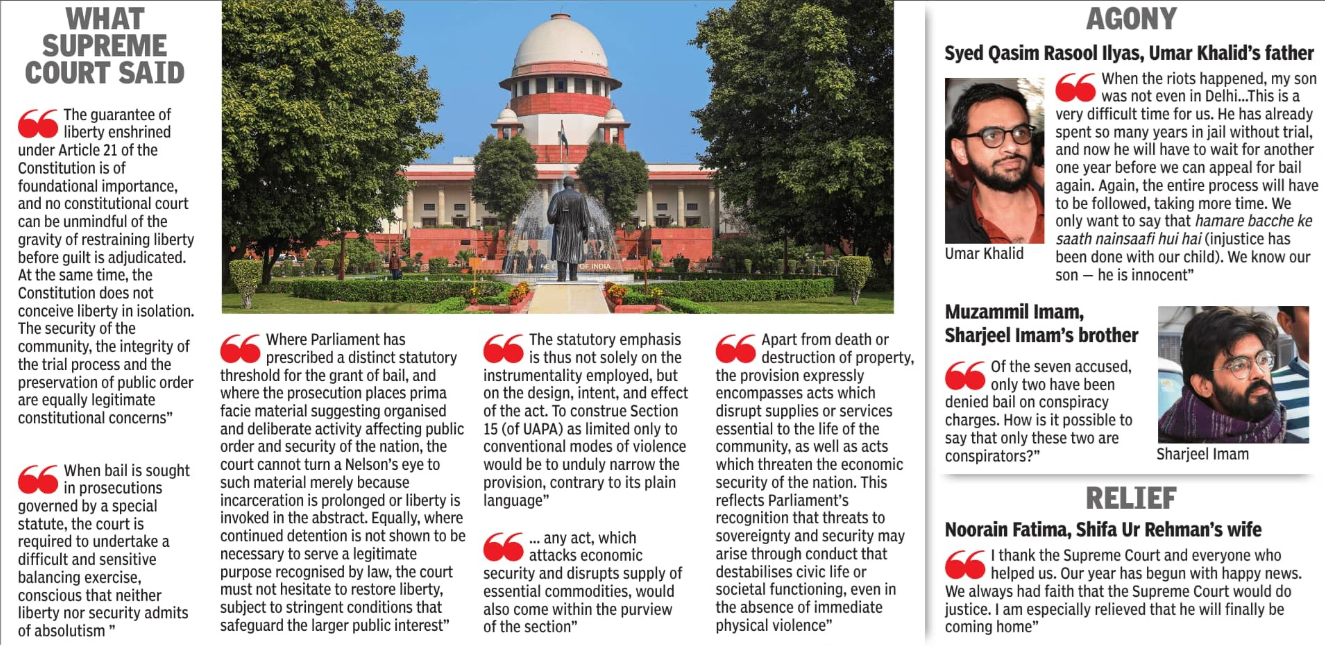
Elaborating upon UAPA’s Section 15 — that mentions “by other means” while defining a terror act — a bench of Justices Aravind Kumar and N V Anjaria said, “The means by which such acts may be committed are not confined to the use of bombs, explosives, firearms, or other conventional weapons alone. Parliament has consciously employed the expression ‘by any other means of whatever nature’, which expression cannot be rendered otiose.”“The statutory emphasis is thus not solely on the instrumentality employed, but on the design, intent, and effect of the act. To construe Section 15 as limited only to conventional modes of violence would be to unduly narrow the provision, contrary to its plain language,” it said.SC said that the consequences contemplated under Section 15 further illuminate the legislative understanding of terrorism, and indicated that any act, which attacks economic security and disrupts supply of essential commodities, would also come within the purview of the section — a reference to the calls given by Khalid and Imam to paralyse traffic in cities and cut the Northeast region off, respectively.“Apart from death or destruction of property, the provision expressly encompasses acts which disrupt supplies or services essential to the life of the community, as well as acts which threaten the economic security of the nation. This reflects Parliament’s recognition that threats to sovereignty and security may arise through conduct that destabilises civic life or societal functioning, even in the absence of immediate physical violence,” it said.The accused had submitted that allegations levelled against them by the Delhi Police, at its highest, disclosed at best a situation of public disorder, and that the invocation of UAPA proceeds on an overstretched understanding of terrorism and they could be booked for conspiracy under Section 18. However, the Delhi Police, through solicitor general Tushar Mehta and additional solicitor general S V Raju, contended that the statutory definition is not confined to conventional forms of violence which has been accepted by the court.“Read together, sections 15 and 18 disclose a legislative design wherein Section 15 defines the nature of acts which Parliament has characterised as terrorist acts, while Section 18 ensures that criminal liability is not confined only to the final execution, but extends to those who contribute to the commission of such acts through planning, coordination, mobilisation or other forms of concerted action. Whether particular conduct ultimately attracts Section 15 directly, or Section 18 read with Section 15, depends upon the role attributed and the statutory ingredients alleged to be satisfied,” the bench said.