





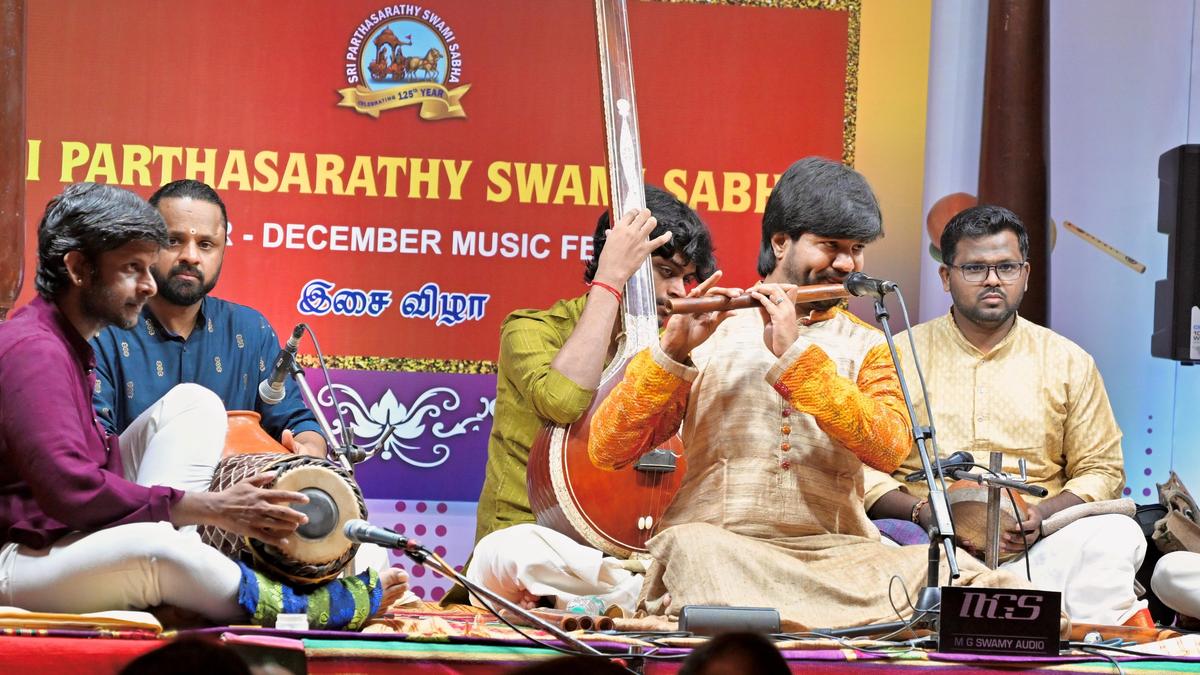
J.A. Jayant accompanied by L. Ramakrishnan (violin), N.C. Bharadhwaj (mridangam), Giridhar Udupa (ghatam) and Sunil Kumar (kanjira).
| Photo Credit: S.R. Raghunathan
Flautist J.A. Jayant presented a concert atSri Parthasarathy Swami Sabha that foregrounded raga elaboration and sustained audience engagement. He was supported by L. Ramakrishnan (violin), N.C. Bharadhwaj (mridangam), Giridhar Udupa (ghatam) and Sunil Kumar (kanjira).
The programme opened with a brief alapana in Kamboji, leading to ‘O rangasayee’. The kalpanaswaras that followed were brisk and interactive, marked by extended exchanges with the violin. Jayant explored multiple swara patterns, including kanakku passages that moved through tempos. The percussionists participated actively in these exchanges, contributing to the momentum of the segment, which elicited sustained audience attention.
In Bhavapriya, ‘Shreekanta niyada’ was presented with kalpanaswaras, steadily building them in mel kala. Jayant’s approach highlighted the flute’s capacity for clear articulation in faster registers, underlining its potential as a concert-leading instrument, despite its relative marginalisation in vocal-dominated formats.
A detailed alapana in Kanada followed, notable for its exploration of the upper octave, including phrases extending beyond tara shadja. Curved movements such as ‘ma-ga’ phrases were rendered with tonal control, emphasising idiomatic flute phrasing. Ramakrishnan mirrored this approach on the violin, maintaining stylistic alignment. ‘Shri narada’ in Rupaka tala once again provided a fluid platform for kalpanaswaras.
Bindumaalini was introduced through an alapana before ‘Enta muddo’. Throughout the concert, Jayant’s emphasis lay in engaging listeners through raga elaborations, swara patterns and rhythmic structures rather than reliance on the compositions alone — this was a good approach.
The central Ragam-Tanam-Pallavi was set in Kalyani, Mohanam and Ritigowla, a concise division that balanced contrast with listener attention. The pallavi was set in Khanda Jathi Triputa tala, traversing chaturashra and tisra gatis. Within each avartanam, raga and gait shifted without overlap, particularly between the somewhat closely allied Mohanam and Kalyani. Swaras alternated between ragas, demanding careful control of melodic identity and rhythmic precision.
The concluding pieces included ‘Govardhana giridhari’ in Bageshri, where Jayant employed a longer flute to produce a distinct tonal colour, and ‘Madhava lokanam’ in Jhonpuri by Swati Tirunal.
The accompanists offered support throughout, contributing to a recital that balanced structure, raga detail and rhythmic clarity.
Published – January 02, 2026 11:12 am IST