




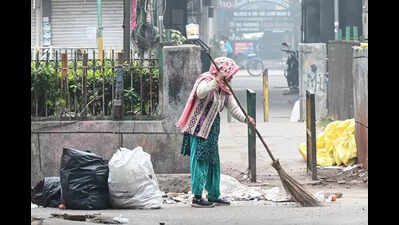
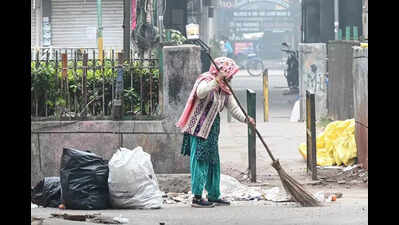
New Delhi: On the last day of the year, Lajpat Nagar’s usually buzzing Central Market lay quiet at 7am, shrouded in a thick winter haze as the city slowly woke up. By then, Sukhbiri, 45, had already been awake for three hours. Her day begins at 4am, and by 5am, she leaves Palwal, Haryana, to reach the market on time.A lone figure in the near-empty lanes of J Block, she sweeps trash piled along the sidewalks, with a few dogs keeping her company, as her shawl doubles up as a mask to shield herself from the dust rising from the road. “The corporation provides us with an apron once a year, and that’s that. No gloves, no mask,” she says, matter-of-factly.
In the last months of the year, it takes little for Delhi to slip into a gas chamber. As people debate whether it is smog or fog, the distinction is irrelevant for sanitation workers. They breathe it in regardless. As pollution worsens, the burden of Delhi’s filth — and its fumes — falls first and hardest on those tasked with cleaning it.A few lanes away, Anita, 60, reaches Lajpat Nagar by 7.30am every day without fail, travelling from Madangir. Suffering from chronic bronchitis, she is now accompanied by her 21-year-old son, who steps in to clean when she becomes breathless and needs to rest. For three decades, Anita has swept roads across the city. After 30 years of labour, her only consolation is the recent regularisation. “I have been made permanent, so there’s a guaranteed monthly salary of Rs 30,000, but that’s where the benefits end,” she says.For most workers, the day begins long before sunrise. While they are expected to reach their designated stretches by 7am, their mornings start much earlier. Many travel from areas bordering Haryana and UP, where last-mile connectivity is poor. The commute itself is exhausting before the labour even begins.Vinod, 45, who travels from Noida, piles soot from waste burnt the day before, used by locals to ward off the cold. The soot makes him cough and worsens his breathing, but the choice, he admits, is simple. “I have 11 mouths to feed at home, so I’ll do what I have to.”An MCD official said under Solid Waste Management Rules, 2016, sanitation workers are mandated to receive personal protective equipment, including particulate masks with nose clips and gloves. However, the reality mirrors Vinod’s experience — masks, if provided, come once a year, while gloves rarely make the cut.The risks intensify along Delhi’s busiest roads. Sanitation workers stationed on PWD-controlled stretches — nearly 1,400km that host a relentless flow of vehicles — remain exposed to exhaust fumes containing pollutants like PM2.5 and PM10. Sohanveer, 51, who cleans along August Kranti Marg, has grown used to it. “A few years ago, my nose would burn, chest would feel heavy, but now I have become immune, I guess,” he says, letting out a sardonic laugh.Projections offer little comfort. According to CAQM, air quality is likely to remain in the ‘very poor’ category till Jan 3, with little improvement expected in the days that follow.