





NEW DELHI: Delhi was the most polluted among NCR cities in 2025, followed by Ghaziabad and Noida, according to a new analysis by the Centre for Research on Energy and Clean Air (CREA).The annual data, recorded till Dec 30, reveals that while Delhi saw a decline in PM2.5 concentrations this time compared with last year, the polluted-season (Oct to Dec) average in 2025 slightly increased from 2024. PM2.5 levels at all 40 stations in Delhi were at least 1.8 times — nearly twice — the annual standard. The analysis showed that of the 29 NCR cities, only 14 had more than 75% PM2.5 data coverage in 2025. The remaining 15 cities with insufficient monitoring coverage were all located in Haryana — Bahadurgarh, Sonipat, Dharuhera, Manesar, Rohtak, Jind, Ballabgarh, Charkhi Dadri, Panipat, Karnal, Narnaul, Bhiwani, Faridabad, Mandikhera and Palwal.
Across India’s megacities, Delhi continued to record the highest annual PM2.5 levels in 2025. While Kolkata and Mumbai remained largely unchanged, Bengaluru showed a marginal decline and Chennai recorded a marginal increase.Delhi recorded an annual PM2.5 concentration of 96 micrograms per cubic metre, as opposed to the annual national ambient air quality standard (NAAQS) for PM2.5 of 40 micrograms per cubic metre. It was 19.2 times higher than WHO’s annual safe guideline of 5 micrograms per cubic metre. Delhi’s PM2.5 concentrations in April, Aug and Dec were higher in 2025 than in the previous year.
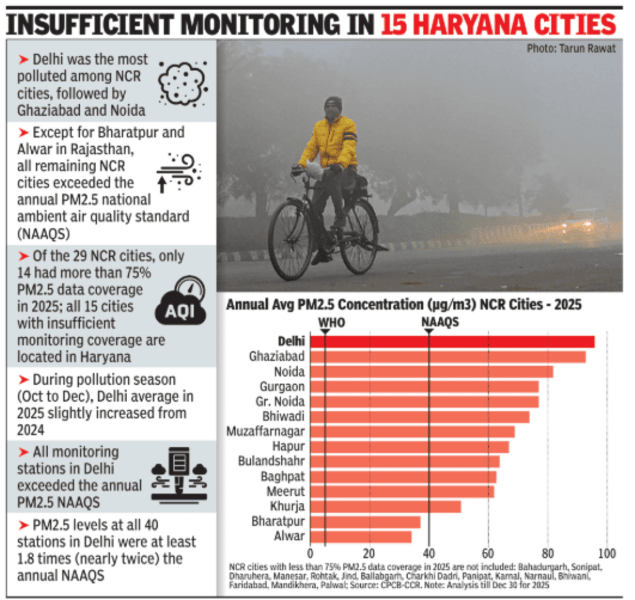
The analysis found that except for Bharatpur and Alwar in Rajasthan, all remaining NCR cities exceeded the annual PM2.5 NAAQS. Ghaziabad had the highest number of days exceeding the daily PM2.5 NAAQS. In Delhi, all monitoring stations exceeded the annual PM2.5 NAAQS.Jahangirpuri was the most polluted station in Delhi, with an annual average PM2.5 level of 130 micrograms per cubic metre. It was followed by Wazirpur (124), Bawana (123), Anand Vihar (121) and Rohini (115). Among the 40 stations in Delhi, NSIT Dwarka recorded the lowest annual PM2.5 concentration at 73 micrograms per cubic metre, but it was still 1.8 times the NAAQS and 14.6 times WHO’s safe guidelines.“The NCR situation shows that elevated pollution now persists throughout the year rather than being confined to a few months. The lack of improvement highlights the limitations of short-term, reactive measures and highlights the need for sector-specific emission reduction targets that address dominant year-round sources of pollution, including significant transboundary contributions,” said CREA analyst Manoj Kumar.According to the Commission for Air Quality Management (CAQM), the average AQI for 2025 has been the second lowest in seven years, since 2018. The average AQI was 201 this year, against 209 last year. Covid year 2020 recorded the lowest AQI, at 185. Meanwhile, the Centre for Science and Environment (CSE), which analysed the Decision Support System (DSS) data for the post-stubble burning period (Dec 1-15, 2025), stated that only about 35% of Delhi’s total PM2.5 originated from local sources within the city. The remaining 65% of pollution was attributed to NCR districts and other regions outside the city limits. “Transport remains the single largest contributor, accounting for nearly half — 46% — of Delhi’s local 2.5 load during this period. The industrial sector contributed 22%, household-level emissions accounted for 11%, and sectors like construction, energy use, waste burning and road dust contributed smaller but persistent shares,” said CSE.