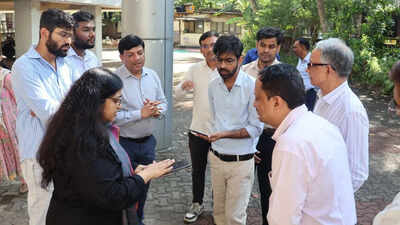







Pune: When Vipin Raghavan began visiting industrial plants in Pune about a decade ago, the contrast between the digital world he came from and the factories he saw was striking. “It felt like these factories were operating in a different era,” he says. “There was so much scope for technology to make a difference, not just in productivity but in how responsibly they used resources.”That observation eventually led Raghavan, a former engineer at Zynga and United Healthcare, to co-found Haber in 2017. The Pune-based company builds artificial intelligence systems that monitor and optimise industrial chemical processes in real time. Its goal, he explains, was to “put the subject-matter expert in software,” capturing the experience of plant operators through algorithms that can anticipate problems, adjust parameters and cut waste before it occurs.The company’s first customer was a local paper manufacturer, followed by ITC’s pulp and packaging division. “Getting ITC onboard was a turning point,” Raghavan recalls. “Once they saw the gains, others in the industry started paying attention.” Today Haber’s systems are used in sectors such as pulp, paper, packaging, tissue and water treatment, industries that rely heavily on water and chemicals.According to company data, its technology has helped save about 30 million cubic metres of water, 97,000 MWh of energy and 92,000 tonnes of emissions across client operations. Raghavan says the impact is achieved through steady optimisation rather than large-scale disruption. “Even a half-per-cent improvement in yield is a big deal for these plants,” he explains. “It means less raw material, less water and less energy for the same output.“This October, Haber opened an AI Green Chemistry Lab at its Pune campus, supported by a $10 million research and development investment. The lab houses a fully functional pilot plant that allows scientists to replicate large-scale manufacturing conditions within a controlled environment. “It’s a bridge between lab work and industrial reality,” Raghavan says. “We can validate and fine-tune new formulations before they reach a factory floor.” The lab will focus on developing cleaner, more efficient chemistries for industries that depend on water-intensive processes. It combines automation, data analytics and chemical research to test formulations designed to reduce chemical use and environmental load. The systems are partly cloud-based but rely on small edge-computing devices installed on site. “Most of the heavy lifting happens on the ground,” Raghavan explains. “Each device consumes roughly the power of a laptop, so the trade-off between energy use and environmental benefit is overwhelmingly positive.”The company’s model draws on Raghavan’s earlier experience in healthcare, where outcomes are tied to cost efficiency. “We tell clients, you pay us only if we keep your production costs within a promised range,” he says. “That way our incentives are aligned.” Haber’s path has not been entirely smooth. Adoption has been easier in Asia and Africa than in North America. “In India, once the plant head decides, the change flows quickly,” Raghavan notes. “In the West, operators are more empowered, so you have to win their trust. They want to understand why an algorithm recommends a particular adjustment.”Still, he believes such conversations are healthy. “It keeps us transparent and makes the system better,” he says. “At the end of the day, the goal isn’t to replace people but to help them make faster, more informed decisions.” For Haber, the new lab represents a practical step rather than a symbolic one. “We’ve always seen sustainability and efficiency as the same problem,” Raghavan says. “If factories can make more with less, that’s good business, and it’s good for the planet too.”