





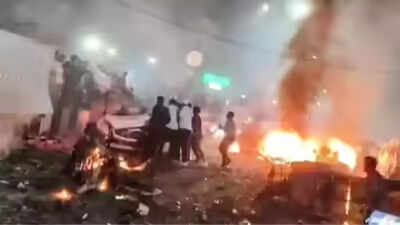
NEW DELHI: For exactly 5,178 days, the streets of Delhi hummed with the deceptive rhythm of normalcy, a silence that many mistook for the permanent defeat of terror. This almost decade-anda-half-long hiatus, stretching from the 2011 High Court blast to the evening of Nov 10, 2025, was not merely a lapse in time but a period of dangerous metamorphosis for the adversary. When the car laden with ammonium nitrate and TATP finally detonated near Red Fort, it did more than just propel vehicles 30 feet up in air or cause over a dozen casualties; it exposed the birth of what intelligence circles now whisper as “IM 2.0.”This was not the chaotic, trial-and-error Indian Mujahideen of the mid-2000s. This was a refined, “white-collar” evolution that had learned the hardest lessons of its predecessors, operating in the blind spots of a security apparatus that was looking everywhere but within its own city walls.The failure to prevent the Nov 10 attack lies in the chilling sophistication of the module’s structure. In the first iteration of the IM, the presence of foreign technical experts often provided the crucial trail for agencies to follow.‘IM 2.0’ eliminated this vulnerability. The 2025 module was entirely homegrown, led not by street-level radicals, but by medical professionals and academics, including Dr Umar Un Nabi and Dr Shaheen. This was a “doctor-led” cell that functioned for two years under the very nose of the law enforcement agencies of Delhi, Haryana and J&K.They didn’t need a foreign bombmaker because they possessed the scientific literacy to refine IEDs themselves. For over 700 days, they collected explosives, ammonium nitrate, and vehicles in small, undetectable increments.“Their success was rooted in their invisibility; they were taxpayers, healers and professors, far removed from the stereotypical “radical” profile that counterterror manuals are designed to flag,” said a retired Delhi Police commissioner.While the terrorists were evolving into a streamlined, intellectual force, Delhi’s premier counter-terror and counter intelligence units were decaying into a state of institutional lethargy and internal strife. For the last 2-3 years, the focus of the city’s anti-terror unit aka the ‘special cell’ had drifted dangerously, obsessing over criminal gangs, bookies and criminals of Punjab in the name of ‘mandate’The anti-terror apparatus became a house divided by intra-unit politics, where rivalries between officers and “camps” within the unit took precedence over counter-terror operations. In 2024, the anti-terror unit had zero anti-terror operations of their own, disclosed an investigator who was then a part of the unit. The few that were executed on the inputs of central intelligence agencies were marred with goof-ups and glitches.The cracks in this foundation were visible long before the Red Fort blast. The brazen killing of businesman Nadir Shah in the heart of the capital — in front of the very sleuths meant to protect the capital from dangerous threats — was a neon sign of systemic failure.2026, road aheadTo fight evolving threats, the first priority, former cell members said, should be to have a dedicated anti-terror squad aka ATS, focussing just on terrorism, in place. A similar unit is coming up in Haryana in line with the national counter terror policy being rolled out. Officers pointed out that instead of turning cell into a copycat version of the NIA (National Investigation Agency), the unit’s founding ethos deserves a renaissance.“The ’white-collar’ threat is no longer a theoretical concern; it is a reality that bypasses traditional surveillance. The traditional ‘informer’ network, often comprised of petty criminals or arms smugglers, is also useless against educated professionals or academics who leave no street-level footprint..” a retired anti-terror unit chief said.“Institutional Intelligence (Inst-Int) is another focus area. Chemical supply chains and research labs need monitoring. ‘Sectoral observers’ need to be in place who can flag anomalies in chemical procurement or shifts in behavior that standard surveillance misses,” he added. A related setback for the unit is that the ones who primarily maintained sources have either retired, have left the unit on their own or have been shunted out in the last one year.By shifting from reactive gang-level policing to a sophisticated humantechnical fusion, the force can bridge the gap between 20th-century tactics and the 21st-century threats and prevent Delhi from turning into a playground for the next generation of educated, invisible killers.As the smoke clears from the 2025 blast, the message is stark. The 5,178-day streak of peace was also a period of preparation for the enemy. If we are not ready, an ‘IM 3.0’ would be far more lethal.