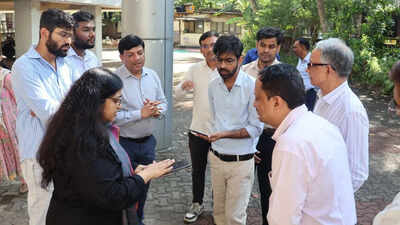




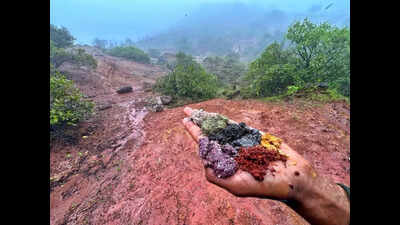
Pune: The subtle hues of earth on this plateau, nestled in Western Ghats at an elevation of 4,694 feet from sea level, tell two tales — one is of science and the other is of faith.The plateau is famous for a Shiva temple and legend has it that Chhatrapati Shivaji Maharaj, founder of the Maratha empire, took an oath to fight against the Mughal rule and form Swarajya. For generations, villagers of Raireshwar, located around 80 km from Pune, have believed that the soil is sacred bhasma and it possesses magical healing powers. “We apply this bhasma to lord Shiva on festive occasions. In case of our animals sustaining injuries or suffering from a disease, we daub this soil on their skin. This tradition has been passed on by our forefathers,” says Dattatray Jangam, president of Raireshwar Villagers’ Organisation that looks after the temple. But curious trekkers and nature lovers are fascinated by this geological marvel and often compare it to the rainbow mountain of Peru known for its vibrant multi-coloured sands. A study carried out in April 2022 by a team of geologists from Bhavatal, a non-profit organisation from Pune, revealed a scientific explanation for the varied shades of the soil. “The soil samples collected were analysed at the chemistry department laboratory of Fergusson College. The results confirmed that the different shades were due to the presence of laterite and certain metal contents,” says Abhijeet Ghorpade, founder of Bhavatal. Ghorpade, who led the group, says the experts initially observed 10 colours. “However, a thorough examination found that some of these variations were the result of overlapping or mixed pigments. The team concluded that the soil distinctly featured at least six primary shades — red, brown, yellow, purple, moss green, and bottle green.” Of the 16-km-long plateau, barely a stretch of 1.5 acres is where this wonder lies. Villagers have named this place, located around 2km from the temple, ‘vibhutichi khan’ (a mine of divine power). Interestingly, Dattatray owns a piece of land where this soil is found. “We perform pooja here on Bail Pola, a festival celebrated by farmers in Maharashtra every year,” he says, adding that villagers often use this soil to make clay pots and bulls. Raireshwar’s laterite layer sits atop basalt, a volcanic rock known as ‘kaala kaatal’ in Marathi, says Vidyadhar Borkar, a retired scientist from Agharkar Research Institute, who was part of the research team. “In tropical regions, the intense heat and heavy rainfall cause the erosion of rocks rich in iron and aluminium, leading to the formation of laterite soil.” He further says it is worth noting that what were previously referred to as ‘soils’ of various colours were actually sand-sized particles of laterite in different shades. “As anticipated, the fragments of different colours exhibited varying chemical compositions, primarily consisting of oxides and hydroxides of iron, aluminium, and manganese. These were identified as different minerals such as haematite, goethite, and bauxite, etc. Colours are imparted to them by the metallic ions,” he says. Explaining the reason behind his team’s exploration initiative, Ghorpade says many consider the vibrant soil a miracle, but no one investigated it scientifically. “The region’s unique topography and specific rock composition played a major role in the ‘lateritisation’ process, which ultimately contributed to the formation of the colourful soil,” he says. Borkar says the laterite found at Raireshwar and many parts of Konkan and the Sahyadri mountains (Western Ghats) is formed owing to the erosion and decomposition of basalts. “Erosion of any rock has two aspects: physical disintegration and chemical decomposition. Soluble compounds resulting from such erosion are drained through groundwater, and insoluble oxides and hydroxides are held back as residue. This ultimately becomes the famous porous rock, the laterite,” Borkar says. The plateau, especially its colourful soil, has become a hotspot for tourists over the years. Much of the credit goes to social media, says Raireshwar resident Sandip Jangam, who arranges camping. “Though the soil has been there for years, it attracted national attention only after people started making videos and posting them on their social media handles,” he said, adding that his village, located on the plateau, has around 45 houses. Sachin Deshmukh, another local trekker and tour organiser, says the number of visitors to Raireshwar plateau increases during monsoon. “Kaas plateau in Satara is popular for flowers; Raireshwar is too home to a variety of flowers which are not explored much. If the weather is clear and there is no fog, one can even see the table land of Panchgani near Mahabaleshwar from here,” he says. However, visitors like Kedar Bidwai say the plateau has been neglected by state govt despite its soaring popularity. “Even though the multi-coloured soil is recorded in videos and widely shared on social media platforms, govt has not cared to either conduct research or promote it. The plateau lacks basic facilities as people still have to walk up to 3 km to reach the base,” he says. Ghorpade says although the topography, climate, and rock type of the Western Ghats suggest that similar soil formations could exist elsewhere, no comparable site has been spotted by anyone so far. “It is possible such places exist, but unless scientifically studied or brought to our attention, it is wrong to make any claims.”