




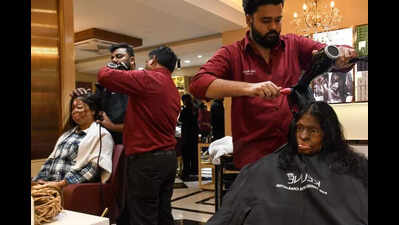
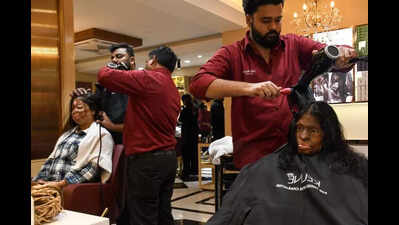
New Delhi: For Anshu Rajput, a visit to the salon was once a cherished ritual — something she allowed herself once a year. The last time she went was in Jan. It’s Dec now, and she hasn’t been back since.At 27, Anshu knows what awaits her in such spaces: second glances that linger too long, the sudden silences, the stylist who looks everywhere except at her face. Over time, the fear of being seen like that grew heavier than the desire to feel cared for. Her friends began learning how to help instead. Haircuts, threading, waxing — everything moved indoors.
Anshu was only 15 when her life changed forever. In 2014, as she slept on a charpai in the courtyard of her home, a 55-year-old neighbour allegedly climbed over the wall and threw acid on her after she rejected his advances. “The pain cannot be explained,” she says. “If hot steam touches your hand, it burns for days. Acid is beyond that.” It entered her mouth, destroyed her teeth, and scarred her face. Seven surgeries followed.But the wounds that pushed her inward came later. “People think survival means you’re fine,” she says softly. “They don’t see how the looks slowly erase you.”“Salons are supposed to make you feel beautiful,” Anshu adds. “For women like us, they often make us feel invisible — or worse.”That is why something shifted when she walked into The Nest, a salon in south Delhi’s Green Park market. When she sat in the chair, no one stared. No one fell silent. For the first time in years, she didn’t brace herself. “It wasn’t just a haircut,” she says. “It was the feeling that I still belong. I won’t tie my hair for at least three days now.”The Nest centres itself on this quiet, often withheld need. Outwardly, it mirrors a high-end salon with royal Rajasthani aesthetics and bespoke beauty and wellness offerings. In essence, though, it reimagines luxury by embedding dignity into its very design.At The Nest, acid attack and burn survivors can access any beauty or wellness service free of cost. Private VIP rooms shield them from unwanted attention, allowing them to sit in front of a mirror without bracing for impact.For Rupa, now 30, that sense of ease was overwhelming. Growing up, she remembers small, private rituals — applying a bindi, a hint of lipstick when no one was watching. “I had a tiny mole just below my lips,” she says. “I used to think I looked like my mother.”An acid attack by her stepmother in Aug 2008, when Rupa was just 13, shattered that image. Acid burned her face and shoulders, leading to nearly 30 surgeries over the years. “I felt I would never look like my mother again,” she says. “I thought I would never be able to wear makeup.” What followed was not just physical pain, but a slow erasure of the self. “You stop doing the little things,” she adds. “You stop trying.”Moments of confidence returned in fragments. In 2013, Rupa walked the ramp. Nervous and unsure, she remembers being told she looked good just the way she was. At The Nest, she felt something similar. “It feels like we are among our own here,” she says. “When you are in a space like this, the wrong gaze slowly disappears. This place doesn’t make you feel different. It reminds you you’re still you.”The salon is the vision of Harita Mehta, senior advocate at Delhi High Court and a long-time women’s rights activist, whose work with survivors spans years through Meher Foundation. Mehta, who has worked closely with Delhi Commission for Women (DCW) for nearly a decade, says the issue was weighing on her for years.“While working with DCW, including at places like AIIMS, I heard the cries of women every day,” she says. “Over time, that work extended to acid attack survivors — women whose lives are often erased the moment the attack happens.”Survival, she says, rarely means recovery. “Most survivors are disowned by families and pushed out by society. This space is meant to tell them they haven’t reached the end.”A fundraising campaign to support medical reconstruction and rehabilitation will be launched soon, with a portion of the salon’s profits dedicated to the cause. “For awareness, we will reach out to multiple NGOs.”“This is not charity,” Mehta says. “It is dignity.”