





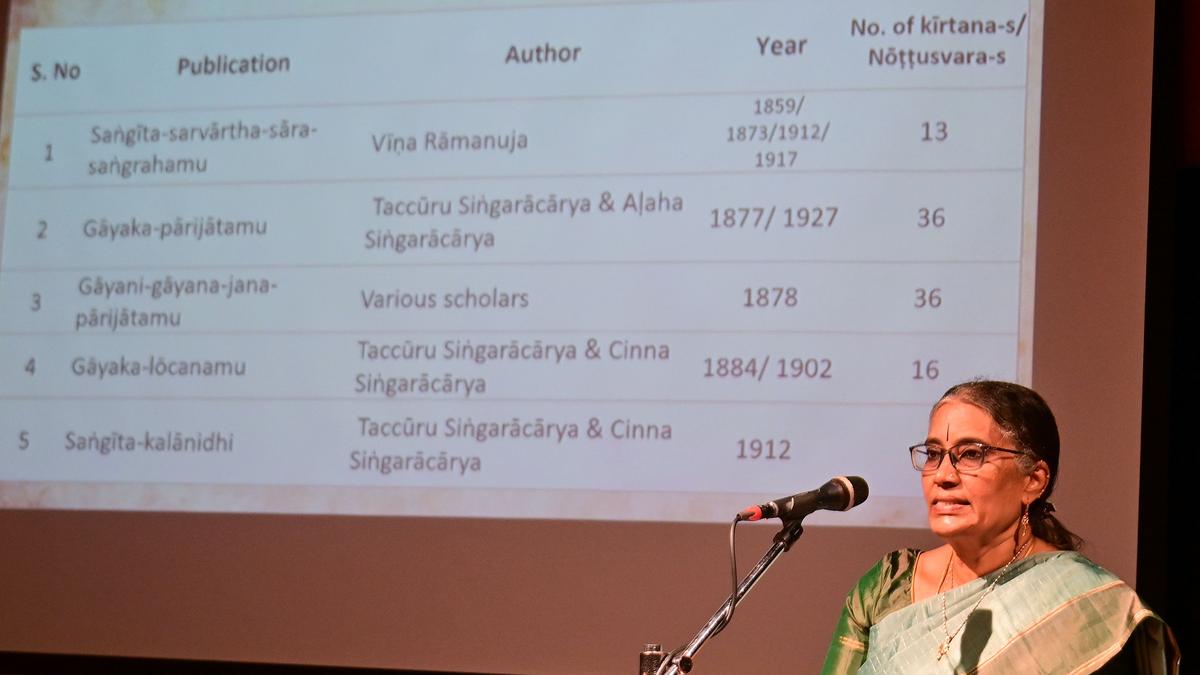
Rajshri Ramakrishna’s lecture demonstratin at The Music Academy’s academic session 2025.
| Photo Credit: Courtesy: The Music Academy
In her lecdem at The Music Academy, Rajshri Ramakrishna analysed Muthuswami Dikshitar’s compositions in publications other than Subbarama Dikshitar’s Sangita Sampradaya Pradarshini (SSP).
Rajshri said that in the 33 books she had gone through, there was no Dikshitar kriti not found in SSP. She went through 21 Telugu books, of which 17 have notations. The earliest Telugu book Sangita Sarvartha Sara Sangrahamu came out in 1859. The Tachur brothers brought out four books. In Sangita Swayambodhini (1892), there are two kritis with notation, one of which is ‘Vatapi’. Rajshri said that the process of introducing sangatis wherever possible had begun quite early. There are eight Tamil books with notations, of which Thiruppamburam Natarajasundaram Pillai’s Dikshita Kirtana Prakasika has 50 compositions.
The raga of the kriti ‘Bhaktavatsalam’ is given in Gayaka Parijatamu and other texts as Mandari, but as Vamsavati in SSP. Rajshri said that Vamsavati was a scalar raga, with uneven tetrachords, making it possible to introduce another note to change the raga. This could be the reason for the mention of Mandari as the raga. ‘Chetasri’ is given as Dwijavanti in other publications, but as Jujavanti in SSP. Rajshri said ‘Akhilandeswari’ (Jujavanti) might have already been in vogue, and to differentiate, they might have given Dwijavanti for ‘Chetasri’.
Two musical formats
From Sangita Swara Prasthara Sagaramu (1914), you can infer that codification was taking place and attempts were being made to put some grammar in place. This work says Dikshitar kritis follow one of two formats — ati citratama marga and citratama marga. The former has one melodic unit in a kriya, and the latter has two. ‘Srimahaganapathim’ (Gowla) comes under ati citratama marga, and ‘Arunachalanatham’ (Saranga) under citratama marga. In the Malayalam work Sangita Rajarangom (1928) by A.S. Renganatha Ayyar, ‘Sri kamalambike’ (Sri raga) is notated in Ata tala. The author has just mathematically arranged the whole song.
In the kriti ‘Venkateswara’ (Megharanjani), we have the words ‘Yettappa bhupati’ in SSP, but ‘Yadava’ is used in place of ‘Yettappa’ in other publications. SSP mentions the composer is Kumara Yettappa. ‘Venkateswara’, ‘Kamalaasanaadhi’ (Brindavani) and ‘Nikhilananda’ (Saveri) are kritis attributed to Dikshitar in many publications. Maybe the sahitya was by the Rajah and the music by Dikshitar. ‘Venkateswara’ is said to be in Megharanji in all publications, but it is Megharanjani in SSP.
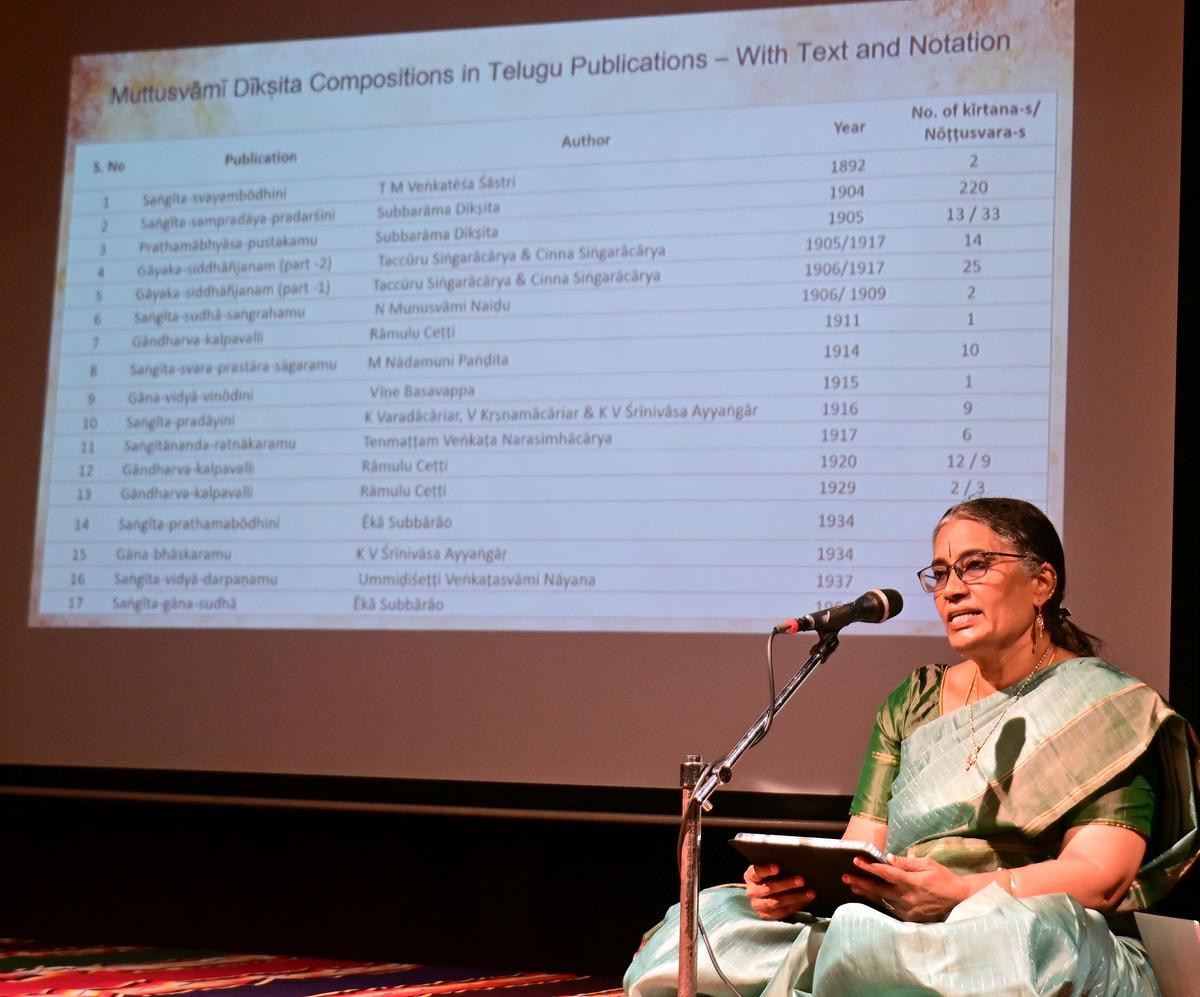
Rajshri Ramakrishna on kritis in publications other than Sangita Sampradaya Pradarshini.
| Photo Credit:
Courtesy: The Music Academy
In Cinnaswami Mudaliar’s Oriental Music in European Notation, ‘Gurumurthe’ is a nottuswara, but it is a keertanai in SSP. There are five works that have two extra avarthas of sahitya in the charanam of ‘Balagopala’ (Bhairavi). For ‘Sarasa dala netra’ (Atana), Cinnaswami Mudaliar gives a metronomic speed of 144, which is the equivalent of singing one kalai fast. He tries to define the kalapramanam in a very quantified way. He has incorporated all the gamakas such as nokku and odukkal in the staff notation. Both Indian and European systems seemed to draw inspiration from each other. Subbarama Diskhitar had the grand idea of reducing the number of swaras, by introducing signs and symbols on top, maybe to facilitate sight reading as in Western music.
SSP shows the contours of Mohanam in the pallavi of ‘Narasimha agaccha’, where it goes to tara sthayi, comes to mandra sthayi and finishes on ‘Sa’. But this is not seen in other publications. For ‘Sri viswanatham’ (Sri raga), kampita gamaka is given for ‘ri’ in SSP. Usually, there is a kampita for ‘ri’ only in Madhyamavati, not in Sri. Orikkai is given for gandhara in SSP. This kind of gandhara is usually seen in Manirangu, not in Sri.
Rajshri played two audio clippings of ‘Mamava pattabhirama’ (Manirangu), one by Brinda and Mukta and the other by M.D. Ramanathan. Both follow the notation of earlier publications and begin on ‘ri’, the way we begin Madhyamavati. But the notation in SSP is different.
Sangita Kalanidhi-designate R.K. Shriramkumar observed that Mandari was not a part of the Dikshitar parampara at all. He said that T.L. Venkatrama Iyer pointed out to D.K. Pattammal that ‘Akhilandeswari’ was not a Dikshitar kriti.
Published – December 24, 2025 01:14 pm IST