




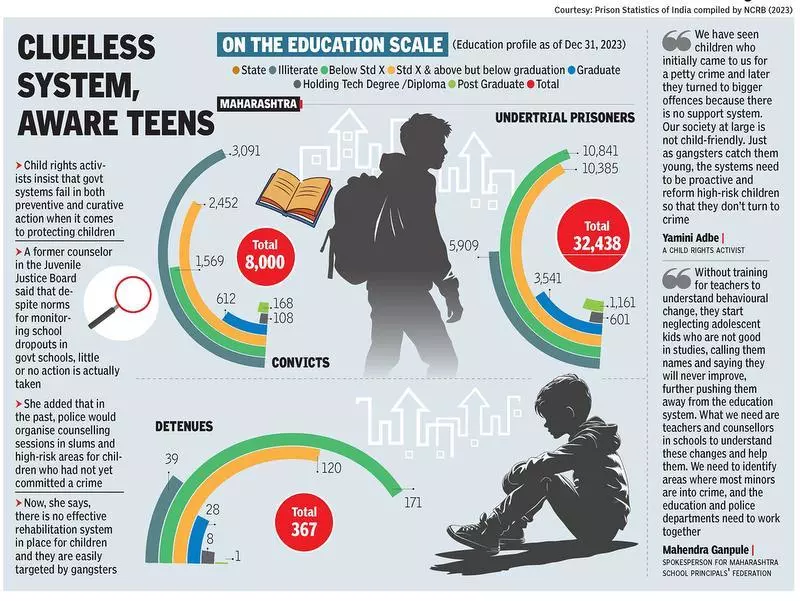
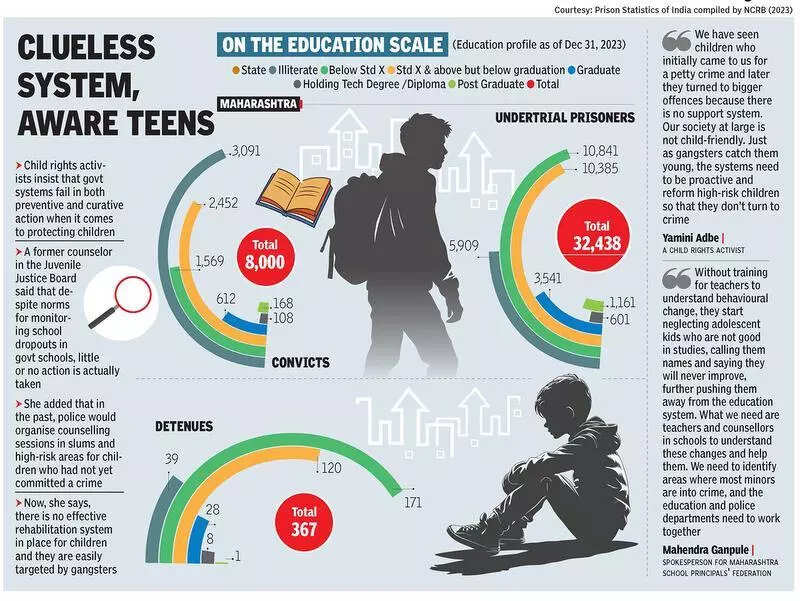
Scores of teens yet to hit 18 are involved in violent crimes. They are also school dropouts and unlikely to go back to education with problems inside the classroom and unable to resist the lure of the big, bad outside world.“We go to school. The teachers are not nice. If we can’t answer or haven’t completed our work, they make fun of the Nigdi Ota scheme we come from. We don’t like it,” a 15-year-old known among his friends for his reel-making skills said.Police officers dealing with juveniles in crime said there is no study to prove it but their observation says that over 80% of the juveniles arrested are either school dropouts or irregular students.Statistics from the state’s education department are stark. The dropout rate among secondary school students is up this year. In the academic year 2024–25, 12.6% boys and 10.3% girls enrolled in Std IX and X dropped out. It was over one per cent higher than the previous year. Actual numbers could be even higher.Yogesh Jadhav, president of the NGO that runs Mission Parivartan, a Pune-based initiative to rehabilitate children in conflict with the law has worked with over 700 such children in the last two years. He said, “There is an urgent need to ensure that students stay in class. Teachers are the first to notice changes in children, especially boys in Stds VIII, IX, and X. If we can just keep them in school and give them hope of a better future through education, the juvenile crime rate will plummet. For that, teachers and parents need to work in coordination,” he added.Prison Statistics of India 2023 reveals a similar trend among adult convicts. Of the 8,000 convicts in Maharashtra’s prisons on Dec 31, 2023, 3,091 dropped out before completing Std X, and 1,569 were illiterate. The trend is starker in undertrial prisoners. Out of 32,438 undertrials, 10,841 dropped out before Std X, while 5,909 are illiterate.The slide begins quietly. “I was regular in school, but my friend dropped out after Std X. We started hanging around with a local bhai and his friends, all a few years older. Except for me and another boy, everyone dropped out of school,” a Std XII student who was booked under Section 395 IPC two years ago said. “I was picked up two days before my board exams. I pleaded with the police, and they let me take them. I passed,” he added.Social workers say that schooling alone isn’t enough. What happens after school matters just as much. “If the child goes to school regularly, half the problem is solved. The other half is what they do after,” Arun More, a boxing trainer who works with young people in Khadki slums, said.More, giving out Coach Carter vibes, said, “If social organisations can offer classes, be it music, sports, or anything to channel their energy, it stops them from loitering with local bhais or spending endless hours on the phone. That’s why we teach boxing. But to join, attendance in school and regularity in the boxing ring are mandatory.”One of the reasons for the free and compulsory education clause in the Right to Education Act 2009, without any provision to fail the students, was also to ensure that students remain engaged in mainstream education system till the age of 14, Mahendra Ganpule, spokesperson for Maharashtra School Principals’ Federation, said.When instant gratification, the need to have money to spend on things and a weak family system combine, it spells doom for the children, especially those living in slums, he said.The systemic failure runs deeper, said Jaywant Kulkarni, a trained counsellor and teacher at Gandhi Balmandir High School, Mumbai, adding that the education system is failing in multiple ways when it comes to helping students at risk.First, teachers are overburdened with work, fewer than required in numbers, and untrained to check behavioural changes among teenagers. Secondly, despite rising problems, govt has not appointed counsellors in schools, he said.“Teenagers are high on energy and aggression. They want attention which they fail to get in school or at home and hence turn to outsiders who, in most slum areas, are local bhais, and all goes downhill from there. Many students who are not good at studies also drop out because they feel they have no place in this highly competitive world. What we want is an education system to identify such students, find qualities in them and give them avenues to nurture these qualities rather than leaving them as numbers in the yearly dropout statistics,” Kulkarni added.But even before the education system, family holds the biggest stake in keeping children from crime, said former Director General, Bureau of Police Research and Development of India, Meeran Borwankar. She is a member of the core advisory group on criminal justice system reforms constituted by National Human Rights Commission. She said that her experience shows that the education system can help, but not more than the families.“So the education system, along with our strong family system, is the way forward. It is also a fact that a prompt criminal justice system, where children see the guilty being punished immediately, will deter them. Trials after 5-6 years and high rates of acquittals have seeped into children, especially teens’ minds. This has led to the “sab chalta hai” (everything goes) phenomenon even among kids,” Borwankar, former Pune police commissioner, added.Experts SayWe have seen children who initially came to us for a petty crime and later they turned to bigger offences because there is no support system. Our society at large is not child-friendly. Just as gangsters catch them young, the systems need to be proactive and reform high-risk children so that they don’t turn to crime – Yamini Adbe | A child rights activist_____________________Without training for teachers to understand behavioural change, they start neglecting adolescent kids who are not good in studies, calling them names and saying they will never improve, further pushing them away from the education system. What we need are teachers and counsellors in schools to understand these changes and help them. We need to identify areas where most minors are into crime, and the education and police departments need to work together – Mahendra Ganpule | Spokesperson for Maharashtra School Principals’ Federation______________________Clueless System, Aware TeensChild rights activists insist that govt systems fail in both preventive and curative action when it comes to protecting childrenA former counselor in the Juvenile Justice Board said that despite norms for monitoring school dropouts in govt schools, little or no action is actually takenShe added that in the past, police would organise counselling sessions in slums and high-risk areas for children who had not yet committed a crimeNow, she says, there is no effective rehabilitation system in place for children and they are easily targeted by gangsters