




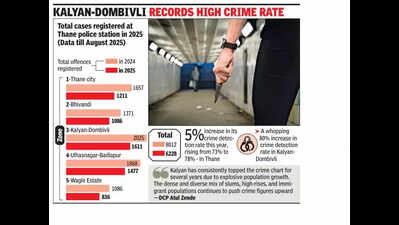
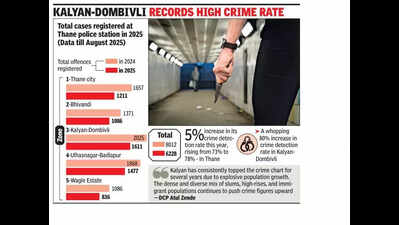
Thane: Police commissionerate has achieved a significant 5% increase in its crime detection rate this year, rising from 73% to 78%, despite a marginal uptick in registered cases. However, the Kalyan-Dombivli zone continues to dominate the crime statistics, reflecting persistent law and order challenges in the rapidly expanding region.According to official data from Jan to Aug 2025, the commissionerate registered 8,012 cases compared to 7,793 during the same period last year, marking a modest increase of about 3%. Senior police officials attribute the improved detection rate to proactive policing measures and faster complaint registration systems.The Kalyan-Dombivli zone, comprising eight police stations, recorded the highest number of offences at 2,025 cases. Paradoxically, it also boasts the best detection rate in the commissionerate at 80%, surpassing the overall average.DCP Atul Zende explained that Kalyan has consistently topped the crime chart for several years due to explosive population growth. “The dense and diverse mix of slums, high-rises, and immigrant populations continues to push crime figures upward,” he noted, adding that detection remains the highest, reflecting focused police efforts. Officials credit the KDMC Smart Project’s extensive CCTV surveillance network for significantly aiding investigations and accelerating the detection process. The sophisticated monitoring system has become a crucial tool in tracking offenders and gathering evidence.In body offences, 1,810 cases were registered with 2,723 accused arrested. The Ulhasnagar zone recorded the maximum with 666 cases and 877 accused arrested. In property offences, 1,712 cases were registered, leading to the arrest of 1,049 offenders., in all five zones.A senior police officer acknowledged that thefts and property offences constitute a major challenge. “The police are strictly against crime burking or underreporting, which is why the total number of cases has increased along with the detection rate. Several dedicated teams are working on specific offences to address this problem,” he said. Police attribute the rising crime figures to a population surge and the commissionerate’s unique geographical character, which represents an amalgamation of rural and cosmopolitan cultures. “The participation of citizens in keeping a check on anti-social elements is also key to controlling crime,” a senior officer noted.However, a section of citizens offers a contrasting perspective, claiming that political patronage to local goons fuels violent crime. One resident pointed out that, similar to the situation in Zone-5 covering Wagle Estate, political interference remains a significant issue in the region, with senior police officers often succumbing to political pressure. These claims highlight an ongoing tension between law enforcement efforts and alleged external influences that some believe hamper effective policing.Despite these obstacles, police officials remain cautiously optimistic. They maintain that a strategic combination of preventive policing, intelligence-led operations, and community surveillance is helping to curb the upward crime trend. The improved detection rate suggests that even as crimes are being more accurately reported and registered, police efficiency in solving cases has kept pace. The data reveals a complex picture where Kalyan-Dombivli’s crime numbers remain concerning, yet the zone’s impressive 80% detection rate demonstrates that increased criminal activity need not translate to decreased police effectiveness when backed by modern technology and dedicated investigative work. Retired police officers who previously served in Thane observe that with continuous migration and rapid infrastructural growth, maintaining law and order in mixed residential and industrial zones has become increasingly challenging. They note that despite these pressures, the integration of artificial intelligence-driven surveillance tools, predictive policing techniques, and data analytics has significantly improved the ability of officers to identify repeat offenders and pinpoint crime-prone areas with greater accuracy. Social activists and community leaders have urged the police to further strengthen citizen engagement programs and expand neighbourhood watch initiatives. They emphasize that early intervention, youth counselling, and collaboration with local NGOs can help prevent first-time offenders from being drawn into crime. “Awareness is the key factor today — many offenders fall into the wrong company in pursuit of quick money, and this must be curbed,” said one activist.