




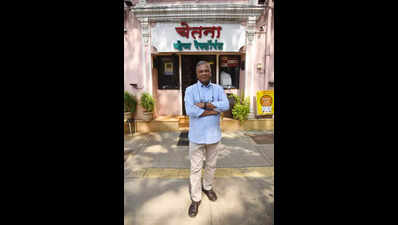
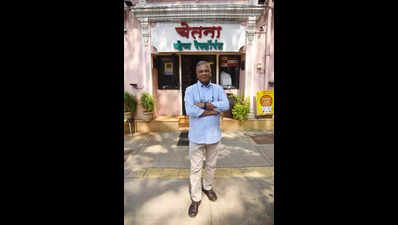
“Sanskrit shlokas on the tables, bright, many-hued ‘cornered’ saris as wall hangings. A huge brass lamp and paintings on the wall — not for decoration but for sale. Works by famous artists (not yet famous then) like M. F. Husain, Ara, Raza and F.N. Souza, Gade, etc.” This is how noted art critic-journalist A R Kanangi reminisced in an article commemorating 60 years of Chetana restaurant in 2006.As Chetana, a restaurant at Kala Ghoda in South Mumbai known for its vegetarian Gujarati, Rajasthani, and Maharashtrian thalis, prepares to enter its 80th year, nostalgia peppers the memories of its many patrons.Sudheendra Kulkarni, journalist-author and aide to former PM Atal Bihari Vajpayee, calls it a cultural landmark dishing out “food for thought and soul” for decades. “It was here that many creative minds met. People came here not just to have coffee and food but also to immerse in spiritual thoughts. I am glad that its third-generation owner, Kavi Arya, is carrying forward the legacy,” says Kulkarni. Arya, 65, welcomes us into the small room accessed through the restaurant. The room houses the bookshop and a few handicrafts that his mother, Chhaya Arya, would keep in a separate centre on the same premises. Kavi is an unlikely restaurateur. A Master’s and Ph.D. from Oxford, this computer scientist worked with the Animation Systems Group at IBM’s Thomas J. Watson Research Laboratory in New York, USA, before he returned “home” and joined IIT Bombay. “My parents and all my friends and acquaintances said I was crazy when I left the flourishing career in the US,” smiles Kavi, nibbling at dhokla — the spongy Gujarati snack — as part of starters before a variety of vegetables and ghee-splashed chapatis and bhakaris fill the steel thali. Juggling running of the restaurant and E-Yantra, a Ministry of Education project on robotics outreach which has trained 2,50,000 young engineers in contemporary skills in the last 13 years, Kavi loves conversation. While attentive bearers keep refilling the small katoris (bowls) till we say “no”, Kavi talks. “Chetana is not just a restaurant. It is an idea and a centre where ideas were discussed,” explains Kavi. Chetana means awareness. So, did it transform from a Chintan (thinking) hub into Chetana? “That is a good headline,” smiles Kavi.To know more about Chetana’s journey, we walk down to the back of the building, to the tiny office of Kavi’s mother, Chhaya Arya, 91. “In 1946, my father, Sudhakar Dikshit, a journalist, founded it as a hub for intellectual discussions over coffee,” reminisces Chhaya, an artist and broadcaster, who, along with her husband, eminent portrait photographer Jitendra Arya, made a famous couple that mingled with Mumbai’s swish set once they returned from England and settled here. Guru Dutt had seen Chhaya at the BBC and offered her the role of Chhoti Bahu in the 1962 film Sahib Biwi Aur Ghulam. “I had even signed this film, but the secretary of Meena Kumari, who saw me at Guru Dutt’s office a couple of times, alerted her. Meena Kumari, who had refused this film, got this role and I never debuted in Bollywood,” she says. “And we were saved,” laughs Arya.Long before the nearby Jehangir Art Gallery opened in 1952, Chetana was a haunt for a group of young, idealistic, and struggling artists. It was here that K. H. Ara and M. F. Husain had their first solo shows. Founded in 1947, the Progressive Artists’ Group, comprising F. N. Souza, Husain, S. H. Raza, Ara, Hari Gade, and Sadanand Bakre, held its first exhibition here.Dikshit and eminent author Raja Rao started Chetana as a cultural café in an open-plan area where a bookshop occupied one corner and a chess table another. Maharaj Singh, the first Governor of Bombay in independent India, would frequent it for a game of chess, while literary giants like Mulk Raj Anand, Evelyn Wood, and Nissim Ezekiel came here to discuss the Vedas, Vedanta, and poetry readings while the restaurant served snacks and coffee. Among others who frequented it were the legendary R. K. Laxman, filmmaker Shyam Benegal, and radio broadcaster Ameen Sayani.When Chetana cafe ran into trouble, Dikshit consulted a few friends who suggested he transform it into a vegetarian restaurant. As the area saw many Gujaratis — also because of the Bombay Stock Exchange in its vicinity — it made sense to keep Chetana pure vegetarian. Kavi says that given the prime location of the restaurant, he could increase the prices. However, its modestly priced Rs 750–Rs 850 per thali still has many takers. “Commerce has never guided Chetana,” declares Kavi as we leave.