




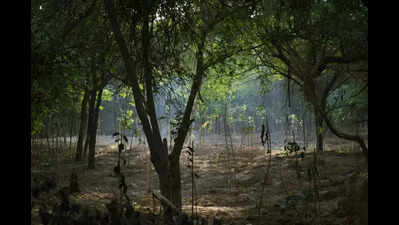
New Delhi: For nearly a century, the Central Ridge has stood under a thick canopy of vilayati kikar (Prosopis juliflora), an invasive species from south and central America. This fast-growing tree, whose leaves and branches block sunlight, spreads so widely that it leaves little room for other species, thus degrading forest diversity. Now, a pilot project attempts to push back the kikar to ecologically restore the Central Ridge by giving native trees a second chance.Of the 864 hectares of the Central Ridge, the forest department has been carrying out ecological restoration in three patches totalling 70 hectares. Using the method of canopy lifting, the branches of vilayati kikar are pruned to allow sunlight to penetrate, facilitating the growth of native species planted around the kikar.The project started on a small patch in 2022 and has now been expanded. “The branches of vilayati kikar are pruned every six months so that other native species can get enough sunlight to grow,” explained an official. When TOI visited the Central Ridge on Thursday, it found the vilayati kikars in the select patches trimmed and saplings planted around them. The pruned branches were dumped nearby.The removal of vilayati kikar is necessary for restoring the Ridge to its pristine glory. Since the tree has both wide-spreading shallow roots and very deep taproot, it takes up rainwater quickly and also pulls large amounts of groundwater during dry spells, often leaving less water for native species and lowering the local water table. It also displays allelopathic traits, releasing chemicals that suppress the growth of surrounding vegetation. Due to its rapid invasion, it replaces native species, disturbs biodiversity, and causes habitat loss.According to the forest department’s project proposal on ‘ecological restoration of Central Ridge through biodiversity enrichment’, city’s green lung has lost its ecological services because of degradation due to urbanisation, other human-induced factors, and biological invasion by alien species, including Prosopis juliflora. “The Ridge ecosystems have been rendering ecological services such as combating desertification (keeping air moist), buffering local weather, serving as a catchment area and recharging the groundwater, and providing recreation to the citizens. All these ecological services have been substantially reduced over time,” stated the proposal.Vilayati kikar is the most dominant species not only in the Central Ridge, but in most of Delhi’s forests and rural areas, according to India State of Forest Report, released in Dec 2024.However, experts aren’t sure of the project’s long-term viability because of the doubt whether the kikar will be pruned regularly as required. Pradip Krishen, environmentalist and author of Trees of Delhi, said, “The overweening presence of vilayati kikar, whose planting began in 1919-20, now makes up over 95% of all the trees on the Ridge. No restoration plan can succeed without getting rid of this tree. Lopping off the big branches and then planting other species underneath is not a feasible plan. But then Delhi’s Trees Act gets in the way. It is important to allow not just anyone, but only the forest department to selectively start removing vilayati kikar to enable natural vegetation to flourish.”Krishen said another big impediment was the system of engaging contractors to undertake the restoration work. “In a recent survey, I counted only four species of native tree species being planted by a contractor. The rest were all exotics. Contractors need to be closely supervised and held accountable,” he said. He added that there was a need to find ways of the forest department understanding and working planners, botanists, restoration experts and ecologists for better results.Proposing Mangar Bani, a sacred grove in Haryana, as a model for restoring the Delhi Ridge, Krishen said, “Mangar Bani is a ready-made model of what a natural forest in the northern Aravali looks like. It shows you what species thrive here, in what kind of density and which ones can form communities. We call such forests a ‘reference site’, a place that teaches you everything you need to know about what to plant and how. Mangar Bani is dominated by a wonderful tree called dhau (Terminalia pendula) that is brilliantly adapted to the rocks and minerals of this tract.” He added that it was astonishing that in the past 120 years, no one had thought to plant even a single dhau when greening the Ridge.Faiyaz Khudsar, scientist-in-charge at DDA’s biodiversity parks programme, said that for the removal of vilayati kikar, just canopy lifting is not enough. “The pods and seedlings of the tree have to be regularly eliminated, followed by the opening of the canopy. If the saplings planted around a kikar do not get proper sunlight, the shade will kill them. Initiating the ecological restoration process is important for establishing a functional ecosystem,” said Khudsar. He noted that some successful experiments of removal of vilayati kikar have been done in the country.A forest official said, “A working plan for Delhi’s forest for the next decade is being prepared in association with the Forest Research Institute. Ecological restoration of the Central and other Ridges will be systematically done as per such a plan.”