




Among the many who shaped the cultural and musical landscape of South India in the 20th century, M.B. Srinivasan (1925–1988) stands out as a unique blend of composer, ideologue, innovator and institution builder. This year marks his birth centenary.
Fondly known as MBS, more than a music director he was a visionary who believed in the power of music as a tool for social change. His contributions to Tamil and Malayalam cinema, Indian choral traditions and progressive cultural movements remain invaluable even decades after his passing.
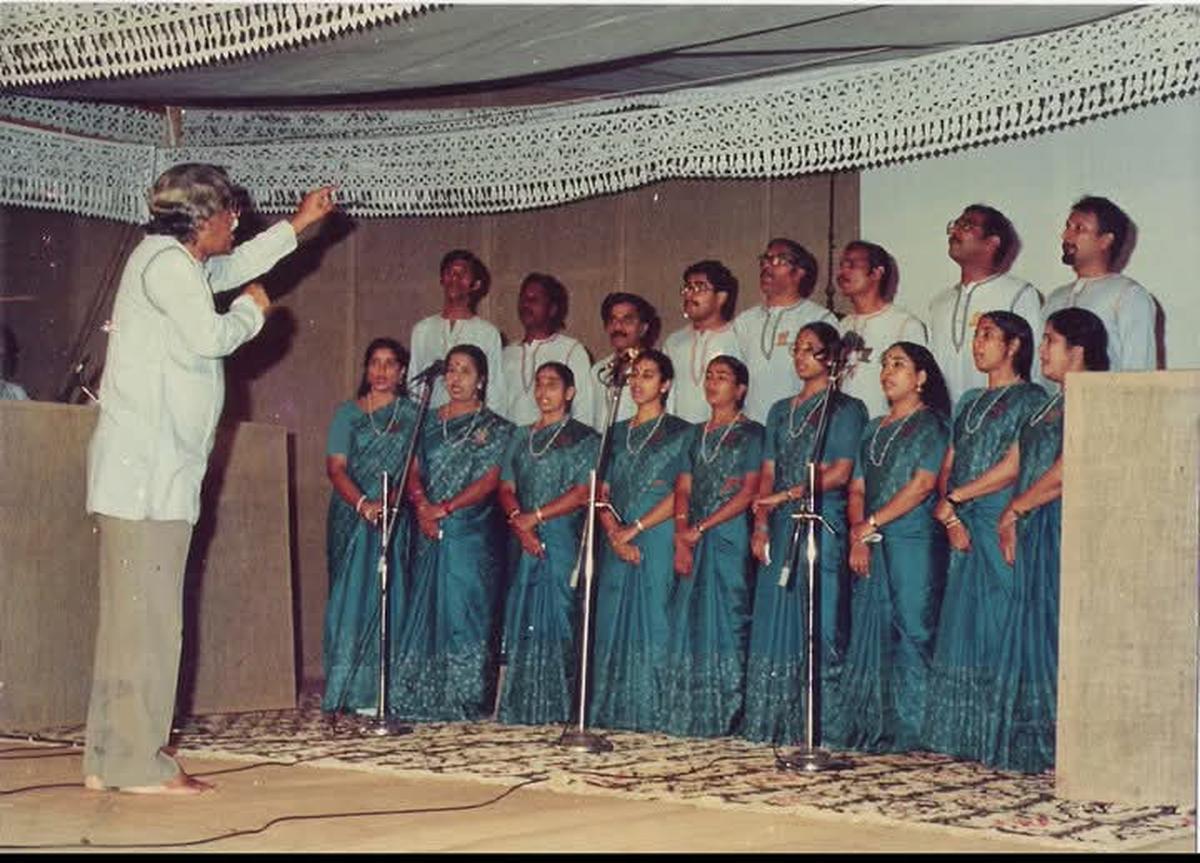
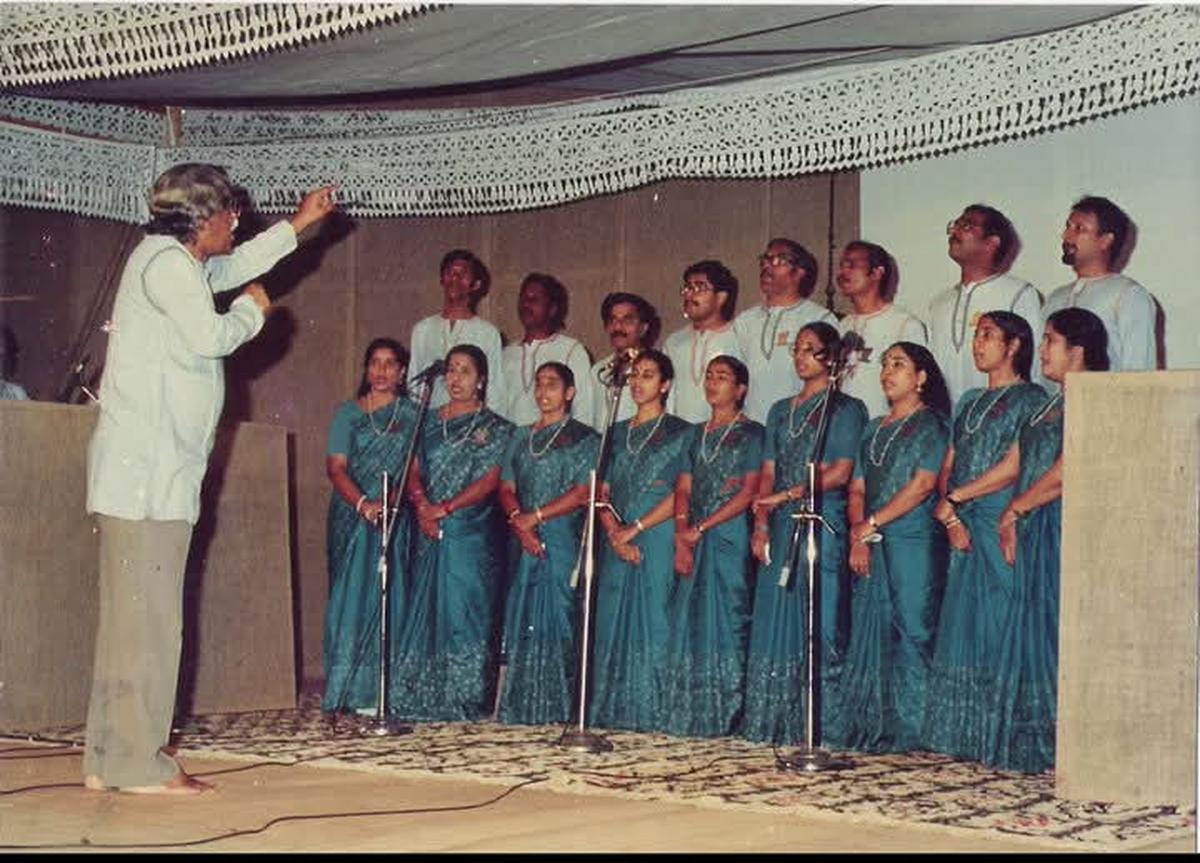
M.B. Srinivasan conducting the choir.
| Photo Credit:
Courtesy: MMC
Born in Andhra Pradesh on September 19, 1925, he had his schooling at P.S. High School, Chennai. During his college days at Madras Presidency, he was drawn to communist ideals and soon aligned with the communist movement. As an active member of the Indian People’s Theatre Association (IPTA), he played a key role in mobilising artistes, playwrights and musicians towards socially-relevant art. He married Zahida Kitchlew, a Kashmiri Muslim and daughter of freedom fighter Saifuddin Kitchlew.
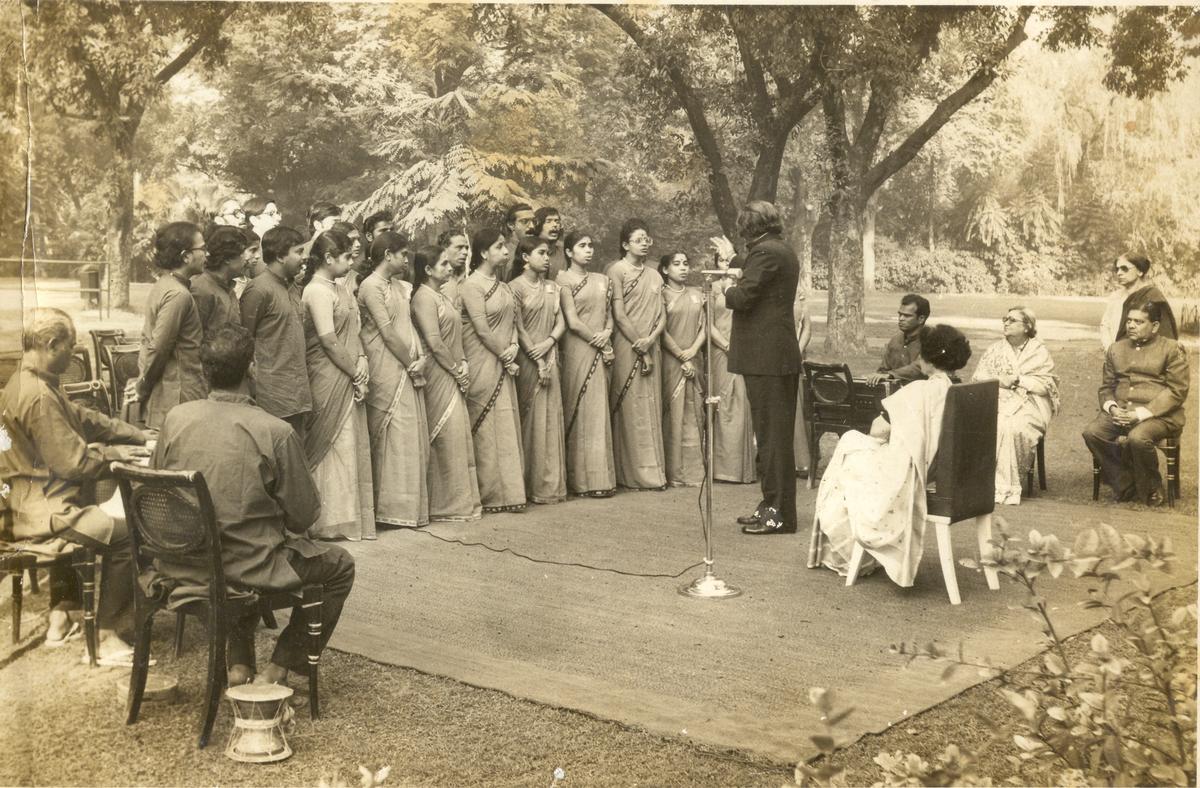
The choir performing in the presence of former Prime Minister Indira Gandhi.
| Photo Credit:
Courtesy: MMC
It was Srinivasan who gave a memorable break to one of India’s finest voices, K.J. Yesudas. He collaborated with several top singers of the time. Singer S. Janaki won a National award for her song ‘Ettumanoorambalathil’. Srinivasan gave P. Jayachandran his award-winning song ‘Ragam sree ragam’. He wrote the lyrics for Usha Uthup’s hit movie song ‘Peethambara O Krishna’. His first film song was composed to noted Tamil writer-lyricist, Jayakanthan, for the film Paadhai Theriyudhu Paar. Srinivasan even played the lead role of an eccentric professor in John Abraham’s Agraharathil Kazhuthai, which went on to become a popular, and perhaps, one of the most controversial Indian films.
Srinivasan was the founder of Cine Musicians’ Union and played a major role in securing labour rights for cine musicians, fighting for fair wages and regular hours. As chairman of Indian Performing Rights Society (IPRS) for years, he strove to protect the rights of music composers, lyricists and provide royalties to them. Rightfully so, an auditorium has been named after him as MBS Memorial Hall. He was one of the founders of FEFSI (Film Employees Federation of South India) and was nominated by the former Prime Minister Indira Gandhi to the Advisory Committee of NCERT — the National Council of Educational Research and Training.
Pioneering efforts in choral music
While his work in films was significant, Srinivasan’s true legacy lies in his pioneering efforts in choral music. In 1970, along with Vasanthi Devi (then Vice Chancellor of Manonmaniam University, K.S. Subramanian and wife Zahida), he launched a youth choral group for a programme on All India Radio (AIR) under the banner — Bharathi Ilangnar Isai Kuzhu. Its radio show, Ilaya Bharatham, was well received. This led to his forming the Madras Youth Choir in 1971 and as its composer-director trained young enthusiasts to sing songs on peace, love and patriotism. He chose the songs penned by national poets such as Subramania Bharathi, Muhammed. Iqbal, K.C.S. Arunachalam and Rabindranath Tagore and set them to music. He then choralised the compositions, which became popular, especially amongst the youth. He was the director of AIR Choral Group, Chennai, for eight years and composed over 200 choral compositions based on Indian classical and folk melodies, infusing elements of Western harmony into Indian music. His riveting compositions include Bharathiar’s ‘Vasana Kavithai’ – Mazhai, in a six-part choral arrangement, Bharathidasan’s Amma unthan kai valaiyai, Manavalan’s Bhagat Singh, and the Telugu poet Dasarathi’s Pillalaara which became a household song in the late 1970s and 80s.
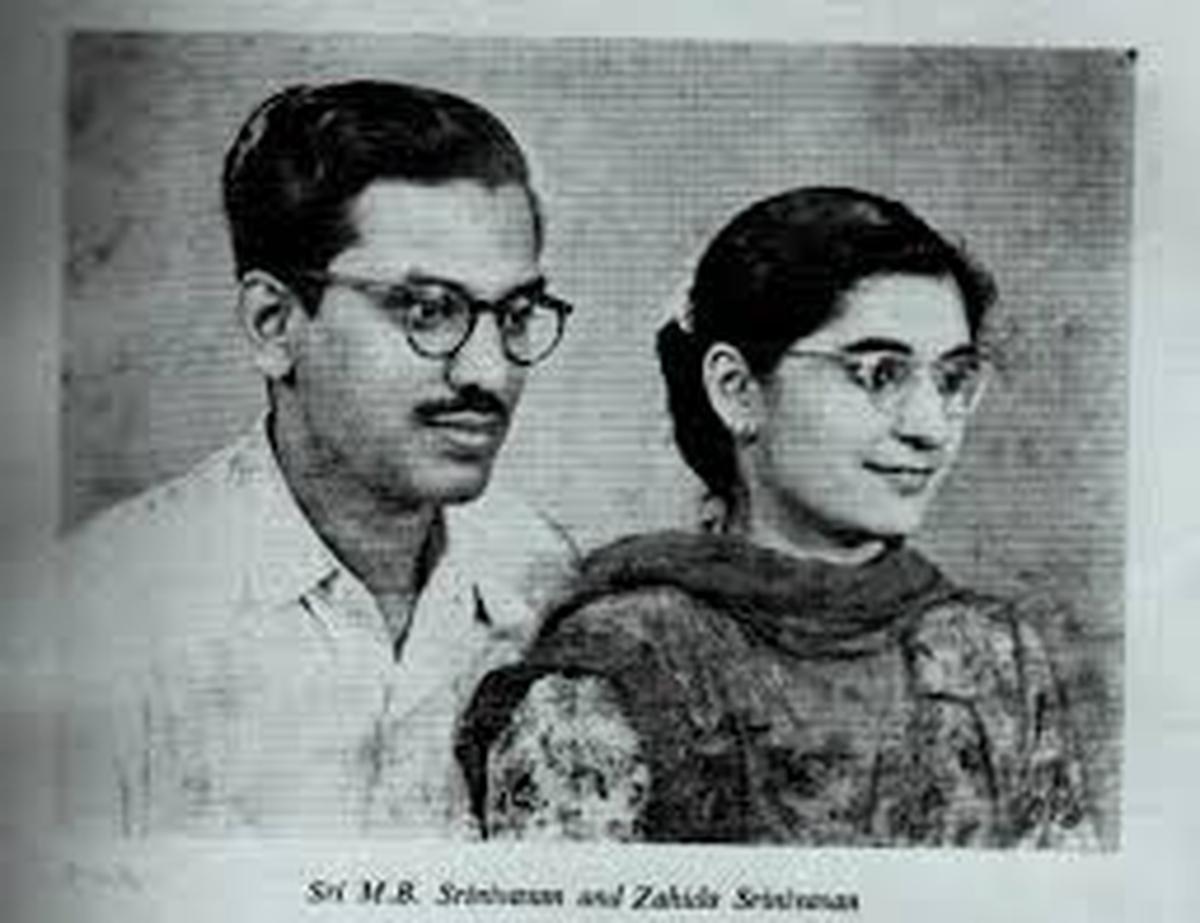
Srinivasan with wife Zahida Kitchlew
| Photo Credit:
Courtesy: MMC
In 1986, he helped set up the Kerala University Choir. M. Jayachandran, today’s leading music director was once a member of the Kerala University Choir. He describes Srinivasan as a musical genius and considers him as his guru. Well-known Carnatic vocalist Sudha Ragunathan and musician and composer Rajkumar Bharathi were part of the AIR Choir Group in Chennai and also sang in the Madras Youth Choir.
Recalling her association with Srinivasan, Sudha says: “A stickler for time and discipline, MBS sir was an epitome of perfection. I have worked with him for five years and was always amazed at his penchant for ‘newness’ in sound. His music carried the pulse of the people, the cry of justice and the tenderness of hope and dreams. Through his choirs, he proved that voices united in harmony could be stronger than any slogan, more enduring and effective than any speech. He gave music a conscience and in every note that he wrote, there was courage, compassion and the dream of a better world. I cherish my memories with MBS sir to date.”
Awards for excellence
Srinivasan won several awards including the FIE Award for Creative Excellence in Choral Music, Sangeet Natak Akademi Award for Creative/Experimental Music and Kerala State Film Awards for Best Music Director. The Malayalam films Nirmalyam, Swayamvaram, Prayanam, Swathi Thirunal, and Utharayan, for which he composed music, won National Awards.
Srinivasan conducted mass singing with nearly 6,000 children in across Tamil Nadu, Kerala and Karnataka. He died of a heart attack while conducting a choir in Lakshadweep on March 9, 1988, but his spirit lingers. He gave us songs that spoke for the people, launched voices that became legends and built choirs that still echo his vision. His inspiring call ‘Come, let’s sing together,’ focussed on youth and collective singing. The MBS Youth Choir (also referred to as MBSYC) was established in 1988 in Thiruvananthapuram to celebrate his memory.
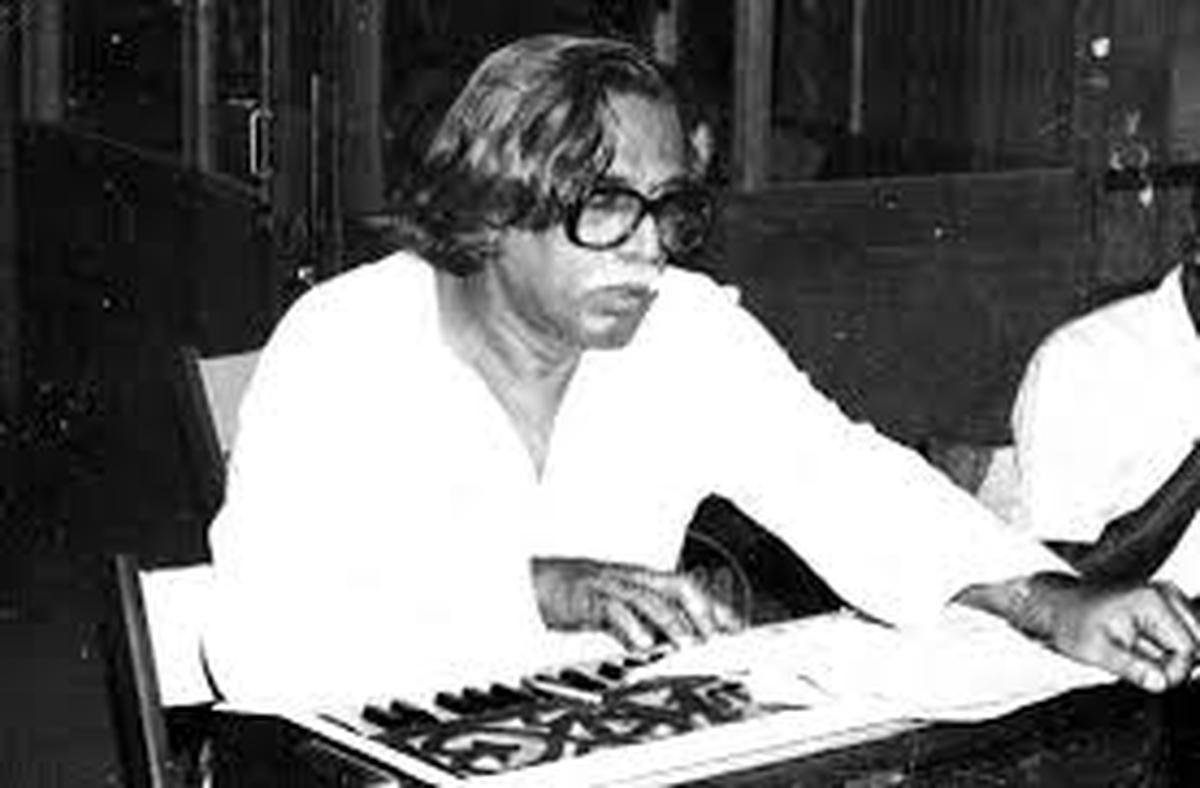
Srinivasan’s legacy lives on
| Photo Credit:
Special Arrangement
The Madras MBS Choir and its sister group in Kerala, MBS Youth Choir, have been working together to keep Indian choral music alive. The Madras MBS Choir plans to celebrate its founder centenary with a special concert on September 20, 2025 at P.S. High School auditorium in Chennai.
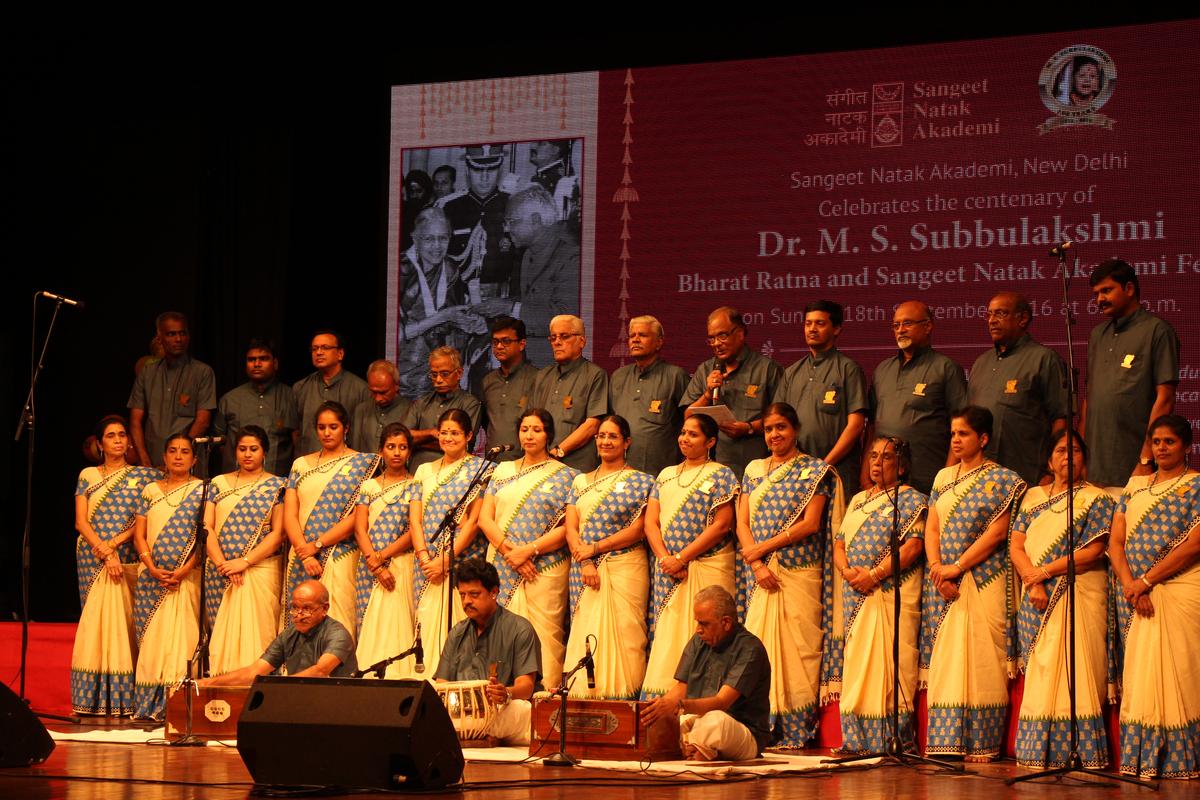
The choir performing at M.S. Subbulakshmi centenary celebrations in 2016 at Shanmukhananda Sabha in Mumbai
| Photo Credit:
Courtesy: MMC
The Madras Youth Choir (MYC) celebrated its golden jubilee with a concert in Chennai in 2023. It boasts of a few senior members who have been with the choir for decades and were trained by Srinivasan. Renamed as Madras MBS Choir (MMC) in 2024, it carries forth his legacy of spreading messages of love for humanity, richness of India’s languages and the greatness of its poets. To build awareness MMC conducts workshops in choral music techniques for teachers and students, and outreach programmes across schools. It also conducts the annual inter-school Indian choral music competition. All this effort led to the Sangeet Natak Akademi recognising the choir’s efforts with a grant. The choir was also invited by the Akademi to perform at events such as the M.S. Subbulakshmi centenary celebrations in 2016 at Shanmukhananda Sabha in Mumbai, and the Shresht Bharat cultural festivities in Thanjavur in 2019. It was a wonderful opportunity to showcase the Indian choral music compositions of MBS, when in 2017, it was invited to participate in the International Choral Music Festival in Washington DC in 2017. The event celebrated John F. Kennedy’s birth centenary with several choral groups from around the world. The choir is on the lookout for new voices.
Published – September 17, 2025 12:09 pm IST