



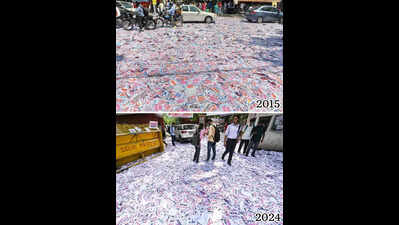
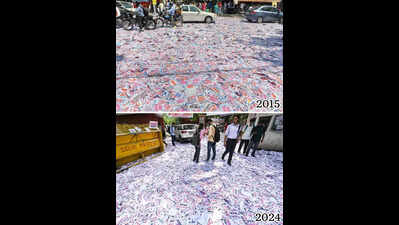
New Delhi: Tuesday was the final day of campaigning for the Sept 18 Delhi University Students’ Union (DUSU) elections — and the campus felt nothing like it once did.Cluttered walls once plastered with pamphlets had now transformed into a high-voltage digital spectacle. While college-to-college interactions were still a big part of the process, a ban on printed pamphlets made this year’s campaign take a dramatic leap into the world of social media — and it showed.Campaigning videos were choreographed at selected backdrops like film sets, complete with trending soundtracks and dramatic drone shots. Classroom rallies unfolded to catchy background music. Candidates hired PR firms, collaborated with influencers, and saturated social media with a relentless flood of curated reels. Some teams posted over 30 reels a day — from fiery speeches and street plays to snappy slogans and behind-the-scenes moments — all carefully packaged for Gen-Z voters’ screens.Both ABVP and NSUI set up dedicated ‘social media war rooms’ — buzzing nerve centres where campaign strategies were drawn, reels edited, and comment sections monitored in real time.ABVP has been recording podcasts with all four of its candidates and releasing short clips online. Each candidate — Aryan Maan (president), Govind Tanwar (vice-president), Kunal Chaudhary (secretary) and Deepika Jha (joint secretary) — now has a dedicated social media page, where follower counts are carefully tracked like vote tallies.NSUI has rolled out similar strategies for its candidates, led by Joslyn Nandita Choudhary, the first woman in 17 years to contest for Dusu president, along with Rahul Jhansla (vice-president), Kabir (secretary) and Lavkush Bhadana (joint secretary). The results are interesting: Joslyn currently leads with nearly 1.3 lakh Instagram followers while Maan commands a following of about 46,000.For many students, this new digital approach is a welcome change from the poster wars of the past. “Earlier, we saw how the campus would be buried in posters and pamphlets. Reels are more relevant in today’s times and reach more people,” said Prakhar, a second-year student.Some students, however, worry the campaigns are becoming more about aesthetics than issues. “It shouldn’t be about trending songs and eye-catching videos, with no real discussion on issues,” said another student.Others see it as a mirror of India’s larger political culture. “Whatever happens in Dusu serves as a microcosm of the country’s politics,” said Gursanjan Singh Natt from St Stephen’s College. “Social media is where everyone is mentally present the entire day. Even without the poster ban, it was always going to dominate.”Inside those war rooms, meanwhile, campaign teams work 12-hour shifts — designing digital flyers, cutting professional-grade videos, and replying to hundreds of comments in real time. It’s clear the battle for DU this year is being fought on screens as fiercely as it is on the ground — fast-paced, flashy, and unmistakably digital. Whether this new face of campus politics sparks deeper engagement or turns elections into yet another performance for the algorithm remains to be seen.