




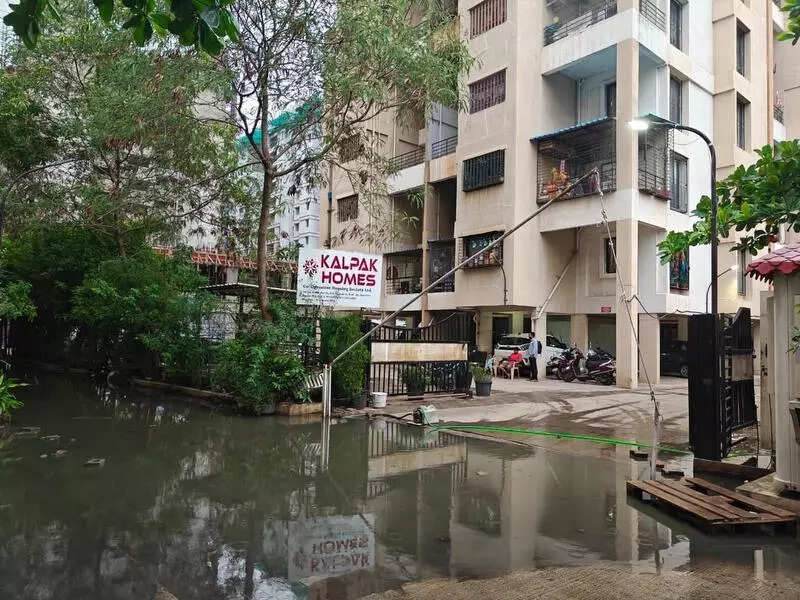
Pune: Imagine being forced to wade through a pool of ankle-deep, filthy and stinking sewage every time you step out of home to go to work or school, to meet family and friends, or even just for routine grocery runs nearby.This is the unfortunate reality in which over 5,000 residents of the Baif Road locality in Wagholi have been mired for at least three years now. This locality has always been a popular draw for residents due to its proximity to the Kharadi IT Park, even while it was under the gram panchayat before its merger into Pune Municipal Corporation (PMC) limits in 2021. But despite high-rises mushrooming on every street of this eastern suburb for over half a decade, the reality on ground is — quite literally — raising a stink. Not only do basic civic facilities remain elusive, but unchecked growth has brought severe consequences along, pointed out residents. Sewage backflow a constant concern “There is sewage everywhere, inside our complex and outside, too,” said Rupesh Pardeshi, chairman of Kalpak Homes Wagholi. This society, located at the end of Baif Road, is bearing the worst brunt of the sewage situation. Residents explained that amid major residential construction in the area, the old pipe networks are no longer able to handle the load of sewage passing through. Most of it flows back into societies or onto the road. Open plots into which the residents earlier released the sewage — as a makeshift solution — have now also been taken over by buildings. “Walking out or using a two-wheeler is impossible on most days. We use wooden crates as makeshift stepping-stones to leave our society on foot. Residents frequently fall ill and the stench is present round the year. Opening windows is a rare event for us,” he added. The monsoon makes matters worse. Rainwater and sewage mix and flood the neighbourhood, making the simple act of leaving one’s home a risk to safety and health. Pardeshi said, “The entire area outside our society garden is flooded with sewage and we cannot let our children go out to play. On some days, we find it difficult even to send them to school as they are forced to wade through sewage to exit and get into their school bus or van. Senior citizens cannot step out for walks. Many of us have repeatedly fallen sick due to the stagnant sewage water, which is a breeding ground for mosquitoes.” Societies on Baif Road are struggling with the drainage issue, explained Ajay Pardeshi, president of the Wagholi Welfare Foundation. He said, “There is a school a mere 500m away and the health of children is at risk. Residents are unable to open their windows and doors because of the stench. This is no way to live. As an association, we have reached out to all authorities and local leaders, but no one has helped. We have all invested our hard-earned money and bought houses here. We pay taxes and get notices when we don’t pay on time. However, we don’t even get basic amenities in return. We are planning an agitation after Ganeshotsav as nothing seems to be improving.” Authorities held to account for situation Since 2022, Baif Road residents have been running from pillar to post to get a single authority to pay heed to their sewage woes. Despite multiple complaints to the Pune Metropolitan Region Development Authority (PMRDA), Maharashtra Pollution Control Board (MPCB) and PMC, nothing has changed, they said. “The area is growing rapidly, but there is no sign of new infrastructure or even basic drainage and stormwater lines being added. The gram panchayat and PMRDA gave permissions and completion certificates to builders without any on-ground inspections. The authorities and builders together are responsible for this mess. Now, the infrastructure cannot take the load of the growing population,” said Rahul Zaware, an IT professional and secretary of Solacia E1/E2 cooperative housing society. “Roads are in a bad shape and dangerous. Without a main sewer or stormwater line, water keeps flowing back into lanes and causes waterlogging,” added Zaware. Residents highlighted that even today, new projects are underway and thousands of more residents are set to be added to the area’s demographic in the next few years, making the situation worse.Increased costs for water, maintenance Most newer societies on Baif Road are equipped with individual sewage treatment plants (STP), which ensures that nearly 60% of their water output gets recycled and reused for the garden or for flushing. However, the remaining 40% needs an outlet. When passed through the unchanged, narrow drainage chambers of the area, sewage flows back into the society at the end of the lane, or is then let out by some into the sole empty PMRDA amenity plot nearby. This comes with its own problems. “Water from the empty plot is likely to seep into groundwater and pollute it. In a way, we are drinking our own sewage. Our primary source of water is borewells or tankers, which also pick up water from nearby wells. Authorities must take cognizance of this sitauation before something serious happens,” added Zaware. These fears of residents are compounded by the Guillain-Barré Syndrome (GBS) outbreak experienced in some areas of the city in 2024, which was attributed to drinking water contaminated by waste. Now, a few societies here are going the extra mile to minimise sewage output. Abhijeet Boralkar, chairman of Green Groves society, said they try to reuse 100% of treated sewage. “Our STP works round the clock and we hired staff to keep watch on it. The load on the plant is large, but we have no other option. We are not only paying higher maintenance as the STP needs more electricity and manpower, but we also pay for tankers, then the society’s water treatment plant, and then our individual RO purifiers. Also add to this the cost of suction machines, which help remove waterlogged sewage,” he enumerated. “As parents, we are always concerned that despite doing all of this, we are playing with the lives of our children, our elders and our own, too,” Boralkar said.“I moved to this area in 2016 and it’s been nine years of not having even the most basic civic facilities. Mosquitoes are a constant concern because of the stagnant sewage. It is frustrating that despite having heavily invested in buying a house in this ‘upcoming area’ and paying high property taxes, this is what we get in return. The worst part is that we have no option. We just have to live with this every single day,” IT professional Pradeep Singh, another resident said. First official meeting brings hopeAfter a series of complaints, a letter sent by the Solacia E1/E2 society on this issue finally caught some official attention. The MPCB sub-regional office on July 28 this year wrote a letter to the director of development permission and planning at PMRDA and to PMC about the environmental and infrastructure deficiencies posing a risk to public health and the environment at large in this locality. In the letter, MPCB sub-regional officer Kartikeya Langote laid out four main grievances and asked both authorities to investigate the complaint regarding the area’s water supply and sewerage connectivity status, approved infrastructure plans for the area and the present civic infrastructure support for sewage and stormwater management. The letter stated, “As a planning authority, immediate intervention is required from your office to ensure that proper public infrastructure is provided, and to prevent further degradation of environmental and public health conditions in the area.” Following this, on Aug 5 this year, residents met officials of MPCB, PMRDA and PMC to discuss drainage issues. At the meeting, a few action points were agreed upon. PMRDA officials were to facilitate coordination between societies and developers, and MPCB would write to PMC and PMRDA to withhold approvals for projects wherever basic infrastructure is absent. MPCB also agreed that no new construction permissions should be granted in the area until proper drainage and stormwater lines are fully developed. A follow-up meeting was to be held on Aug 7 with PMRDA commissioner Yogesh Mhase — but a month down the line, this meeting is still pending, leaving residents waiting with bated breath for a concrete resolution._______________________________ Officials Say‘We have suggested no further construction’We recently held a common meeting with all officials and suggested immediate action to resolve the issue, including not allowing further constructions in the area. The drainage lines in the area were laid when the gram panchayat was the authority, but the population has grown. These are not enough anymore. MPCB gives a go-ahead once the local body and planning authority has given their nod. For these constructions, since both PMRDA and the gram panchayat had signed off, we signed off as well. We will try from our end to resolve the issue as much as possible and help coordinate with the other authorities to the best of our ability — Kartikeya Langote | Sub-regional Officer, MPCB__________________________‘Infra works are local authority’s responsibility’The PMRDA keeps conducting drives to get rid of illegal encroachments and Wagholi is no exception. The area is expanding at a rapid pace. Wagholi is under PMC and so, taking action and keeping check falls under its jurisdiction. We are not the authority for infrastructure. The local governing body (first the gram panchayat and now PMC) must develop drainage lines as per the need of the area. In new areas that PMRDA is developing, we have taken it upon ourselves to work on the civic infra as well, to avoid such issues in the future. We are also learning from our mistakes. We are not denying that there is a problem or pushing the blame on another authority — Deepak Singla | Additional Commissioner, PMRDA____________________________‘Gram panchayat should have done the needful’When the area was under the gram panchayat, sewage was being let out into nearby farmlands in this area. Now, the farmers to whom these lands belong, either want to get them developed or sell them off. They are no longer allowing sewage to be let out on their land. As a result, there is no place for sewage to go anywhere. Ideally, a pipeline network should have been built to take the drainage downstream. Backflow will create sanitary issues. A solution must be sought at the earliest. We also need land in our possession to be able to do pipeline work. We are trying our best, given the current circumstances — Ravi Khandare | Executive Engineer, PMC Drainage Department