




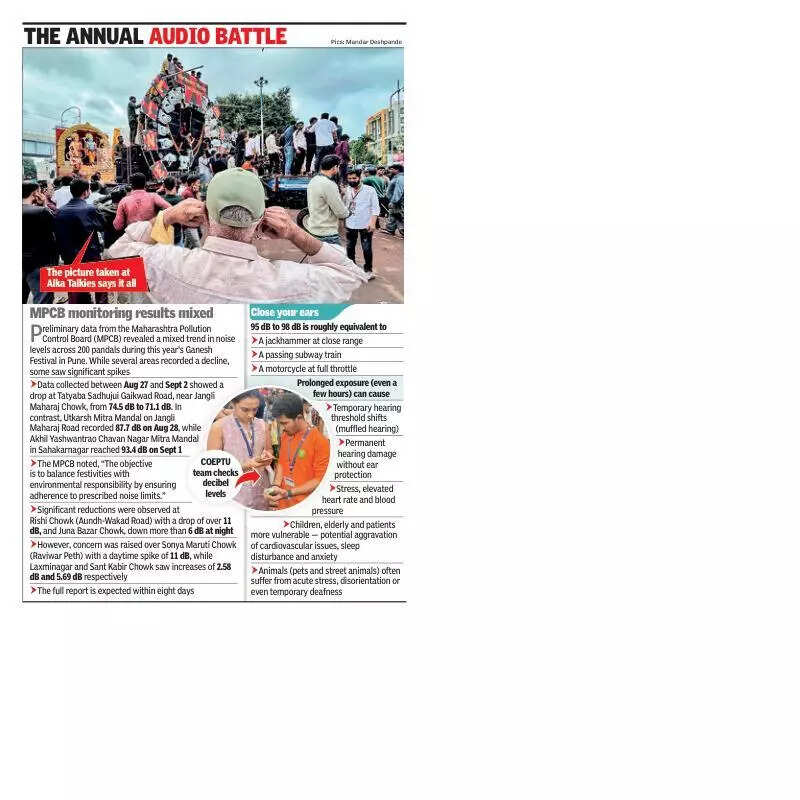
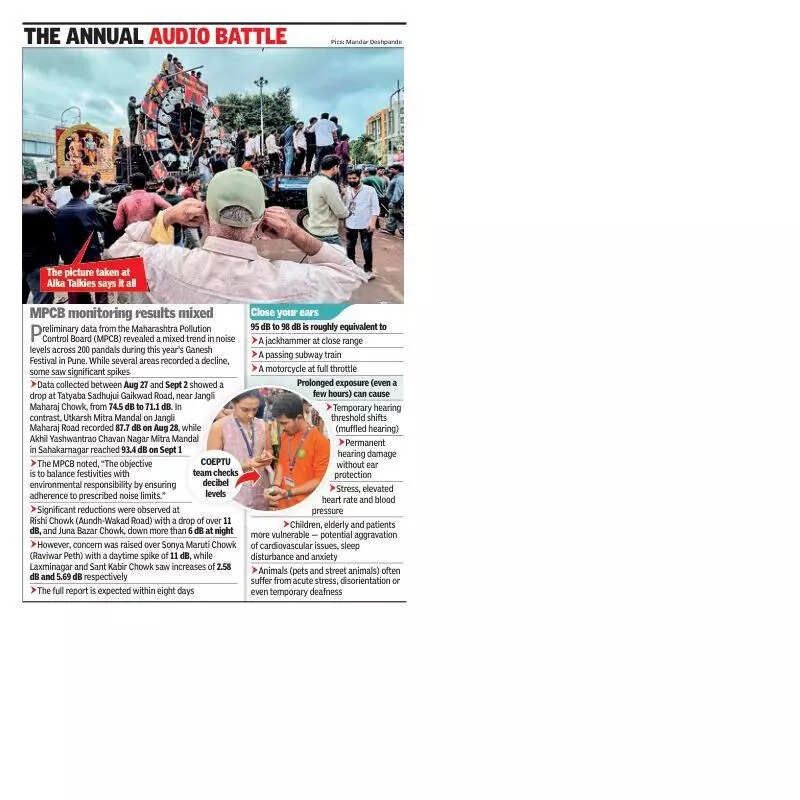
Pune: The Ganapati immersion-day noise monitoring by College of Engineering Pune (COEP) Technological University students may have recorded a marginal dip in sound levels this year — lowest since the pandemic — but the overall exposure remained alarmingly above permissible limits.The average noise across 10 chowks on Laxmi Road during the two-day immersion (Sept 6 and 7) was 92.6 decibels (dB), down from 94.8 dB last year. COEPTU attributed the 2.2 dB fall to improved procession planning, tighter crowd control, better coordination with mandal volunteers and a clampdown on post-midnight sound systems.However, readings remained well above the Central Pollution Control Board (CPCB) norms — 55 dB for residential and 65 dB for commercial zones during the day. COEPTU study said even traditional instruments are contributing to persistently high levels.The loudest average was recorded at Belbaug Chowk (98.8 dB), followed by Kumthekar Road (95.2 dB) and Holkar Chowk (94.7 dB).The extremes were stark: the quietest recorded moment was 61.6 dB at Khandojibaba Chowk on Sept 6 at noon, while the loudest spike hit 111.8 dB at Kumthekar Chowk on Sept 7 at 8 am.Professor Mahesh Shindikar, head of the department of applied science and engineering, COEPTU, said, “These swings reflect how short bursts — DJs, bands, or localised amplifiers — push exposure well beyond acceptable limits.”Despite the overall drop, some chowks saw a rise. Kumthekar Chowk crossed last year’s 94.9 dB to 95.2 dB and Shedge Chowk rose from 92.8 dB to 93.9 dB. “It shows certain pockets continue to defy regulations despite improvements elsewhere,” said the COEPTU student team.The relief was negligible for residents. Kaumudi Joshi of Narayan Peth said, “The noise levels just do not seem to reduce despite action and prohibition by the authorities. A slight drop does not do any good. Many senior citizens live in peth areas and these sounds are proving harmful to them.”The COEPTU team, led by Mohit Kandalkar and Shreya Karande, recommended several measures: permanent decibel displays, real-time noise monitoring during processions, time-restricted permits for amplified sound and crackdowns on plasma speakers. “Even with police and volunteer support, single-point peaks — like last year’s 118 dB — show that regulators cannot afford to relax vigilance,” they said.Residents remain unconvinced. Malati Vedpathak of Apte Road said, “There is no end to DJs and even dhol-tasha troupes flouting norms. The festival has become unbearable because of the blaring sounds — not just on immersion day, but throughout the celebrations.”Senior citizen Ashok Tauke said, “Many of us suffer from high blood pressure and other ailments. These noise levels are unbearable, even for young people and children.”Health professionals echoed the concerns. Audiologist Vaibhavi Mohan warned of “aggravated cardiovascular issues, sleep disturbances, anxiety and even temporary hearing loss — not just for people, but also pets and street animals.”Sociologist Dyanesh Meshram of Savitribai Phule Pune University said even drummers, mandal workers, and police personnel are at risk. “They are within the noise field for extended durations, often unprotected.”COEPTU has urged continued vigilance, technical controls and public awareness to safeguard vulnerable groups.———————————————-MPCB monitoring results mixedPreliminary data from the Maharashtra Pollution Control Board (MPCB) revealed a mixed trend in noise levels across 200 pandals during this year’s Ganesh Festival in Pune. While several areas recorded a decline, some saw significant spikes.Data collected between Aug 27 and Sept 2 showed a drop at Tatyaba Sadhujui Gaikwad Road, near Jangli Maharaj Chowk, from 74.5 dB to 71.1 dB. In contrast, Utkarsh Mitra Mandal on Jangli Maharaj Road recorded 87.7 dB on Aug 28, while Akhil Yashwantrao Chavan Nagar Mitra Mandal in Sahakarnagar reached 93.4 dB on Sept 1.The MPCB noted, “The objective is to balance festivities with environmental responsibility by ensuring adherence to prescribed noise limits.”Significant reductions were observed at Rishi Chowk (Aundh-Wakad Road) with a drop of over 11 dB, and Juna Bazar Chowk, down more than 6 dB at night.However, concern was raised over Sonya Maruti Chowk (Raviwar Peth) with a daytime spike of 11 dB, while Laxminagar and Sant Kabir Chowk saw increases of 2.6 dB and 5.7 dB respectively.The full report is expected within eight days.————–*** 95 dB to 98 dB is roughly equivalent to:– A jackhammer at close range– A passing subway train– A motorcycle at full throttle*** Prolonged exposure (even a few hours) can cause:– Temporary hearing threshold shifts (muffled hearing)– Permanent hearing damage without ear protection– Stress, elevated heart rate and blood pressure– Children, elderly and patients more vulnerable — potential aggravation of cardiovascular issues, sleep disturbance and anxiety– Animals (pets and street animals) often suffer from acute stress, disorientation or even temporary deafness.————–Average readings (in dB) on Sept 6 and 7Spot — 2025 — 2024Belbaug Chowk — 98.8 — 99.8Ganapati Chowk — 92.7 — 95.8Limbraj Chowk — 93.4 — 98.1Kumthekar Chowk — 95.2 — 94.9Gokhale Chowk — 93.7 — 93.5Shedge Chowk — 93.9 — 92.8Holkar Chowk — 94.7 –94Tilak Chowk — 89.5 — 96.7Khandujibaba chowk — 82.1 — 90.2Average — 92.6 — 94.8