



These days, OTT films flirt with hinterland politics but settle for safe social commentary. They are conceived with the data-driven rigour of a journalistic research project, but executed with the unfinished, compromised soul of a half-written novel. The trending themes are child abuse and caste honour, but the actual grit remains strictly dialogue-heavy and dialect-deep. The volatile social issues get diluted by a cautious approach. The narrative feels distinctly over-vetted, leaving one with the inescapable impression that a legal team sat directly beside the editor, scrubbing away uncomfortable truths.
After Bhakshak, writer-director Pulkit once again creates a tense, morally grey heartland universe that pulls the distracted urban viewer in instantly, but after the build-up, the screenplay holds a flat pulse in what promises to be an intense tale of a conflicted cop whose conscience is still as pristine as his white shoes in the line of duty.
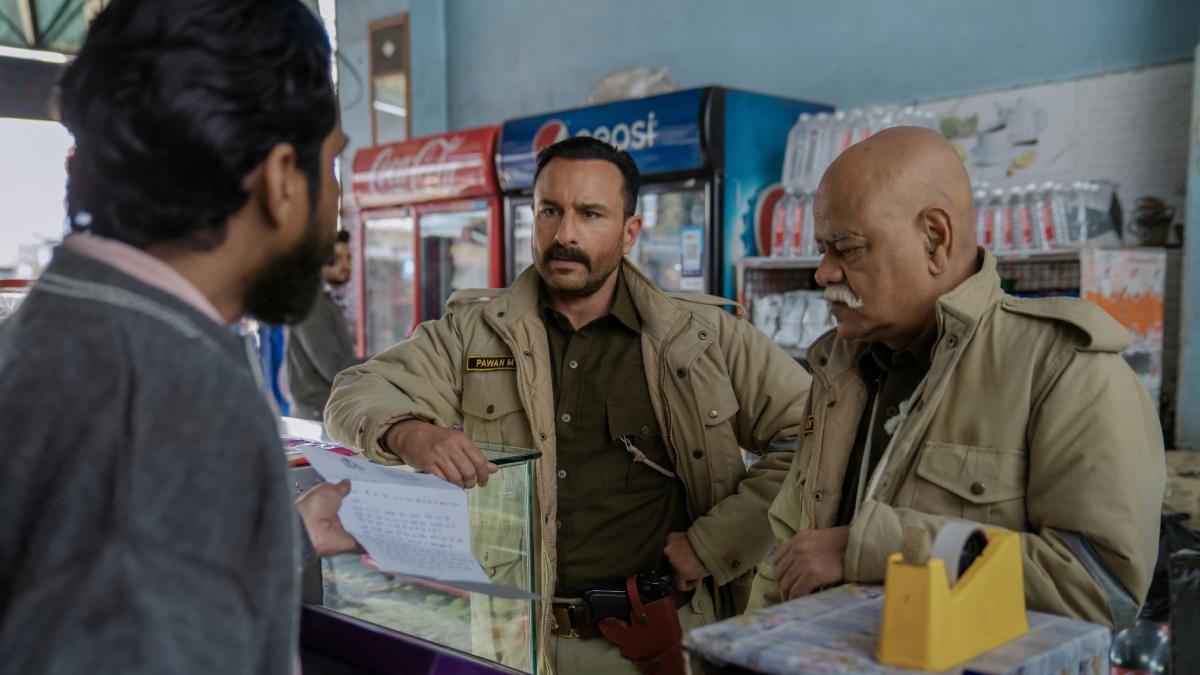
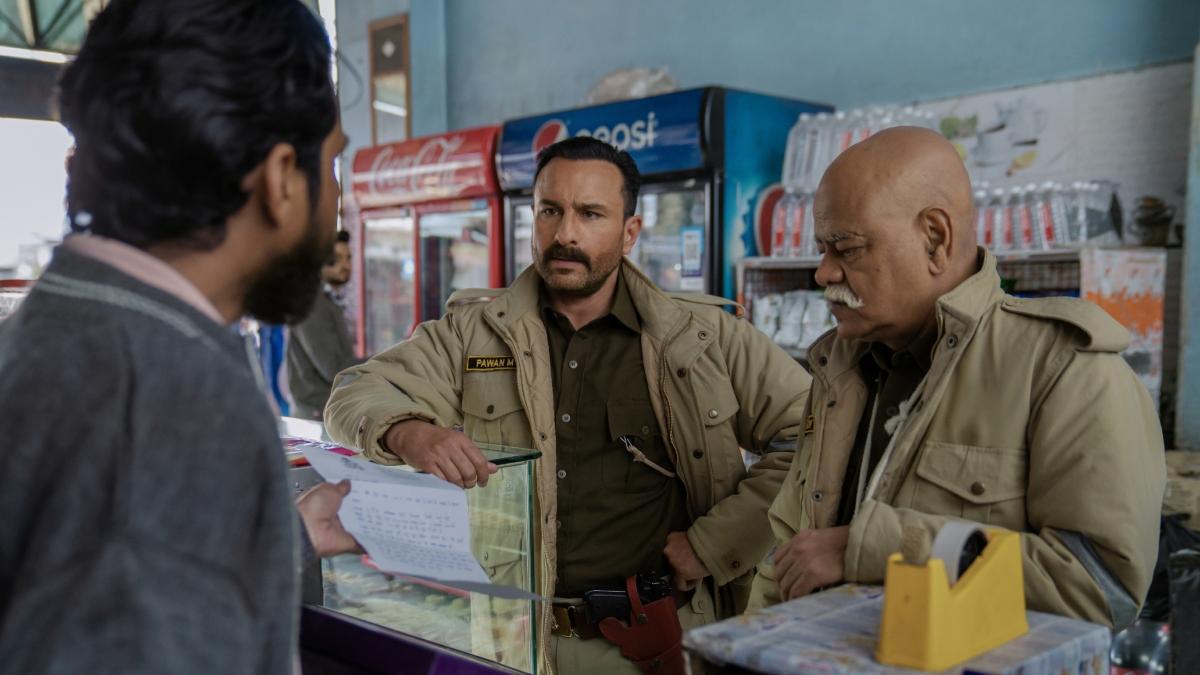
A still from ‘Kartavya’
| Photo Credit:
Netflix
Kartavya (Hindi)
Director: Pulkit
Duration: 147 minutes
Cast: Saif Ali Khan, Rasika Dugal, Sanjay Mishra, Saurabh Dwivedi, Zakir Hussain
Synopsis: A dedicated police officer faces intense professional and personal turmoil when a journalist under his protection is shot.

On his 40th birthday, Station House Officer Pawan (Saif Ali Khan) is at work providing security for a journalist and her team, in town to investigate serious charges against influential godman Anand Shri (debutant Saurabh Dwivedi).
A routine job turns into a nightmare when the journalist is shot, and his colleague and confidant, Ashok (Sanjay Mishra) gets injured in a shootout carried out by a teenager. About to be suspended by his superior (Manish Chaudhuri), Pawan seeks a week’s time to salvage his reputation. But before he gets going, the cop finds that his brother is missing, and the community feels that he has eloped with a girl from a caste considered lower in social hierarchy.
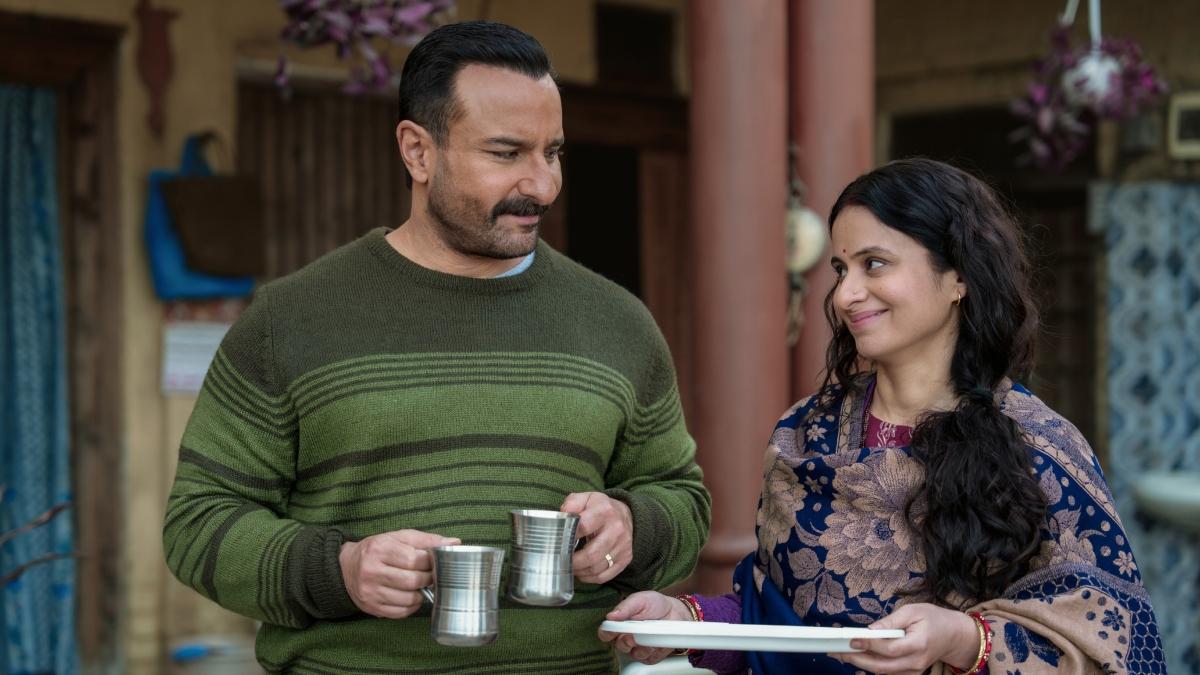
Saif Ali Khan and Rasika Dugal in ‘Kartavya’
| Photo Credit:
Netflix
As he investigates the layers of the two cases, he discovers that it is a lonely fight where he has to confront the corrupt system as well as his own father (Zakir Hussain), blinded by an atavistic idea of honour. Ashok nudges him towards self-preservation, but Pawan can’t resist being a wind of change.
The setup promises a deeply unpolished, realistic look at godman-bureaucracy collusion in a fictitious town on the West UP-Haryana border, but the makers steer clear of specifics, and the hints amount to little more than surface-level clues, like reducing surnames to M and Y. The storytelling gives a feeling that the events have been predetermined. For instance, the pilot vehicle follows the journalist’s car rather than leading it.

Pulkit nails the academic and structural side of the issues. Dialogues carry relevant interjections on the state of affairs that capture the intricacies of the caste divide and child abuse, but somehow, the emotional flavour and visceral connection feel manufactured. The characters seem to be struggling to free themselves of the archetypes. The story of teenager Harpal (Yudhvir Ahalawat looks the part) is not fully mined, and even though Pulkit tries to hide it as a big twist, the real shocker in the tale is visible from a distance.
Like the recent Subedaar, Kartavya sees a star attempting to immerse himself in a gritty, grounded world. Full marks for the ambition, but the effort is clearly visible. Saif successfully captures the exhaustion of an ordinary cop torn between a broken system and a fractured home. He has polished the art of projecting psychological warfare outward. While Saif treats Pawan’s collapse as a profound psychological crisis, the script quickly falls back on standard procedural beats and lazy twists and turns, while doing lip service to the philosophical conflict over duty. Of course, he has a son to bring up in a cruel world, but the motivation for Pawan’s fight against the tide is almost taken for granted. There is hardly any gradation in his understated heroism.
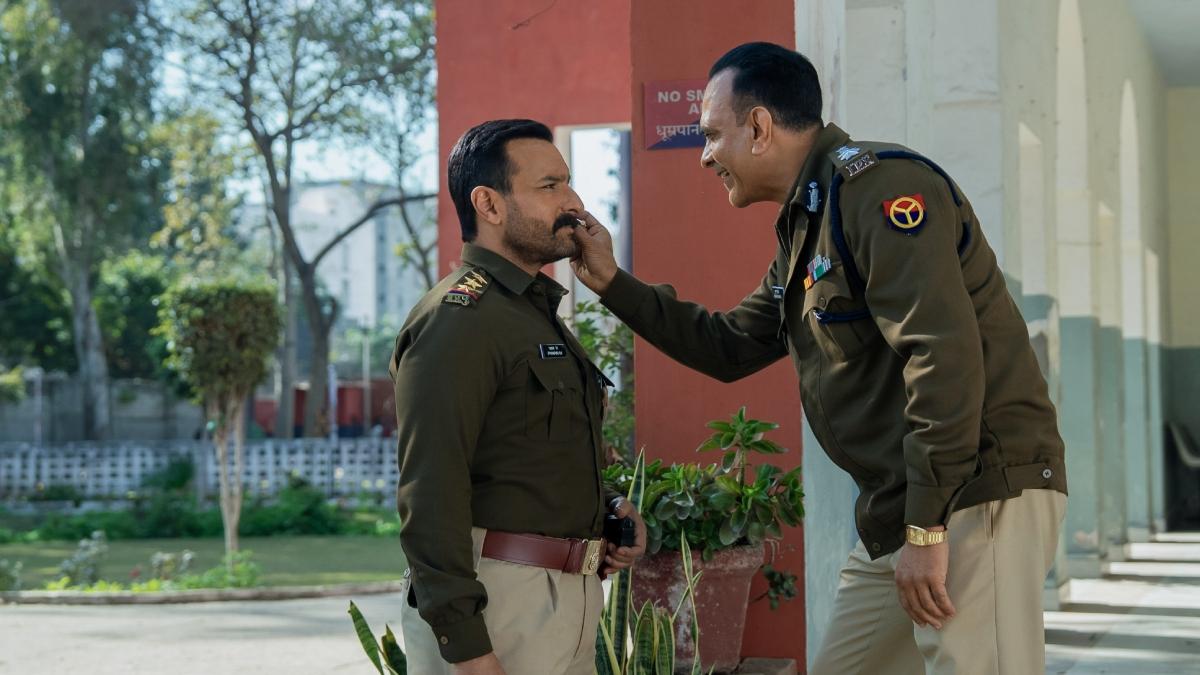
A still from the film
| Photo Credit:
Netflix
It is not the first time that Saif has ventured into the wild west or the scale of OTT. However, if you remember the western Uttar Pradesh swagger and dialect of Langda Tyagi in Omkara thrived within a theatrical, stylised world opposite Ajay Devgn. Similarly, the scale and ambition of Sacred Games were cinematic.
By contrast, the pursuit of authentic realism on a smaller screen falters, mirroring how the town of Shamli is weakly disguised as Jhamli. Placed in the company of the purveyors of naturalism, Mishra and Rasika Dugal, Khan’s performance occasionally exposes its own artifice. Much like Anil Kapoor in Subedaar, Saif, sometimes, feels like a larger-than-life actor consciously trying to fit into a smaller size.
The choice of two crucial supporting actors is a bit baffling. While Zakir is a fine actor, his portrayal as Saif’s father feels slightly off and doesn’t entirely land. Journalist Saurabh Dwivedi steps into the acting domain as the piece’s antagonist. For a story spurred by the murder of an investigative journalist, the film employs a meta-fictional approach by casting real-life journalist Saurabh Dwivedi as a villainous figure. The characterisation highlights the lethal dangers facing media in volatile regions, with Anand Shri’s line, “committed journalists are an endangered species,” serving as a cynical diagnosis of a system without protections for truth-tellers.
As an influencer, he might bring in the likes, but Saurabh needs to shed the anchor’s voice and internalise the dialogues. He must have discovered that acting is not limited to hand gestures and voice modulation; it demands full-body coordination. The director helps him by moving the camera behind his back in crucial scenes, but the cheating shows.

More importantly, his character arc remains unrealised. As the grand orchestrator of a horrifying crime syndicate that employs minors, Anand Shri’s internal motivations and depth are perhaps deliberately left unexplored. It means the script denies Saif a dynamic rival to bounce his performance off of, reducing Kartvaya to a tense ride that ultimately settles for a safe parking spot.
Kartavya is currently streaming on Netflix
Published – May 15, 2026 01:45 pm IST