


From courtrooms to a disaster site, from the battlefield to the archaeological dig, the age is a frequently asked question. A study from Armed Forces Medical Services has now demonstrated that advanced dental imaging can estimate age with remarkable accuracy.Lt Col Dr Poonam Prakash, a classified specialist in prosthodontics at Command Military Dental Centre, Udhampur, has developed a method that uses Cone Beam Computed Tomography (CBCT) scans of the upper front teeth to calculate the pulp-to-tooth volume ratio (PV/TV). Her research, published in the Medical Journal Armed Forces India, could change how age estimation is carried out.The study examined 1,800 male soldiers aged between 20 and 40. Using high-resolution CBCT scans and advanced HOROS software, researchers calculated pulp and tooth volumes. “Since pulp naturally shrinks with age, the pulp-to-tooth volume ratio provides a biological marker of the chronological age,” she said.
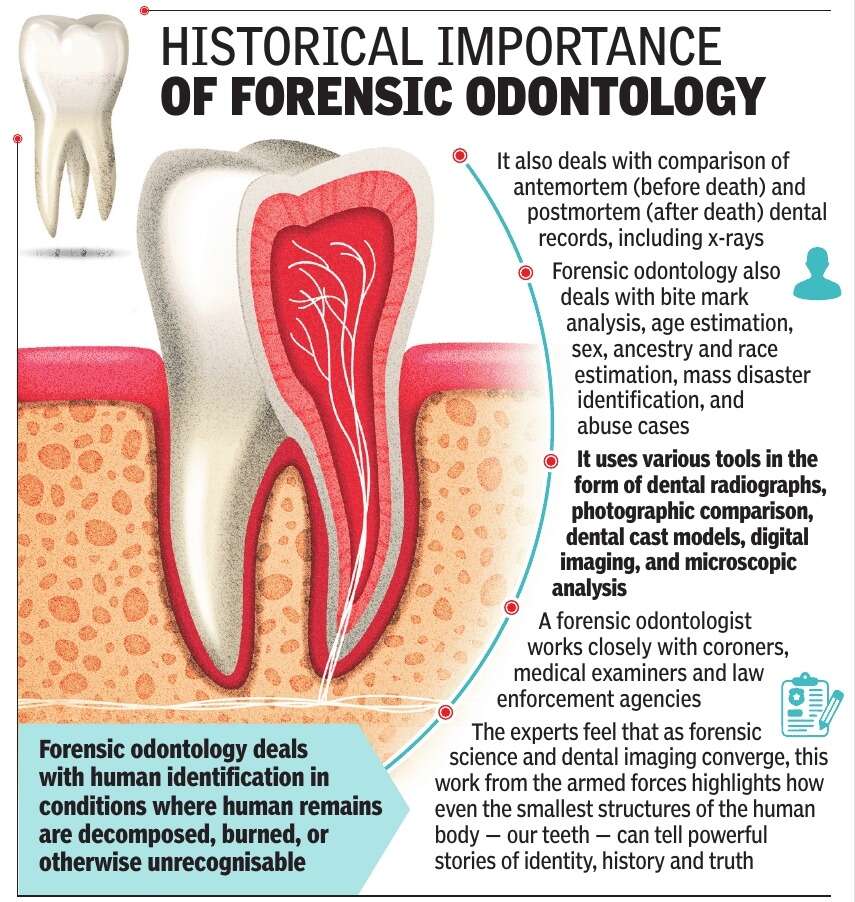
Among the teeth studied, canines showed the strongest correlation, enabling prediction models with up to 96% accuracy and a margin of error between 3.5 and 4.3 years — figures considered highly reliable in forensic science, she said. “This is a non-invasive, scientific and reproducible method for age estimation,” Dr Prakash said. “It has applications not just in dentistry, but in fields ranging from forensic to archaeological research.”A tool for justice and scienceFor the armed forces, the method could help in verifying age at the time of recruitment, authenticating service records and identifying soldiers. “In situations like floods, earthquakes, or battlefield casualties, where bodies are often unrecognisable, dental structures are one of the few elements that survive,” a senior officer from the armed forces medical services, a forensic odontology expert, told TOI.This study adds a layer of accuracy to the identification process critical for families waiting for closure, he said.Legal experts also see the promise. “Courts often face disputes about juvenility in criminal cases or inconsistencies in official documents. A scientifically validated dental method like this could offer judges a dependable tool,” a senior public prosecutor, who worked on several juvenile justice cases in Pune and Mumbai, said.Archaeologists, too, are intrigued. “Age estimation through non-destructive imaging allows us to preserve skeletal remains while still learning about past populations,” Manager Singh, retired archaeologist from Archaeological Survey of India (ASI), said.Maj Gen SK Bhandari (retd), a maxillofacial surgeon, said, “This research is unique as it is based on a large volume of patient data. Accurate age identification is crucial in insurance cases too. Even in extreme situations, it has proven vital. One of the well-known examples is the identification of General Bipin Rawat after the air crash.”What lies aheadWhile the study’s success is evident, Dr Prakash and her team caution that further validation is essential. Expanding the database to include diverse population will be vital, she said.The science of examination, evaluation and identification of dental evidence in the interest of justice is forensic odontology. “This science has been prevalent since the World Wars. It was even used in the identification of top Nazis,” Brigadier SK Roy Chowdhury (retd), currently dean and professor at Dr DY Patil Dental College and Hospital in Pimpri, said.It also comes through when identifying human remains. “The preservation of dental records for members of the armed forces is crucial. They may need identification in case of fatality where it may not be possible to match with genomic sequencing,” Roy Chowdhury, an oral and maxillofacial surgeon, said.