



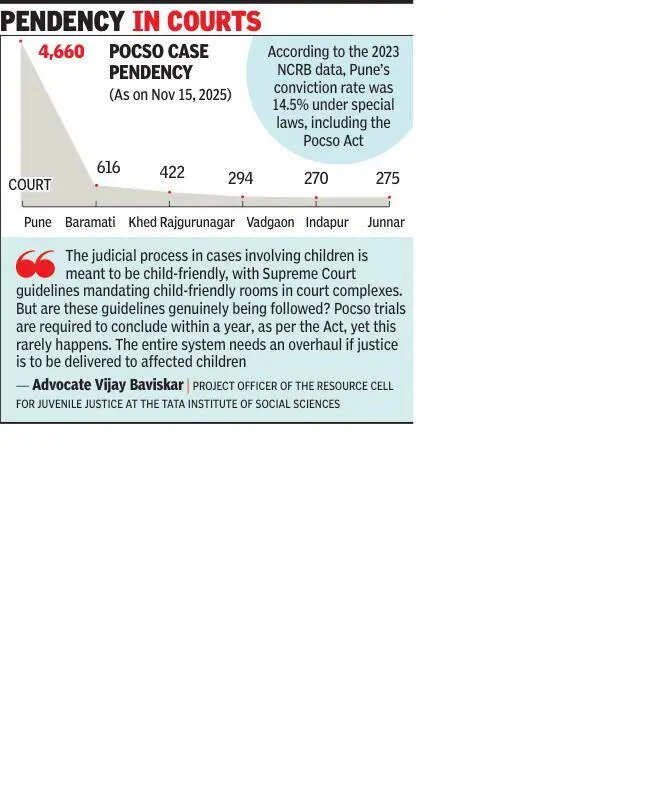
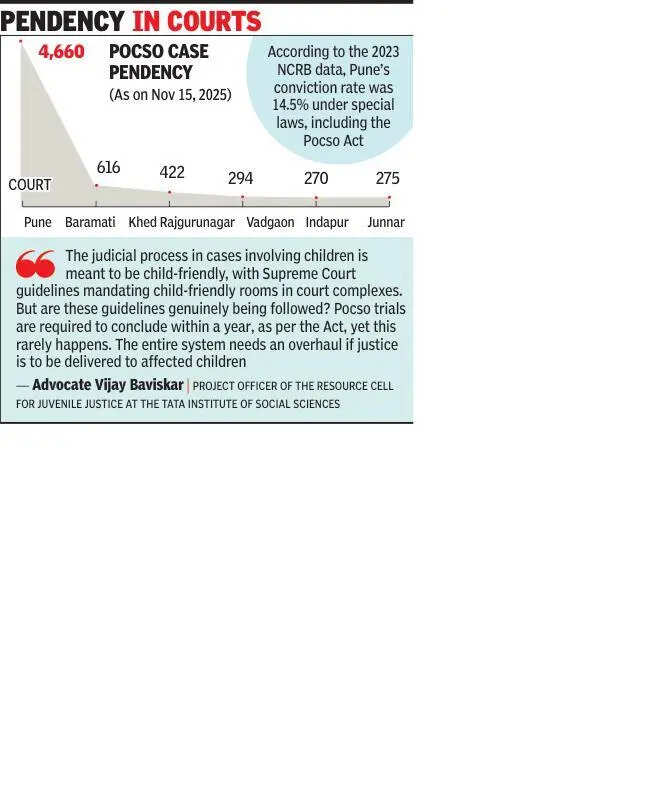
Pune: An 11-year-old girl allegedly sexually assaulted by a family member in 2021 is among several Pocso cases in Pune district where prolonged delays in trial ultimately resulted in acquittals.According to case records, the alleged assault took place on Oct 14, 2021, after which the child’s mother filed an FIR on Nov 16, 2021. Police then filed a chargesheet on Dec 6, 2021, after which the accused was sent to jail. Charges were, however, framed only on Dec 2, 2024, and when the survivor’s evidence was finally recorded in Nov 2025, she had turned hostile.Legal experts said the case reflected a broader pattern in trials under the Protection of Children from Sexual Offences (Pocso) Act, where prolonged proceedings often resulted in acquittals. In many such cases, the accused are known to the survivors, making them vulnerable to family and social pressure over time, they said.Judiciary data available till Nov 15, 2025, showed that 6,537 Pocso cases were pending across courts in Pune district, forming a substantial share of cases registered under special laws. Public prosecutor Leena Pathak said, “In serious offences under the Pocso Act, accused often secure bail due to delays in filing chargesheets and prolonged trials. If witnesses do not turn up or evidence is not recorded in time, it weakens the prosecution’s case.“Pathak said some accused avoided engaging a lawyer to delay framing of charges, and later approached the high court seeking bail on the ground of prolonged incarceration pending trial.Child rights activists warned that unless trials were completed within a year, convictions in Pocso cases would be increasingly difficult. Sharmila Raje, cofounder and director of Muskaan, an NGO working to support survivors, attributed the delays to a mix of factors. “There are not enough courts, defence lawyers frequently remain absent and repeated adjournments exhaust families. Preparing a child for every hearing, only to be told the matter is postponed, is extremely hard. Repeatedly revisiting the trauma is damaging,” she said.Raje said younger children tend to forget critical details over time. “In many cases, girls are married off soon after they turn 18. Often the husband’s family is unaware of the abuse, making court appearances difficult. Daily wage workers lose income attending court or lawyers’ offices, and eventually some accept money and compromise. Even educated and financially stable families grow weary of procedural delays and give up,” she said.Other factors contributing to delays include long waits for forensic and DNA reports, which could take up to a year, and the heavy workload on public prosecutors, a member of an NGO working with children said. “What is most lacking is consistent counselling support for children throughout the trial process. Under the law, a child’s statement is expected to be recorded within 30 days, but even this timeline is routinely breached,” the member said.Advocate Vijay Baviskar, project officer of the Resource Cell for Juvenile Justice at the Tata Institute of Social Sciences, said the judicial process in cases involving children was meant to be child-friendly, with Supreme Court guidelines mandating child-friendly rooms in court complexes. “But are these guidelines genuinely being followed? Pocso trials are required to conclude within a year, as per the Act, yet this rarely happens. The entire system needs an overhaul if justice is to be delivered to affected children.”According to the 2023 NCRB data, Pune’s conviction rate was 14.5% under special acts and laws, including the Pocso Act. “The low conviction is not a failure of the judiciary, but a reflection of deficiencies in investigation, evidence collection and witness management. If the investigation is prompt and of high quality, and the evidence is strong, the courts will certainly deliver justice. For justice to be achieved, law alone is not enough. Its effective implementation is equally important,” advocate Milind Dattatraya Pawar, ex-President, Pune Bar Association, said.