





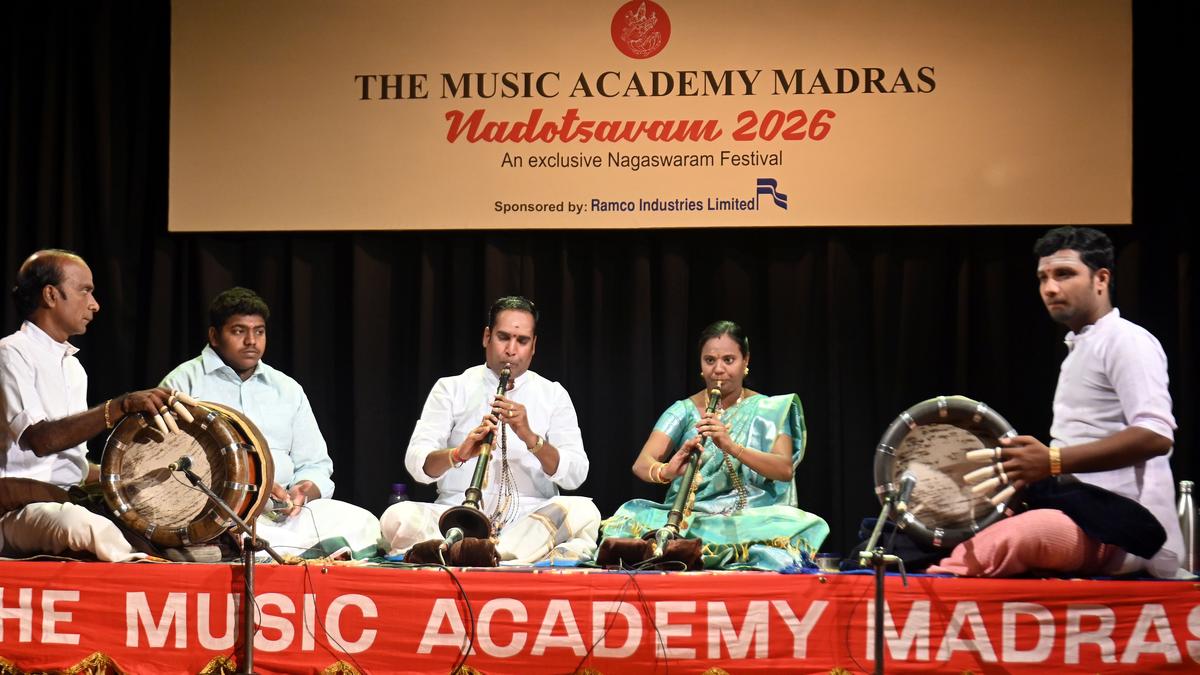
Tirupananthal Viswanathan and Vijayalakshmi with Achalpuram A.V. Selvam and Tiruvenkadu T.M. Guhan on the thavil.
| Photo Credit: K. Pichumani
The nagaswaram occupies a position of eminence among aerophone musical instruments of South India. A double-reed instrument is classified among the mangala vadyams, whose presence is mandatory at temple rituals and auspicious ceremonies.
It was this tradition that the third edition of Nadotsavam sought to celebrate, presenting six concerts across three days at The Music Academy, offering sustained engagement with the nagaswaram-thavil partnership.
The festival’s inaugural concert featured artiste-couple Tirupananthal Viswanathan and Vijayalakshmi. The couple were accompanied by Achalpuram A.V. Selvam and Tiruvenkadu T.M. Guhan on the thavil. The four musicians brought to the occasion their sustained training and familiarity with the tradition’s demands.
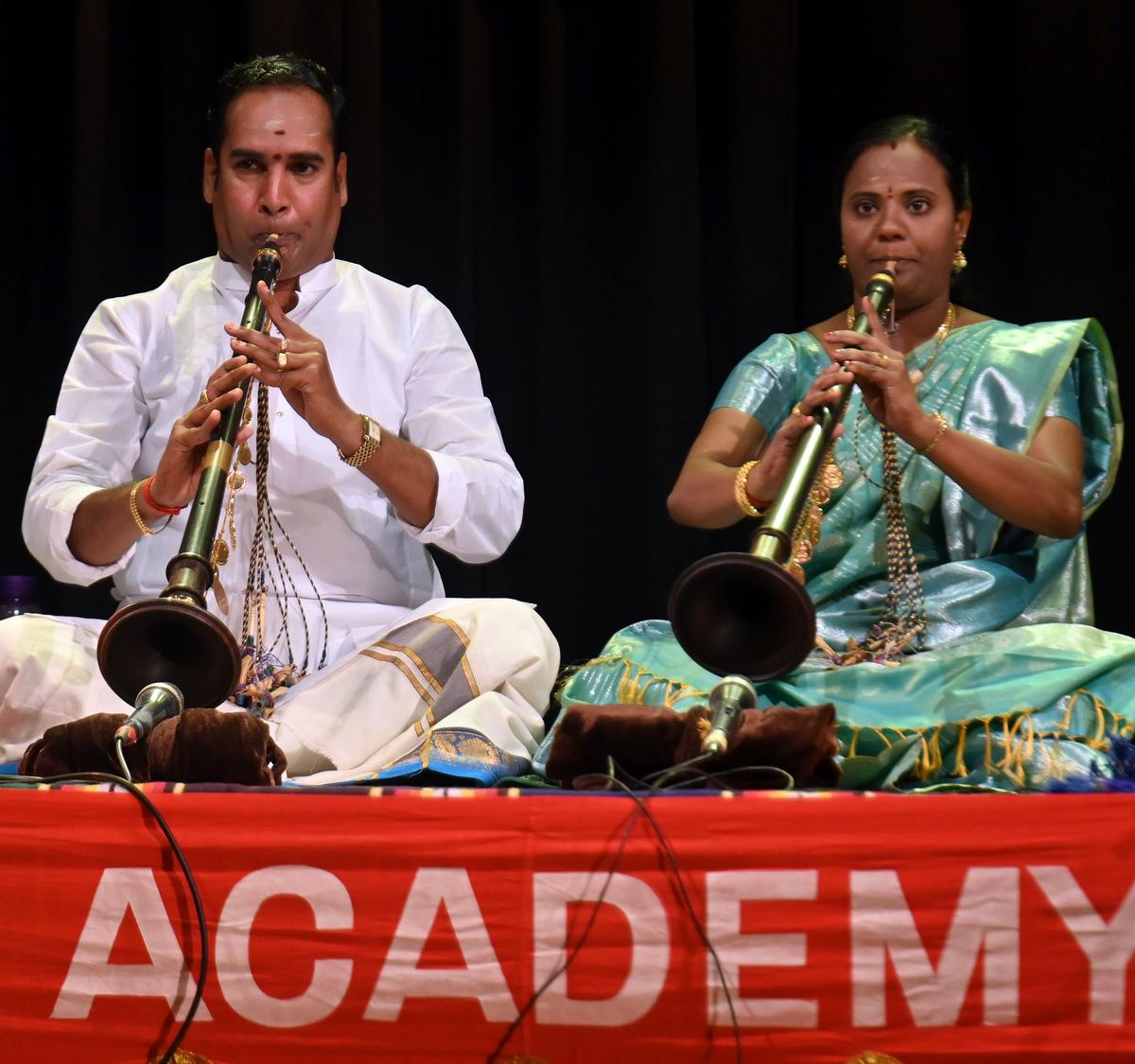
Tirupananthal Viswanathan and Vijayalakshmi.
| Photo Credit:
K. Pichumani
The concert opened with Tyagaraja’s ‘Sri ganapatini sevimpara’ in Sowrashtram, a fitting invocation that the instrument carried with characteristic fullness. The thavil accompaniment was notable for its structured division: Selvam held the pallavi, Guhan stepped in for the anupallavi, and Selvam returned for the charanam — an arrangement that lent the piece a conversational rhythm between the two percussionists. What further distinguished the evening was the manner, in which the thavil artists kept up the momentum with their interludes. The contrast in their approach was interesting. While Selvam’s playing carried a tonal resonance and nadham that filled the hall, Guhan’s greater use of the thoppi lent a textural subtlety that balanced the ensemble well.
An alapana in Nasikabhushani preceded ‘Mara vairi’, followed by the brisk ‘Nati mata marachitivo’ by Tyagaraja in Devakriya, a kriti that demands not only speed but also rhythmic steadiness. Here, Guhan’s accompaniment was particularly assured, the kala pramanam held without drift from first beat to the last.
The concert deepened considerably as Viswanathan moved to an unhurried and naadam-rich Pantuvarali alapana, that drew the audience’s attention through every phrase.
The alapana for Muthu Thandavar’s ‘Eesane koti surya’ captured the raga’s inherent flavour. The duo rendered the kriti by working across registers — Vijayalakshmi on the lower pitch, Viswanathan on the higher.
Thanjavur Sankara Iyer’s ‘Natajana palini’ in Nalinakanti followed, its alapana a studied contrast to the preceding Pantuvarali — lighter in disposition, the phrases moving with a certain ease.
‘Appan avatharitha’ in Karaharapriya was the evening’s centrepiece — Viswanathan’s alapana assured, the kalpanaswaras well-rounded. A brief swarastanam lapse from Vijayalakshmi was steadied unobtrusively by Viswanathan. The thani opened with a five-avartanam interplay, with tisra nadai from Selvam standing out for sollu clarity. Guhan’s thoppi double strokes, gumki technique and rim shot were the highlights. The kuraippu reduced to a single beat before a clean, if somewhat self-contained, 84-beat mohara korvai closed the thani to a warm audience response.
The concert drew to a close through three well-chosen pieces — Manikkavachagar’s ‘Ammaye appa’ in Mohanam, followed by Thirugnanasambandar’s ‘Manthiramavathu’ in Navroj and Arunagirinathar’s Tiruppugazh verse in Husseni. The final moments were both about bhakti and musical substance.
Published – March 31, 2026 05:48 pm IST