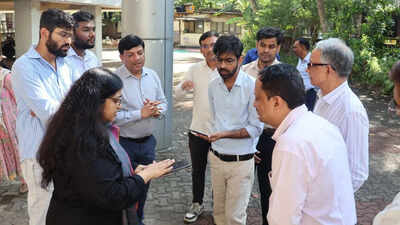





Pune: Long before taps and pipelines, residents of Elephanta Island off Mumbai’s mainland appear to have engineered a sophisticated solution to a pressing problem—how to store drinking water on a rocky island where most of the rain drains into the sea.A newly excavated 1,500-year-old reservoir on the island offers a rare glimpse into that ingenuity. The ongoing excavation, led by Archaeological Survey of India (ASI), has revealed a rectangular reservoir with a perpendicular stepped extension to the north, forming a T-shaped stepped tank. Located at Morabandar on the eastern side of the island, the excavation aims to establish the chronology and nature of earlier habitations on the island.ASI’s superintending archaeologist Abhijit Ambekar described the structure as one of the most significant discoveries from the site. “The structure measures about 14.7m in length, with a width of 6.7m and 10.8m forming a T-shape. Excavation has reached a depth of 5m so far, exposing 20 steps constructed using stone blocks that are not from the island,” he said.Unlike Elephanta’s famed rock-cut architecture, this reservoir is a built structure. While earlier cisterns on the island were carved out of rock for water storage, this represents a deliberately engineered system designed to manage water resources. Experts said the discovery highlighted the challenges of water availability on the island despite heavy monsoon rainfall.Due to Elephanta’s rocky terrain, most rainwater quickly runs off into the sea, limiting groundwater recharge. “On an island that faces water scarcity after the monsoon months, such structures would have been essential to ensure a steady supply of drinking water,” Ambekar said.The structure cannot be classified as a traditional ‘kund’ as it is not attached to a temple or located within a temple complex. “Instead, it bears resemblance to early stepwell formations seen in Gujarat and Rajasthan, where steps lead down to a central water tank. The form is believed to have originated around the 7th century CE, and the Elephanta structure may represent a regional variant adapted to an island setting,” Ambekar added.Elephanta is internationally recognised for its monumental rock-cut caves, yet scholars have long debated why such a small, tide-affected island was chosen for large-scale religious and architectural activity instead of a mainland site. The broader context of rock-cut monuments in western India provides some clues. Of over 900 such sites associated with Buddhist, Brahminical and Jain traditions, around 130 are located on islands near Mumbai, including Elephanta and Salsette.“This clustering of caves on islands is not incidental; such sites occur in zones of intense movement, exchange and patronage. Across western India, caves functioned not only as religious spaces but also as institutional nodes embedded in mercantile networks,” Ambekar said.Evidence Supports Mercantile Network TheoryArchaeologists have recovered Indo-Mediterranean amphora sherds, along with other imported ceramics and glass, indicating participation in long-distance trade networksThe excavation has yielded over 3,000 potsherds, including fragments of torpedo jars of Mesopotamian origin and amphorae from the Mediterranean regionThese vessels were used in ancient maritime trade to transport commodities such as wine, oil and fish sauceWhile Mediterranean amphorae were prevalent from early historic periods, torpedo jars — characterised by elongated, handle-less forms lined with bitumen — are believed to have emerged later, around the 2nd or 3rd century CE, facilitating bulk transport across the Gulf and the Indian OceanEleven coins — six copper and five lead — have also been recovered from the sitequote Three copper coins have been identified as belonging to Krishnaraja of the Kalachuri dynasty. The identification is based on the depiction of a seated bull facing right on the obverse and a temple symbol within a beaded border, along with the legend “Śrī Kṛṣṇarāja” on the reverseAbhijit Dandekar I Researcher, Deccan College Post-Graduate Research Institute